
Santosh and 4 Others v. Smt. Asha Rani and 7 Others, 2026
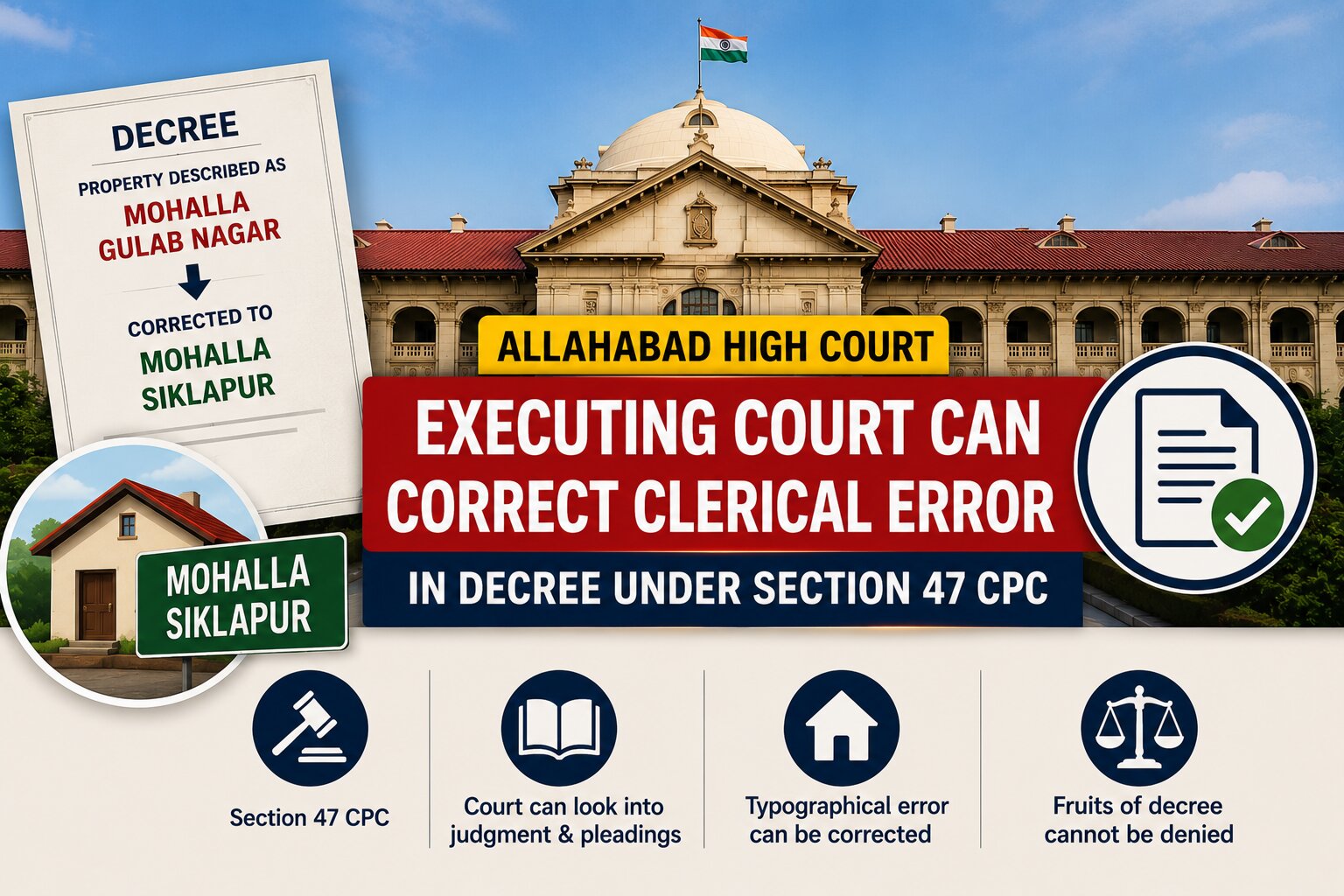
An Executing Court can correct a clerical or typographical error in the description of the decretal property while exercising powers under Section 47 CPC.
Judgement Details
Court
Allahabad High Court
Date of Decision
18 July 2026
Judges
Justice Manish Kumar Nigam
Citation
Acts / Provisions
Facts of the Case
-
The predecessor of the respondents, Pooran Lal, instituted a suit for specific performance of an agreement to sell dated 31.12.1967 against Maya Devi, the predecessor of the petitioners.
-
After several rounds of litigation, the First Appellate Court decreed the suit in 1975, directing execution of the sale deed.
-
The High Court dismissed the Second Appeal in 2006, thereby affirming the decree.
-
Meanwhile, the decree-holders had already initiated execution proceedings in 1994.
-
During execution, it was noticed that the decree described the property as situated in Mohalla Gulab Nagar, whereas the draft sale deed described it as situated in Mohalla Siklapur.
-
The decree-holders filed an application stating that the mention of "Gulab Nagar" in the decree was merely a clerical/typographical mistake committed while preparing the decree.
-
The Executing Court allowed the application and corrected the property description from Gulab Nagar to Siklapur.
-
The Revisional Court upheld the Executing Court's order.
-
The judgment-debtors challenged both orders before the Allahabad High Court under Article 227 of the Constitution.
-
They contended that only the court which passed the decree could amend it and that the Executing Court lacked such power.
Issues
-
Whether an executing court can correct a clerical or typographical error in the description of the suit property while executing a decree under Section 47 CPC?
-
Whether the power to correct such errors is confined only to the court that originally passed the decree?
-
Whether a dispute regarding the identity or description of the decretal property falls within the scope of Section 47 CPC?
-
Whether an executing court can examine the judgment and pleadings where the decree is vague or ambiguous?
-
Whether the doctrine of merger prevents an executing court from correcting a clerical mistake in the decree?
Judgement
-
The Allahabad High Court dismissed the petitions.
-
The Court held that Section 47 CPC empowers the Executing Court to determine all questions relating to execution, discharge or satisfaction of the decree.
-
It ruled that a dispute regarding the identity or description of the property is a question relating to execution and therefore falls within Section 47.
-
The Court observed that where a decree is vague or ambiguous, the Executing Court may refer to the judgment and pleadings to remove the ambiguity.
-
It found that the body of the plaint consistently described the property as situated at Mohalla Siklapur, while the mention of Gulab Nagar was only a typographical error.
-
The Court noted that the defendant had never disputed the identity or location of the property during the trial and raised the objection only at the execution stage.
-
It held that the mistake was purely clerical and could be corrected either under Section 152 CPC or by the Executing Court while exercising powers under Section 47 CPC.
-
The Court rejected the argument based on the doctrine of merger, holding that the issue concerned correction of an accidental error rather than alteration of the decree.
-
Relying upon Pratibha Singh v. Shanti Devi Prasad, the Court observed that a successful litigant should not be deprived of the fruits of the decree because of an accidental slip.
Held
- Such power is not restricted to the court that originally passed the decree.
-
The Executing Court may examine the judgment and pleadings where necessary to remove ambiguity in the decree.
-
A dispute relating to the identity or description of the property is a matter relating to execution under Section 47 CPC.
-
The doctrine of merger does not bar correction of accidental or clerical mistakes.
-
The writ petitions were dismissed.
Analysis
-
The judgment expands the practical scope of Section 47 CPC by recognizing that executing courts possess sufficient authority to resolve execution-related ambiguities without driving parties into fresh litigation.
-
The Court reaffirmed that procedural law should facilitate enforcement of decrees rather than defeat substantive rights because of accidental clerical errors.
-
By allowing the Executing Court to consult the judgment and pleadings, the Court ensured that technical mistakes do not obstruct justice where the identity of the property is otherwise undisputed.
-
The decision harmonizes Sections 47 and 152 CPC, making it clear that both provisions can be invoked to correct accidental mistakes depending on the stage of proceedings.
-
The ruling discourages judgment-debtors from exploiting typographical mistakes to delay execution of lawful decrees.
-
The Court's reliance on Pratibha Singh v. Shanti Devi Prasad reinforces the principle that successful litigants should receive the benefit of the decree without being prejudiced by inadvertent drafting errors.
-
The judgment provides important guidance to executing courts dealing with clerical discrepancies in decrees relating to immovable property.