
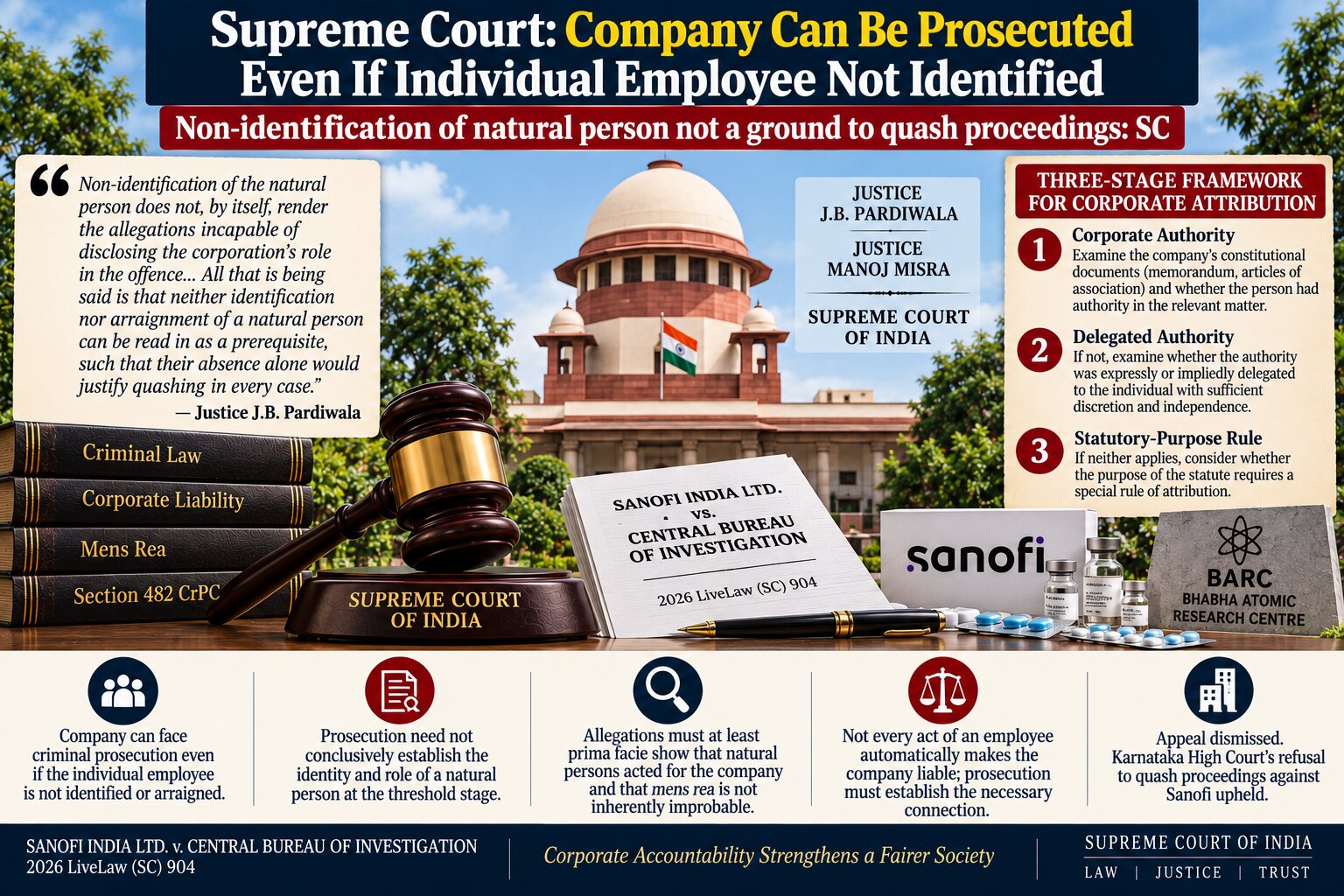
Sanofi India Ltd. v. Central Bureau of Investigation, 2026
A corporation can face criminal prosecution even when the specific natural person through whom the alleged offence was committed has not yet been identified or arraigned.
Judgement Details
Court
Supreme Court of India
Date of Decision
7 September 2026
Judges
Justice J. B. Pardiwala and Justice Manoj Misra
Citation
Acts / Provisions
Facts of the Case
-
The case arose from the supply of pharmaceutical products by Sanofi India Ltd. to the Rare Materials Project of the Bhabha Atomic Research Centre (BARC).
-
The CBI alleged irregularities in the procurement of medicines by BARC.
-
According to the prosecution, BARC scientific officer Dr. P. Anand conspired with pharmaceutical companies to procure medicines at inflated prices.
-
It was also alleged that medicines were procured in quantities exceeding the actual requirement.
-
The prosecution alleged that Sanofi was favoured in the procurement process despite lower bids being submitted by other companies.
-
The CBI further alleged that Dr. Anand received illegal gratification of ₹42,750 from Sanofi.
-
The alleged wrongful loss caused to BARC was stated to be approximately ₹3,53,361.
-
Criminal proceedings were initiated against Sanofi India Ltd. in connection with the alleged procurement irregularities.
-
Sanofi approached the Karnataka High Court seeking quashing of the criminal proceedings.
-
One of the principal arguments advanced by Sanofi was that no individual employee or officer of the company had been arraigned as an accused.
-
Sanofi contended that where the alleged offence required mens rea, the company could not be prosecuted without identifying and prosecuting the natural person whose conduct and mental state were sought to be attributed to the corporation.
-
The Karnataka High Court declined to quash the proceedings.
-
Sanofi thereafter approached the Supreme Court challenging the High Court's decision.
-
The Supreme Court examined whether identification and arraignment of a specific natural person was an indispensable precondition for continuing a criminal prosecution against a corporation.
-
The Court also considered how the conduct and mens rea of a natural person can legally be attributed to a corporation.
-
The Court formulated a three-stage framework for corporate attribution.
-
The Court clarified that not every criminal act committed by an employee automatically becomes an act of the corporation.
-
At the same time, the Court held that the absence of identification or arraignment of a natural person, by itself, does not require quashing of proceedings against the corporation at the threshold stage.
-
On the facts of the case, the Court found prima facie material indicating that natural persons had acted on behalf of Sanofi in connection with the transactions.
-
The surrounding circumstances also did not make the possibility of the requisite mens rea inherently improbable.
-
The Supreme Court therefore found no justification for quashing the proceedings against Sanofi at the threshold stage.
Issues
-
Whether a corporation can be prosecuted for an offence requiring mens rea when the individual natural person through whom the alleged offence was committed has not been identified or arraigned as an accused?
-
Whether non-identification or non-arraignment of a natural person, by itself, is sufficient ground for quashing criminal proceedings against a corporation under Section 482 CrPC?
-
Whether the prosecution must, at the threshold stage, conclusively establish the identity and precise role of the natural person whose conduct and mens rea are sought to be attributed to the corporation?
-
Whether the conduct and mens rea of a natural person can be attributed to a corporation through the company's constitutional structure or delegated authority?
-
Whether the purpose of the statute creating the offence can provide an additional basis for attributing the conduct and mens rea of a natural person to a corporation?
-
Whether every act of an employee, director or senior executive can automatically be treated as an act of the corporation for the purpose of establishing criminal liability?
-
Whether the allegations and material against Sanofi India Ltd. disclosed sufficient prima facie circumstances to justify continuation of the criminal proceedings?
Judgement
-
The Supreme Court dismissed Sanofi India's appeal.
-
The Court held that the mere absence of identification or arraignment of a particular natural person does not automatically require quashing of criminal proceedings against a corporation.
-
The Court clarified that prosecution against a corporation can proceed where the surrounding allegations and material prima facie indicate that natural persons acted on behalf of the corporation.
-
The Court held that the prosecution need not conclusively establish the identity and precise role of the relevant individual before the proceedings can continue.
-
The identity and precise role of the natural person may emerge during the investigation or trial.
-
However, the allegations must at least prima facie disclose that some natural person or persons acted on behalf of the corporation.
-
Those actions must have a connection with the offence in question.
-
The surrounding circumstances must also not make the existence of the required mens rea patently absurd or inherently improbable.
-
The Court emphasised that this inquiry at the Section 482 stage is broad rather than microscopic.
-
The Court then laid down a three-stage framework for determining whether the conduct and mens rea of a natural person can be attributed to a corporation.
-
Under the first stage, the Court examines the company's constitutional documents and applicable company-law principles to determine whether the relevant authority was vested in the person whose conduct is sought to be attributed to the company.
-
Under the second stage, where attribution does not arise from the company's constitutional structure, the Court examines whether the relevant authority was expressly or impliedly delegated to the individual.
-
Under the third stage, where attribution cannot be established through either of those routes, the Court may consider whether the purpose of the particular statute requires a special rule of attribution.
-
The Court clarified that attribution is not automatic even after one of these stages is satisfied.
-
The circumstances of the particular transaction must still be examined.
-
The Court further clarified that merely being an employee, director or senior executive does not automatically make every act of that person attributable to the corporation.
-
On the facts before it, the Court found sufficient prima facie material indicating that natural persons had acted on behalf of Sanofi in relation to the transactions.
-
The Court further found that the surrounding circumstances did not make the possibility of the required mens rea inherently improbable.
-
The High Court therefore had correctly declined to quash the proceedings at the threshold.
-
The appeal was accordingly dismissed.
Held
-
Non-identification or non-arraignment of a natural person is not, by itself, a ground for quashing criminal proceedings against a corporation.
-
The prosecution must, at least prima facie, show that:
-
some natural person or persons acted on behalf of the corporation;
-
the conduct was connected with the offence alleged; and
-
the surrounding circumstances do not make the required mens rea inherently improbable.
-
-
The prosecution is not required to conclusively identify the natural person at the threshold stage.
-
The precise identity and role of the relevant individual may emerge during investigation or trial.
-
Corporate criminal liability requires a legally sufficient connection between the individual's conduct, mental state and the corporation.
-
The first method of attribution is examination of the corporation's constitutional documents and corporate structure.
-
If that does not establish attribution, the Court may examine whether the relevant authority was expressly or impliedly delegated to the individual.
-
Where neither route provides the answer, the Court may consider whether the purpose of the statute requires a special rule of attribution.
-
Mere employment, directorship or participation in negotiations does not automatically establish corporate attribution.
-
The three-stage framework does not apply where the relevant statute itself provides a specific rule of attribution, creates vicarious liability, imposes strict or absolute liability, or otherwise treats the employee's act as the corporation's own act.
-
The framework primarily applies where the offence requires mens rea and the prosecution seeks to attribute the natural person's conduct and mental state to the corporation.
-
The framework concerns attribution from the natural person to the corporation and does not automatically determine the individual's own criminal liability.
-
In Sanofi's case, sufficient prima facie material existed to allow the proceedings to continue.
-
The appeal was therefore dismissed.
Analysis
-
Corporate criminal liability: The judgment clarifies an important question concerning when a company can be prosecuted for offences requiring mens rea. The Court rejected the proposition that prosecution necessarily fails unless a specific employee or officer has already been identified and arraigned.
-
Threshold versus trial: The Supreme Court distinguished between what must be established at the threshold stage and what must ultimately be proved at trial. At the Section 482 stage, the Court is not required to conduct a detailed examination of evidence or conclusively determine the identity and culpability of the individual.
-
Prima facie standard: The prosecution only needs to show, at this stage, that natural persons acted on behalf of the corporation, that their actions relate to the alleged offence and that the existence of the required mens rea is not inherently improbable.
-
Three-stage attribution framework: The judgment provides a structured method for determining when an individual's conduct and mental state may be treated as those of a corporation:
-
Corporate authority under constitutional documents;
-
Delegated authority expressly or impliedly conferred upon the individual; and
-
Statutory-purpose attribution, where necessary to give effect to the particular criminal provision.
-
-
No automatic liability for employees: The Court simultaneously placed an important limitation on corporate criminal liability. Every wrongful act committed by an employee does not automatically become the company's criminal act.
-
Authority matters: The first two stages focus on whether the individual had sufficient authority and independence in relation to the particular transaction. The Court therefore avoided treating the status of “director” or “senior executive” as sufficient by itself.
-
Transaction-specific attribution: The relevant question is not simply who controls the company generally. It is whose conduct in relation to the particular transaction or matter can legally be treated as the corporation's conduct.
-
Statutory interpretation: The third stage is not an unrestricted judicial power to impose corporate liability. The Court described it as an exercise in interpreting the particular statute to determine whether attribution is necessary to fulfil its purpose.
-
Exceptions to the framework: Where legislation itself creates vicarious liability or strict/absolute liability, the three-stage framework may not be necessary. The applicable statutory scheme must first be examined.
-
Mens rea: The decision is particularly significant for offences where proof of a guilty mental state is essential. The Court recognised that corporate structures can make it difficult to immediately identify the particular human source of that mental state, especially at the investigation stage.
-
Sanofi's case: The Court found that the material concerning the pharmaceutical procurement transactions provided sufficient prima facie basis to conclude that natural persons had acted for Sanofi and that the surrounding circumstances did not make the required mens rea inherently improbable.
-
Section 482 CrPC: The judgment reinforces that the High Court's inherent jurisdiction is intended to prevent abuse of process, but it should not be used to conduct a detailed factual or evidentiary examination where the allegations disclose a prima facie case.
-
Broader significance: The ruling provides a structured approach to corporate attribution of criminal conduct and mens rea, while simultaneously protecting corporations from automatic liability for every independent criminal act of their employees.
-
Overall legal principle: A company cannot demand quashing merely by pointing to the absence of an arraigned individual. Conversely, the prosecution cannot establish corporate liability merely by pointing to an employee's wrongdoing. A legally sufficient connection between the individual's authority, conduct, mens rea and the corporation must ultimately be established.