
Sanjiv Kumar v. Shakuntla Devi and Others, 2026
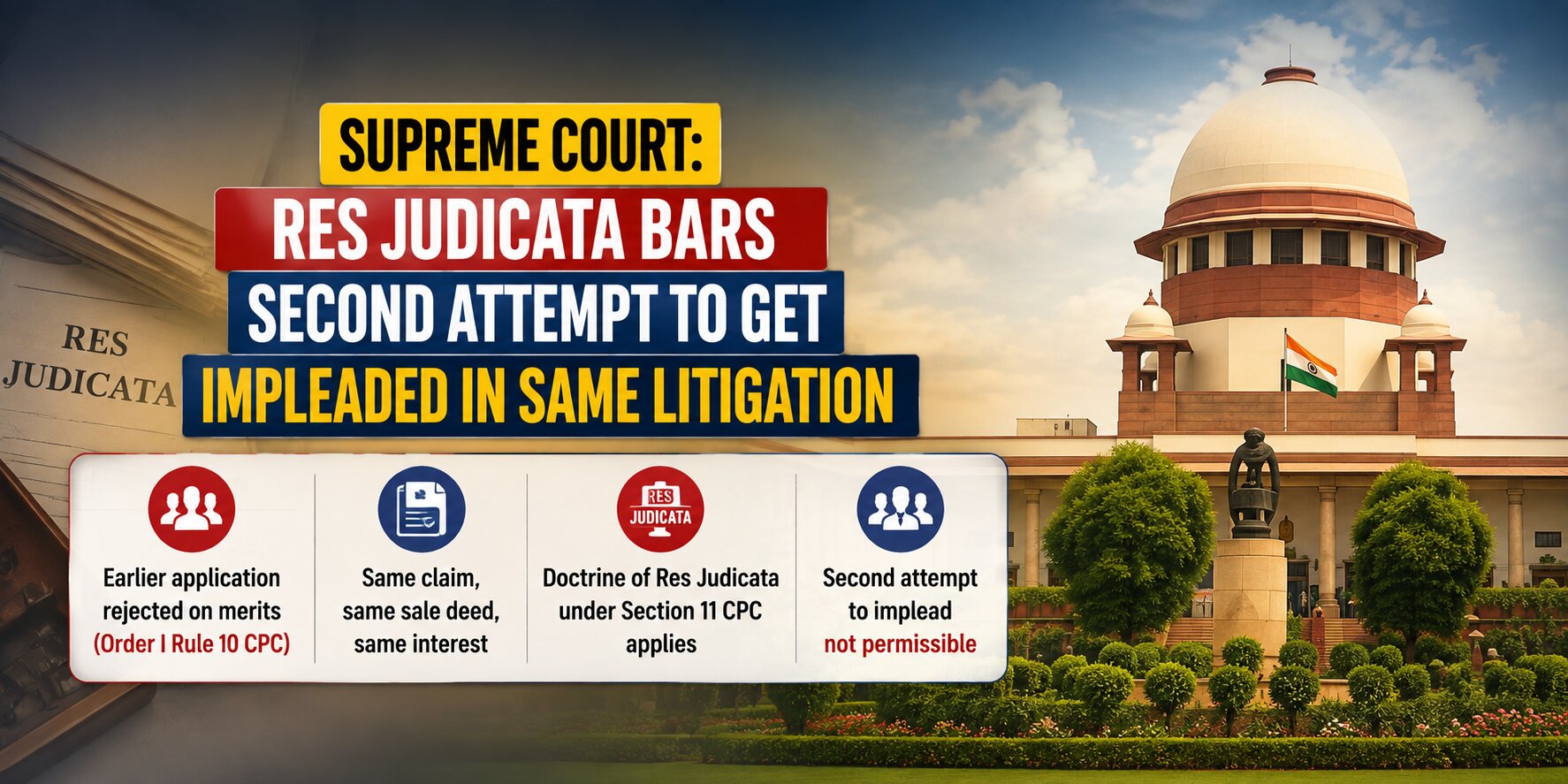
The Court held that the earlier application under Order I Rule 10 CPC had been decided on merits and therefore the decision was binding upon the parties.
Judgement Details
Court
Supreme Court of India
Date of Decision
6 August 2026
Judges
Justice Sanjay Karol and Justice Augustine George Masih.
Citation
Acts / Provisions
Facts of the Case
-
The dispute arose from a long-pending property litigation concerning property left behind by Girdhari Lal.
-
The litigation involved competing claims concerning ownership and rights in the disputed property.
-
During the pendency of the litigation, Respondent Nos. 3 and 4 purchased part of the property from the existing owners through a registered sale deed.
-
The subsequent purchasers sought to be brought on record in the pending litigation because they claimed an interest in the property which was the subject matter of the proceedings.
-
In 2000, the subsequent purchasers filed an application under Order I Rule 10 CPC seeking their impleadment in the main appeal.
-
The High Court rejected that application on 19 May 2000.
-
The rejection was not merely procedural; the High Court considered the purchasers' claim and recorded findings concerning the circumstances of their purchase and the nature of their interest.
-
The subsequent purchasers did not successfully challenge that order, and it therefore attained finality.
-
Years later, the main appeal was dismissed for non-prosecution, while the cross-objections were subsequently restored.
-
The subsequent purchasers again sought impleadment, this time invoking Order XXII Rule 10 CPC.
-
They relied upon the same underlying transaction and the same registered sale deed that had formed the basis of their earlier application under Order I Rule 10 CPC.
-
The Punjab and Haryana High Court allowed their subsequent application and permitted their impleadment in the main appeal as well as the cross-objections.
-
The High Court also restored the main appeal after dealing with the delay and restoration applications.
-
The appellant, Sanjiv Kumar, challenged the High Court's order before the Supreme Court.
-
The appellant argued that the second application was essentially an attempt to obtain the same relief of impleadment through a different procedural provision after the earlier application had already been rejected on merits.
-
The appellant therefore contended that the subsequent application was barred by the doctrine of res judicata under Section 11 CPC.
-
The subsequent purchasers argued that Order I Rule 10 and Order XXII Rule 10 operated in different fields and that a fresh cause of action had arisen because of later developments concerning the appeal and cross-objections.
Issues
-
Whether a subsequent application under Order XXII Rule 10 CPC seeking impleadment is barred by res judicata when an earlier application under Order I Rule 10 CPC seeking the same relief was rejected on merits?
-
Whether Order I Rule 10 CPC and Order XXII Rule 10 CPC provide different procedural remedies such that rejection of an application under the former can never bar a subsequent application under the latter?
-
Whether the doctrine of res judicata applies to an earlier interlocutory order deciding the right of a subsequent purchaser to be impleaded in the same litigation?
-
Whether an earlier decision on merits remains binding between the parties even when the earlier court's decision was based upon an erroneous appreciation of the facts?
-
Whether a subsequent application under Order XXII Rule 10 CPC based upon the same sale deed, same interest and same factual foundation constitutes a fresh cause of action or merely a re-agitation of an issue already decided?
-
Whether the subsequent purchasers could be impleaded under Order XXII Rule 10 CPC in the cross-objections when their earlier application under Order I Rule 10 CPC had been filed only in respect of the main appeal?
-
Whether the subsequent purchasers were entitled to restoration of the main appeal after its dismissal for non-prosecution?
Judgement
-
The Supreme Court partly allowed the appeal filed by Sanjiv Kumar.
-
The Court emphasized that an erroneous decision does not automatically lose its character as a final adjudication merely because the decision may have been factually incorrect.
-
The Court distinguished between a dismissal based upon a technical or procedural defect and a decision involving conscious adjudication of the substantive issue.
-
The Court held that where an earlier Order I Rule 10 application has actually examined the transferee's claim, the nature of the interest and the relevant circumstances, and the decision has attained finality, the matter can attract res judicata.
-
The Court explained that Order I Rule 10 and Order XXII Rule 10 are conceptually distinct provisions.
-
Order I Rule 10 concerns addition or deletion of necessary or proper parties, whereas Order XXII Rule 10 concerns the devolution, assignment or creation of an interest during the pendency of litigation.
-
Therefore, rejection under Order I Rule 10 does not automatically and in every case bar a subsequent application under Order XXII Rule 10.
-
However, where both applications concern the same transfer, same interest, same facts and same underlying claim for impleadment, and the earlier application was decided on merits and attained finality, the subsequent application may be barred by res judicata.
-
The Court described the two provisions, in such circumstances, as “different procedural doors to the same relief.”
-
The Court found that the purchasers' right to seek impleadment under Order XXII Rule 10 had already arisen when they filed their original application under Order I Rule 10.
-
Consequently, the subsequent application in the main appeal was held to be a re-agitation of an issue that had already been conclusively decided.
-
The Court therefore set aside the High Court's order insofar as it restored the main appeal and permitted the subsequent purchasers to be impleaded in that main appeal.
-
However, the Court reached a different conclusion concerning the cross-objections.
-
The earlier Order I Rule 10 application had been filed only for impleadment in the main appeal and had not sought impleadment in the cross-objections.
-
Since the earlier decision had not adjudicated upon their right to be impleaded in the cross-objections, res judicata did not operate against their subsequent application concerning that separate proceeding.
-
The Supreme Court therefore upheld their impleadment in the cross-objections under Order XXII Rule 10 CPC.
-
The appeal was consequently partly allowed, with no order as to costs.
Held
-
An earlier Order I Rule 10 CPC application decided on merits can bar a subsequent Order XXII Rule 10 CPC application through the doctrine of res judicata when both applications concern the same relief, same transfer, same interest and same factual foundation.
-
The mere change in the statutory provision relied upon does not permit a litigant to reopen an issue that has already been finally decided.
-
Order I Rule 10 and Order XXII Rule 10 CPC are distinct provisions, and rejection under Order I Rule 10 does not automatically bar every future application under Order XXII Rule 10.
-
Res judicata applies where the earlier application involved a conscious adjudication on merits and the decision attained finality.
-
A purely technical or procedural rejection of an earlier application, without adjudication of the transferee's substantive interest, will ordinarily not create the same bar.
-
A fresh devolution, assignment or transfer occurring after the earlier decision may constitute a distinct factual basis and therefore may not be barred by the earlier adjudication.
-
Where the earlier order itself remains under challenge and has not attained finality, the doctrine of res judicata may likewise not operate in the ordinary manner.
-
A decision can remain binding for purposes of res judicata even if the earlier court committed an error of fact, provided the court had jurisdiction and the issue was consciously adjudicated and the decision attained finality.
-
The subsequent purchasers could not use Order XXII Rule 10 to reopen their already-decided right to impleadment in the main appeal.
-
Their impleadment in the cross-objections, however, was permissible because their earlier application under Order I Rule 10 had not concerned the cross-objections.
-
The High Court's order was therefore set aside in part and sustained in part.
Analysis
-
Res judicata applies beyond ordinary suits: The judgment demonstrates that the doctrine is not confined to final judgments determining the entire suit. It can also operate at an interlocutory stage where a specific issue has been conclusively adjudicated.
-
Finality of adjudication is the central principle: The Court focused on whether there had been a conscious decision on the relevant issue and whether that decision had attained finality.
-
Change of procedural provision cannot defeat finality: A litigant cannot ordinarily circumvent an adverse decision simply by changing the statutory provision under which substantially the same relief is sought.
-
Order I Rule 10 and Order XXII Rule 10 remain legally distinct: The judgment does not collapse the two provisions into one. Order I Rule 10 deals with necessary and proper parties, whereas Order XXII Rule 10 addresses devolution or assignment of an interest during pending litigation.
-
The distinction is between different legal situations, not merely different labels: If a genuine new event occurs after the earlier decision, such as a fresh transfer or devolution, the later application may be maintainable. But if the same transaction already existed and was considered earlier, changing the procedural route does not create a new cause.
-
The phrase “different procedural doors to the same relief” captures the ratio: Where the substantive question remains identical, procedural variation cannot be used to repeatedly litigate the same issue.
-
An erroneous judgment may still operate as res judicata: The Supreme Court rejected the proposition that an allegedly erroneous factual finding automatically destroys the finality of the earlier adjudication. The appropriate remedy against an erroneous judgment is ordinarily to challenge it through available appellate or review mechanisms rather than to ignore it in subsequent proceedings.
-
Jurisdiction and finality remain important safeguards: Res judicata presupposes an adjudication by a competent court. The doctrine does not validate an order passed without jurisdiction or otherwise falling within recognized exceptions.
-
The Court preserved flexibility for genuinely new causes: The judgment carefully identifies circumstances where the bar would not apply, including a technical dismissal, a fresh devolution or assignment, or an earlier order that has not attained finality.
-
The cross-objections demonstrate the importance of identifying the exact proceeding: The Court did not apply res judicata mechanically. Because the earlier impleadment application concerned the main appeal and not the cross-objections, the issue in the latter proceeding had not previously been adjudicated.
-
The ruling promotes judicial discipline: Allowing repeated impleadment applications based on the same transaction would permit parties to endlessly reopen procedural questions and prolong already protracted litigation.
-
The judgment balances finality with fairness: While preventing re-litigation of the same issue, the Court preserves a remedy where circumstances genuinely change or where a later proceeding involves a question that was never previously adjudicated.
-
Significance for subsequent purchasers: A purchaser pendente lite may have a legitimate interest in being brought on record, but that interest must be asserted through the appropriate procedural mechanism and cannot ordinarily be asserted repeatedly after an adverse adjudication has become final.
-
Impact on civil procedure: The judgment provides an important clarification on the interaction between Section 11, Order I Rule 10 and Order XXII Rule 10 CPC, particularly in long-running property litigation.
-
Practical rule emerging from the judgment: Before filing a second impleadment application under a different CPC provision, a litigant must determine whether the same right, transaction and factual foundation have already been adjudicated. If they have, the second application may be barred by res judicata.
-
Overall legal principle: The judgment reinforces the broader judicial policy that litigation must eventually attain finality and that parties cannot repeatedly reopen a settled issue merely by changing the procedural form of their application.