
Sandeep @ Kala v. State of Haryana, 2026
A dying declaration can by itself sustain a conviction when it is found to be voluntary, truthful, reliable and made by a person in a fit state of mind.
Judgement Details
Court
High Court of Punjab and Haryana
Date of Decision
16 August 2026
Judges
Justice Rajesh Bhardwaj and Justice Deepak Manchanda
Citation
Acts / Provisions
Facts of the Case
- The prosecution case originated from an incident alleged to have occurred in 2010.
-
On 2 August 2010, the prosecutrix was taken to PGIMS, Rohtak, where she was medically examined.
-
The prosecution alleged that the appellant came to the prosecutrix's house when she was alone.
-
It was alleged that the appellant forcibly subjected her to sexual intercourse.
-
The prosecutrix allegedly resisted the appellant, resulting in grappling between the two.
-
The prosecution further alleged that she was beaten during the incident.
-
Other persons allegedly arrived thereafter.
-
Following the incident, the prosecutrix consumed two tablets of aluminium phosphide with tea.
-
Her medico-legal examination was conducted at approximately 7:22 p.m.
-
The medical ruqa was sent at approximately 8:35 p.m.
-
Her statement was recorded at approximately 9:45 p.m.
-
On the basis of the statement, an FIR was registered at approximately 12:30 a.m. on 3 August 2010 under Sections 376 and 309 read with Section 34 IPC.
-
The prosecutrix died during treatment at approximately 12:05 a.m. on 3 August 2010.
-
The FSL report confirmed the presence of aluminium phosphide.
-
The post-mortem examination attributed the cause of death to poisoning.
-
Since the prosecutrix died after making the statement, the statement relied upon by the prosecution acquired the legal character of a dying declaration under Section 32 of the Evidence Act.
-
The Additional Sessions Judge, Rohtak, by judgment and order dated 23 December 2013, convicted the appellant.
-
The appellant was sentenced to 12 years' rigorous imprisonment and a fine of ₹40,000.
-
The Trial Court also directed payment of ₹1 lakh as compensation to the family of the deceased under Section 357 CrPC.
-
The appellant challenged the conviction before the Punjab and Haryana High Court.
-
On behalf of the appellant, Senior Advocate Sunil Chadha challenged the reliability and admissibility of the dying declaration and pointed out contradictions and irregularities concerning its recording.
-
The defence also relied upon the medical evidence concerning the physical and mental condition of the prosecutrix.
-
The prosecution relied substantially upon the statement made by the prosecutrix, which effectively became the principal foundation of the conviction.
-
The High Court examined whether that statement was sufficiently reliable to sustain a conviction in the absence of adequate corroborative evidence.
Issues
-
Whether the statement made by the prosecutrix before her death was voluntary, truthful and reliable enough to constitute the sole basis for conviction?
-
Whether the medical evidence established that the prosecutrix was in a fit physical and mental condition to make a reliable statement at the time it was recorded?
-
Whether the failure of the investigating agency to have the prosecutrix's statement recorded by a Judicial Magistrate, despite sufficient opportunity, affected the reliability of the dying declaration?
-
Whether the contradictions and inconsistencies concerning the recording of the statement created a reasonable doubt regarding its authenticity and reliability?
-
Whether the absence of injuries on the prosecutrix and the absence of injury marks on the appellant constituted circumstances relevant to assessing the prosecution case?
-
Whether the dying declaration, in the circumstances of the case, could safely form the sole basis for maintaining the appellant's conviction?
-
Whether the appellant was entitled to the benefit of doubt where the prosecution evidence suffered from infirmities, inconsistencies and unexplained circumstances?
Judgement
-
The Punjab and Haryana High Court allowed the appeal filed by the appellant.
-
The Division Bench carefully examined the prosecution's reliance upon the dying declaration.
-
The Court reiterated that a dying declaration can constitute substantive evidence and, when found completely reliable, may by itself be sufficient to sustain a conviction.
-
However, the Court emphasised that because the accused does not have the opportunity to cross-examine the deceased, a dying declaration must inspire full confidence before it can safely be acted upon.
-
The Court examined the circumstances in which the statement of the prosecutrix had been recorded.
-
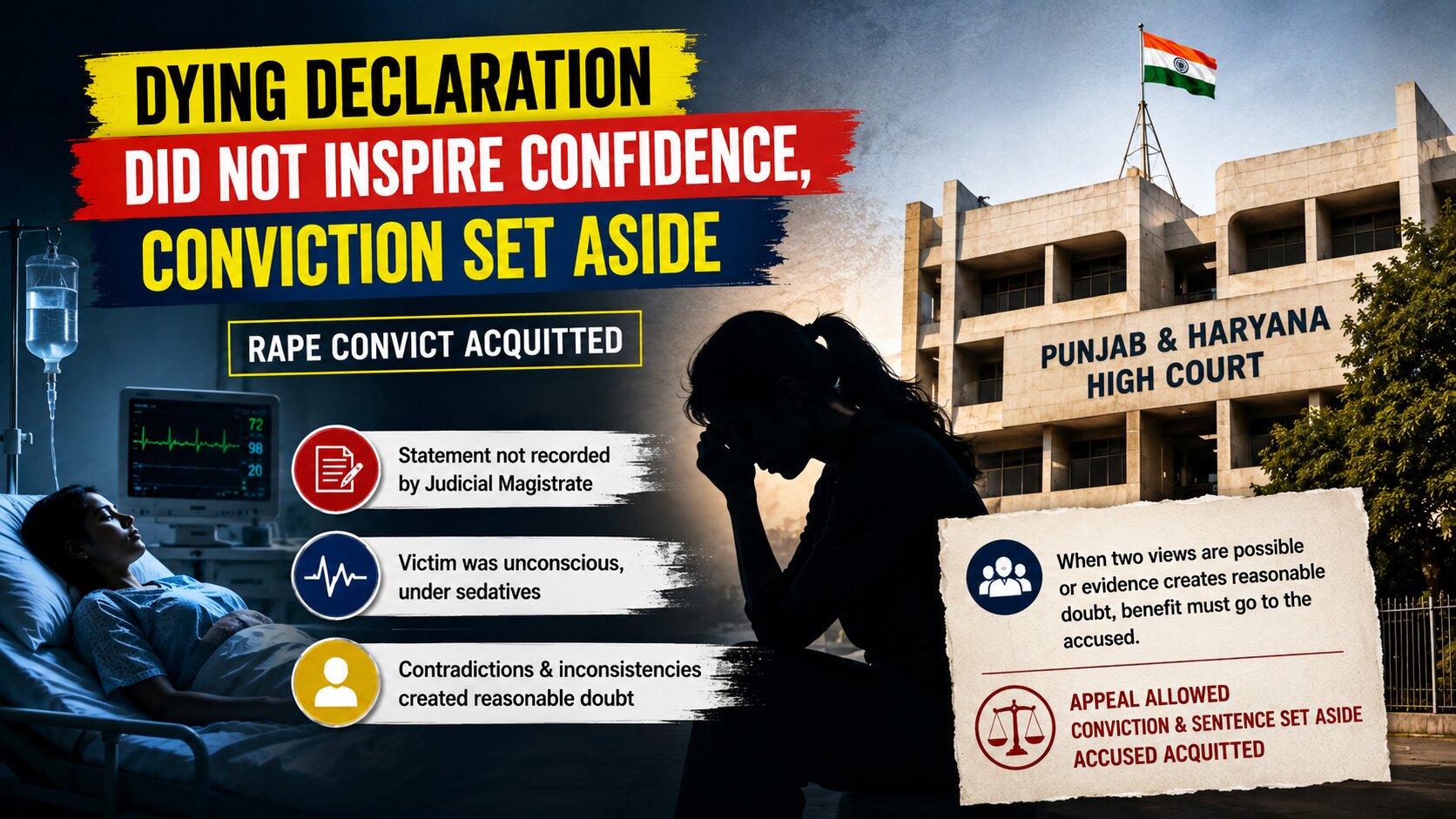
The Court found significance in the fact that the investigating agency had not made any effort to have the statement recorded by a Judicial Magistrate, despite adequate opportunity to do so.
-
The Court observed that this omission assumed greater importance because the prosecution itself sought to base the conviction substantially upon the dying declaration.
-
The Bench examined the evidence of the doctors concerning the condition of the prosecutrix.
-
The medical evidence indicated that the prosecutrix was in a critical condition and was being administered sedatives.
-
The Court noted the evidence of Dr. Ashok Chauhan, who stated during cross-examination that the prosecutrix was unconscious at the time of her medico-legal examination.
-
The Court also considered the evidence of Dr. Jatin Ahuja, who had not endorsed on the statement that the prosecutrix remained fit throughout its recording.
-
The defence also pointed out an apparent cutting or alteration in the time recorded on the statement.
-
These circumstances created doubt concerning the precise condition of the prosecutrix and the circumstances in which the statement was recorded.
-
The Court further noted that there was no injury found on the body of the prosecutrix, including on either wrist, according to the post-mortem evidence of Dr. Pawan Mittal.
-
The medical examination of the appellant also did not reveal any injury marks on his body.
-
Although the Court acknowledged that injuries to an accused may not necessarily be present in every rape case, the absence of injuries was considered as one of the surrounding circumstances while evaluating the prosecution evidence.
-
The Court reiterated the legal principle expressed through the maxim nemo moriturus praesumitur mentiri, meaning that a person at the point of death is not ordinarily presumed to lie.
-
At the same time, the Court emphasised that this principle does not eliminate the judicial duty to carefully scrutinise the reliability of a dying declaration.
-
The Court relied upon precedents including Muthu Kutty v. State by Inspector of Police, Panneerselvam v. State of Tamil Nadu, Paniben v. State of Gujarat, and Satish Ambanna Bansode v. State of Maharashtra.
-
The Court reiterated that a dying declaration must be examined carefully to exclude the possibility of tutoring, prompting, imagination or other circumstances affecting its reliability.
-
Where a dying declaration is suspicious or suffers from serious infirmities, it should not ordinarily be relied upon without sufficient corroboration.
-
The Court ultimately held that the dying declaration in the present case did not inspire confidence.
-
Once the principal evidence relied upon by the prosecution was found unreliable, the Court held that it would be unsafe to maintain the conviction.
-
The Court also found that the prosecution case contained several infirmities, inconsistencies and unexplained circumstances.
-
Applying the cardinal principle of criminal jurisprudence, the Court held that where the evidence gives rise to a reasonable doubt, the accused is entitled to the benefit of doubt.
-
The Court consequently set aside the judgment of conviction and order of sentence dated 23 December 2013.
-
The appellant was acquitted of all charges.
Held
-
However, a dying declaration that suffers from serious inconsistencies or circumstances affecting its authenticity cannot safely be made the sole basis of conviction.
-
The failure of the investigating agency to obtain a statement through a Judicial Magistrate, despite sufficient opportunity, assumed considerable significance because the prosecution principally relied upon that statement.
-
The medical evidence raised doubts regarding the prosecutrix's physical and mental fitness at the relevant time.
-
The contradictions and irregularities concerning the recording of the statement further weakened its reliability.
-
The absence of injuries on the prosecutrix and the appellant constituted additional surrounding circumstances relevant to the overall assessment of the prosecution case.
-
The dying declaration did not inspire the Court's confidence sufficiently to sustain a conviction.
-
The prosecution evidence, taken as a whole, created a reasonable doubt regarding the appellant's guilt.
-
The appellant was therefore entitled to the benefit of doubt.
-
The conviction and sentence were set aside, and the appellant was acquitted.
Analysis
-
The central issue in the judgment is the evidentiary value of a dying declaration when the prosecution substantially or entirely depends upon it to establish guilt.
-
Section 32 of the Indian Evidence Act creates an exception to the general rule against hearsay because statements made by a person regarding the cause or circumstances of their death may be relevant after their death.
-
The Court nevertheless emphasised that admissibility does not automatically mean that the statement is reliable enough to sustain a conviction.
-
The fundamental requirement is that the dying declaration must inspire full confidence of the Court.
-
The Court correctly recognised that the absence of cross-examination makes careful judicial scrutiny particularly important.
-
A dying declaration may legally form the sole basis of conviction, but this depends upon the Court being satisfied that it is voluntary, truthful, coherent and reliable.
-
The maxim nemo moriturus praesumitur mentiri provides the underlying rationale for treating a dying declaration with evidentiary significance, but it does not create an irrebuttable presumption that every statement made before death is truthful.
-
The Court's approach demonstrates that the medical condition of the declarant is highly relevant when determining whether a dying declaration can safely be relied upon.
-
The evidence that the prosecutrix was critically ill, had been administered sedatives and was stated by one doctor to be unconscious during the medico-legal examination created an important factual concern.
-
The absence of a clear endorsement that she remained fit throughout the recording of the statement further weakened the prosecution's position.
-
The Court also attached significance to the fact that the investigating agency did not have the statement recorded by a Judicial Magistrate, even though there was sufficient opportunity to do so.
-
The Court did not treat the absence of a Magistrate's recording as an absolute rule invalidating a dying declaration, because the law does not require every dying declaration to be recorded only by a Magistrate.
-
Instead, the omission was treated as an important circumstance affecting reliability in the particular facts of this case, especially because the prosecution relied heavily upon the declaration.
-
The Court's reasoning therefore reflects a distinction between a mandatory legal requirement and a rule of prudence and reliability.
-
The contradictions in the recording officer's account were particularly important because they concerned the very process through which the principal piece of prosecution evidence came into existence.
-
The alleged alteration or cutting concerning the time of recording further contributed to the Court's doubts.
-
The Court did not assess the dying declaration in isolation but considered the entire evidentiary circumstances surrounding it.
-
The medical evidence regarding the absence of injuries on the prosecutrix was considered as one of the circumstances relevant to the prosecution narrative.
-
Similarly, the absence of injuries on the appellant was not treated as conclusive proof of innocence, but it was considered while assessing the overall credibility of the prosecution story.
-
The judgment demonstrates the principle that circumstantial and medical evidence may become particularly important when the principal direct evidence is a disputed dying declaration.
-
The Court's reliance on precedents such as Paniben, Muthu Kutty, Panneerselvam and Satish Ambanna Bansode reflects the established judicial approach that a suspicious dying declaration requires particularly cautious scrutiny.
-
The Court emphasised that a declaration affected by tutoring, prompting, imagination or uncertainty regarding the declarant's condition cannot safely be used as the sole foundation for conviction.
-
The judgment also reinforces the fundamental criminal-law principle that the prosecution must establish guilt beyond reasonable doubt.
-
Where the evidence permits a reasonable alternative view or contains serious unresolved doubts, the benefit must go to the accused.
-
The decision is significant because the Court did not merely identify isolated discrepancies; it considered the cumulative effect of the infirmities affecting the dying declaration and the surrounding prosecution evidence.
-
The judgment therefore demonstrates that the reliability of a dying declaration must be assessed on the basis of the entire factual matrix, including medical evidence, the circumstances of recording, consistency, the declarant's condition and the conduct of the investigating agency.
-
The decision does not establish that a dying declaration must invariably be recorded by a Judicial Magistrate before it can be relied upon.
-
Rather, it establishes that where the prosecution principally relies upon such a declaration and there was a realistic opportunity to obtain a more formal and independent recording, the failure to do so can assume substantial significance when other circumstances already cast doubt upon the declaration.
-
The judgment also illustrates the difference between admissibility and probative value: a statement may fall within Section 32 but still be insufficiently trustworthy to sustain a conviction.
-
The ultimate acquittal therefore rests not on a finding that the alleged offence could not have occurred, but on the conclusion that the prosecution failed to establish the appellant's guilt with evidence sufficiently reliable to meet the criminal standard of proof.