
Salimbhai Abubakarbhai Lakhani & Ors. v. Aksanabanu Samirbhai Lakhani & Ors., 2026
Where sisters-in-law are living separately from the complainant, allegations of direct physical or mental torture require specific factual foundation.
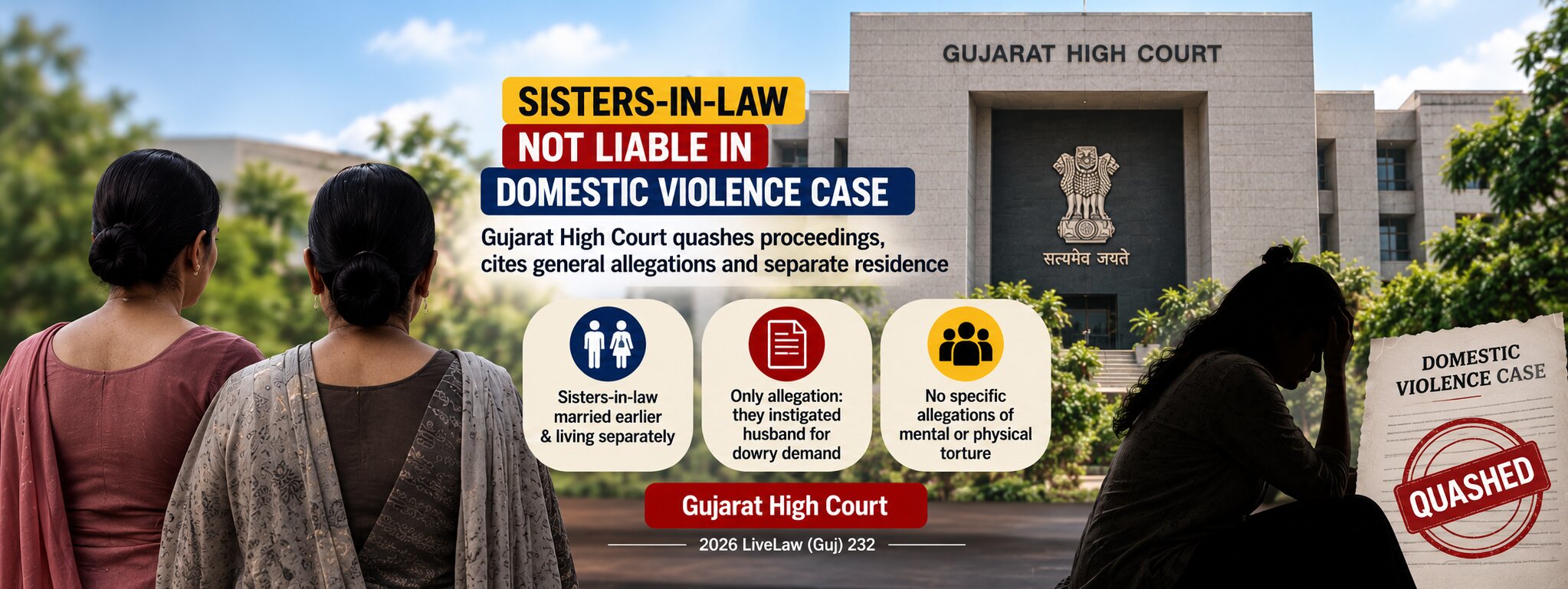
Judgement Details
Court
Gujarat High Court
Date of Decision
19 August 2026
Judges
Justice A.Y. Kogje
Citation
Acts / Provisions
Facts of the Case
-
The son of Petitioners Nos. 1 and 2 was married to Respondent No. 1 according to Muslim rites.
-
Due to marital discord, the wife left the matrimonial home along with the couple's two children.
-
She subsequently filed complaints against the husband and his family members alleging mental and physical harassment and dowry demands.
-
The allegations against the husband included demands for items such as a laptop, watch and mobile phone.
-
The principal allegation against Petitioners Nos. 3 and 4, who were the husband's sisters, was that they instigated the husband to demand dowry.
-
The sisters-in-law had been married much earlier than the complainant and were admittedly living separately.
-
Earlier, the complainant had filed various proceedings, including maintenance proceedings, a complaint under Section 498A IPC and proceedings under the Domestic Violence Act against the family members.
-
Those earlier proceedings were withdrawn after the parties allegedly reached a settlement through intervention by elders and community leaders.
-
The present proceedings were subsequently initiated against the family members.
-
The sisters-in-law approached the Gujarat High Court seeking quashing of the proceedings against them.
Issues
-
Whether general allegations of instigation against married sisters-in-law residing separately are sufficient to constitute domestic violence?
-
Whether the absence of any specific allegation of mental or physical torture against the sisters-in-law warrants quashing of the proceedings?
-
Whether married sisters-in-law who are living separately can be proceeded against solely on allegations that they instigated the husband to demand dowry?
-
Whether the allegations disclosed the necessary ingredients of domestic violence under Sections 18, 19, 20, 22 and 23 of the Domestic Violence Act?
-
Whether continuation of proceedings against the sisters-in-law, in the circumstances of the case, would amount to an abuse of the process of law?
Judgement
-
The Gujarat High Court quashed the proceedings against Petitioners Nos. 3 and 4, the sisters-in-law of the complainant.
-
The Court observed that the allegations in the complaint were primarily directed against the husband.
-
It found that the only allegation against the sisters-in-law was that they used to instigate the husband to demand dowry.
-
No specific allegation of physical or mental torture by the sisters-in-law was made.
-
The Court took note of the fact that both sisters-in-law had been married much before the complainant and were residing separately.
-
The Court concluded that the allegations were general in nature and did not establish the necessary ingredients of domestic violence against them.
-
It further found that the requirements of Sections 18, 19, 20, 22 and 23 of the Domestic Violence Act were not made out against the two petitioners.
-
The proceedings against the sisters-in-law were therefore quashed.
Held
-
Mere allegations that married sisters-in-law instigated the husband to demand dowry, without specific allegations of harassment or violence, are insufficient to sustain domestic violence proceedings against them.
-
General and omnibus allegations against relatives of the husband cannot, by themselves, establish the ingredients of domestic violence.
-
The Court must examine the complaint as a whole and determine whether the statutory ingredients are actually disclosed against each accused.
-
Where the allegations do not satisfy the statutory requirements, continuation of proceedings against the concerned relatives can be quashed.
-
The High Court found that no ingredients under Sections 18, 19, 20, 22 and 23 of the Domestic Violence Act were made out against the sisters-in-law.
Analysis
-
The judgment highlights the importance of distinguishing between allegations against the principal accused and allegations against extended family members in matrimonial disputes.
-
The Court noted that the complaint itself primarily attributed the alleged harassment and dowry demands to the husband, while the allegations against the sisters-in-law were limited to alleged instigation.
-
A significant factor was that the sisters-in-law were married and living separately, making allegations of direct day-to-day physical or mental harassment less sustainable in the absence of specific facts.
-
The decision demonstrates that criminal or quasi-criminal matrimonial proceedings cannot rest solely on vague, general or omnibus allegations against relatives.
-
The Court also considered the complainant's earlier proceedings and their subsequent withdrawal after an alleged settlement. This formed part of the overall factual context in assessing whether the present allegations disclosed a genuine statutory case.
-
Importantly, the Court did not hold that a sister-in-law can never be proceeded against under the Domestic Violence Act. The ruling is based on the absence of specific allegations and statutory ingredients in the facts before the Court.
-
The judgment reinforces the High Court's role in preventing criminal proceedings from continuing where the allegations, even if taken at face value, fail to establish the required legal ingredients.
-
The decision therefore reflects a balance between protecting genuine victims of domestic violence and preventing misuse of matrimonial litigation against relatives who are not shown to have participated in the alleged acts.