
Sahab Singh Alias Sat Pal v. State of Haryana, 2026
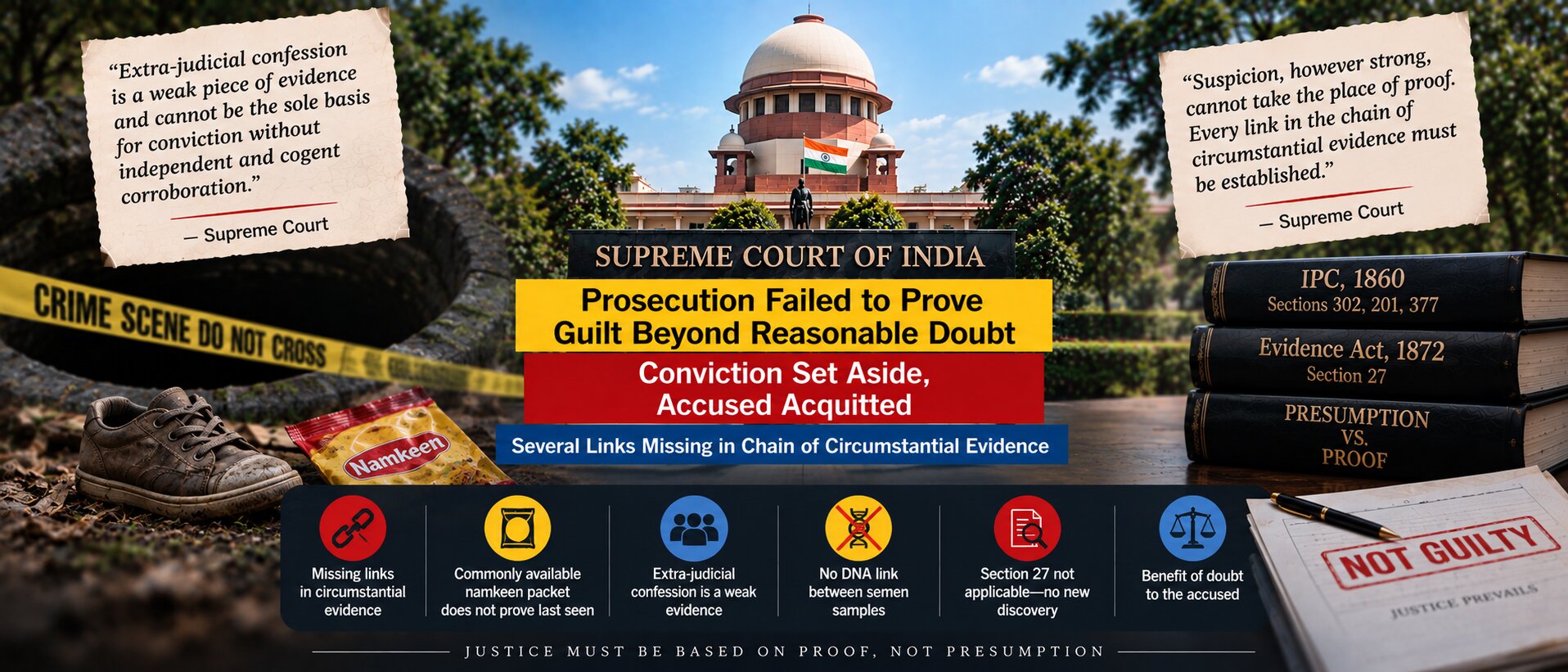
The prosecution must establish a complete and convincing chain of circumstances before a conviction can be based solely on circumstantial evidence.
Judgement Details
Court
Supreme Court of India
Date of Decision
2 September 2026
Judges
Justice Sanjay Kumar and Justice Sanjeev Sachdeva
Citation
Acts / Provisions
Facts of the Case
-
The case arose from the disappearance of a six-year-old child, Gaurav, in 2007.
-
The child's dead body was recovered from a well the following morning.
-
The post-mortem examination stated that the cause of death was asphyxia due to smothering and cervical spinal injury.
-
The prosecution case was based entirely on circumstantial evidence.
-
The prosecution alleged that the child was last seen with the appellant while the appellant was purchasing a packet of namkeen and two cold tablets.
-
The prosecution also relied upon an alleged extra-judicial confession said to have been made by the appellant before the village Sarpanch.
-
An alleged disclosure statement made by the appellant was also relied upon by the prosecution.
-
Forensic evidence included the detection of semen on the appellant's underwear and on the rectal swab of the deceased.
-
The Trial Court convicted the appellant under Sections 302, 201 and 377 IPC.
-
The Punjab and Haryana High Court upheld the conviction.
-
The appellant thereafter approached the Supreme Court challenging the concurrent findings against him.
-
The appellant had already spent more than 16 years and seven months in custody.
-
The Supreme Court examined whether the circumstances relied upon by the prosecution formed a complete and reliable chain connecting the appellant with the crime.
-
The Court found that the alleged disclosure statement did not lead to the discovery of any new fact or incriminating material.
-
The child's body had already been recovered before the statement was recorded, and the relevant locations were already known to the police.
-
The Court also found that the namkeen packet was a commonly available product and that no connection between the packet and the appellant had been established.
-
The alleged extra-judicial confession was made to a village Sarpanch with whom neither the appellant nor the deceased had any established connection.
-
The Court further noted that although semen was detected in two samples, no DNA examination was conducted to establish that the samples originated from the same person.
-
The Supreme Court concluded that several important links in the prosecution's circumstantial chain were missing.
Issues
-
Whether the prosecution established the appellant's guilt beyond reasonable doubt on the basis of circumstantial evidence?
-
Whether the alleged last seen theory was established merely through the recovery of a commonly available namkeen packet?
-
Whether the alleged extra-judicial confession made before the village Sarpanch was sufficiently reliable and corroborated to support the conviction?
-
Whether the alleged disclosure statement resulted in the discovery of a new fact so as to attract Section 27 of the Indian Evidence Act?
-
Whether the recovery of semen from the appellant's underwear and the deceased's rectal swab, without DNA linkage, established a connection between the appellant and the deceased?
-
Whether the prosecution had established a complete chain of circumstances sufficient to sustain the conviction under Sections 302, 201 and 377 IPC?
Judgement
-
The Supreme Court allowed the appeal filed by the appellant.
-
The Court set aside the judgments of the Punjab and Haryana High Court and the Sessions Court at Ambala.
-
The Court found that the prosecution had failed to establish the appellant's guilt beyond reasonable doubt.
-
The Court held that the prosecution's reliance on the namkeen packet was insufficient to establish that the appellant was present at the scene at the relevant time.
-
The Court noted that the packet was readily available and sold widely in the village, and no evidence connected the particular packet with the appellant.
-
The Court found the alleged extra-judicial confession unreliable and insufficiently corroborated.
-
The Court observed that an extra-judicial confession is generally a weak piece of evidence and requires careful scrutiny and corroboration before it can form the basis of conviction.
-
The Court found that the alleged disclosure statement did not result in the discovery of any new fact.
-
The Court noted that the deceased's body had already been recovered before the disclosure statement was recorded.
-
The locations allegedly identified by the appellant were already known to the investigating agency, and a site plan had already been prepared.
-
The Court therefore held that the requirements of Section 27 of the Evidence Act were not satisfied.
-
The Court also found a major gap in the forensic evidence because no DNA examination established that the semen detected in the two samples belonged to the same person.
-
The Court held that the prosecution could not shift the burden onto the appellant to explain an alleged forensic connection that it had itself failed to establish.
-
The Court concluded that several essential links in the chain of circumstantial evidence were missing.
-
The appellant was therefore entitled to the benefit of doubt.
-
The conviction was set aside and the appellant was directed to be released forthwith, unless his continued detention was required in connection with another case.
Held
-
An extra-judicial confession is a weak form of evidence and ordinarily requires independent and cogent corroboration.
-
A confession containing material discrepancies or inherent improbabilities may be excluded from consideration.
-
Section 27 of the Evidence Act applies only when the accused's information leads to the discovery of a new fact.
-
A disclosure statement cannot be relied upon under Section 27 when the relevant fact or location was already known to the police.
-
Recovery of a commonly available namkeen packet, without evidence connecting it to the accused, does not establish the last seen theory.
-
Detection of semen in two samples without establishing a DNA link does not by itself connect the accused with the deceased.
-
The prosecution failed to establish the appellant's guilt beyond reasonable doubt.
-
The appellant was entitled to the benefit of doubt and his conviction was set aside.
Analysis
-
Circumstantial evidence: The judgment reiterates that when a case rests entirely on circumstances, every important link must be established through reliable evidence.
-
Complete chain required: Suspicious circumstances cannot replace proof. The circumstances collectively must point towards the accused's guilt and exclude reasonable alternative explanations.
-
Last seen theory: The Court refused to accept the namkeen packet as meaningful corroboration because it was a commonly available item and there was no evidence establishing its connection with the appellant.
-
Extra-judicial confession: The Court emphasised the inherently weaker nature of an extra-judicial confession. Such evidence requires careful examination of its credibility and surrounding circumstances.
-
Lack of relationship with Sarpanch: The absence of an established relationship between the appellant and the Sarpanch made the alleged confession particularly questionable in the circumstances of the case.
-
Section 27 disclosure: The decision reinforces that Section 27 is concerned with discovery resulting from information supplied by the accused. It cannot be invoked where the police already knew the relevant fact or location.
-
Timing of disclosure: The fact that the child's body had already been recovered before the alleged disclosure was particularly significant in undermining the prosecution's reliance on Section 27.
-
Forensic evidence: The Court highlighted that merely finding biological material in two places does not automatically establish that it came from the same person.
-
DNA linkage: The absence of DNA testing meant that the prosecution failed to establish the necessary scientific connection between the samples.
-
Burden of proof: The prosecution cannot shift the burden onto the accused when it has failed to first establish the necessary evidentiary link.
-
Faulty investigation and missing evidence: The Court's approach demonstrates that significant investigative deficiencies become particularly important when the remaining evidence itself is insufficient to inspire confidence.
-
Benefit of doubt: Where substantial gaps remain in the chain of circumstances, the accused is entitled to the benefit of reasonable doubt.
-
Long incarceration: The Court also noted that the appellant had spent more than 16 years and seven months in custody, although the acquittal was fundamentally based on the prosecution's failure to establish guilt beyond reasonable doubt.
-
Significance: The judgment reinforces the principle that conviction in a serious criminal case cannot rest on suspicion, weak confession evidence or incomplete forensic links; the prosecution must establish guilt through legally reliable evidence.