
Sagesh v. State of Kerala, 2026
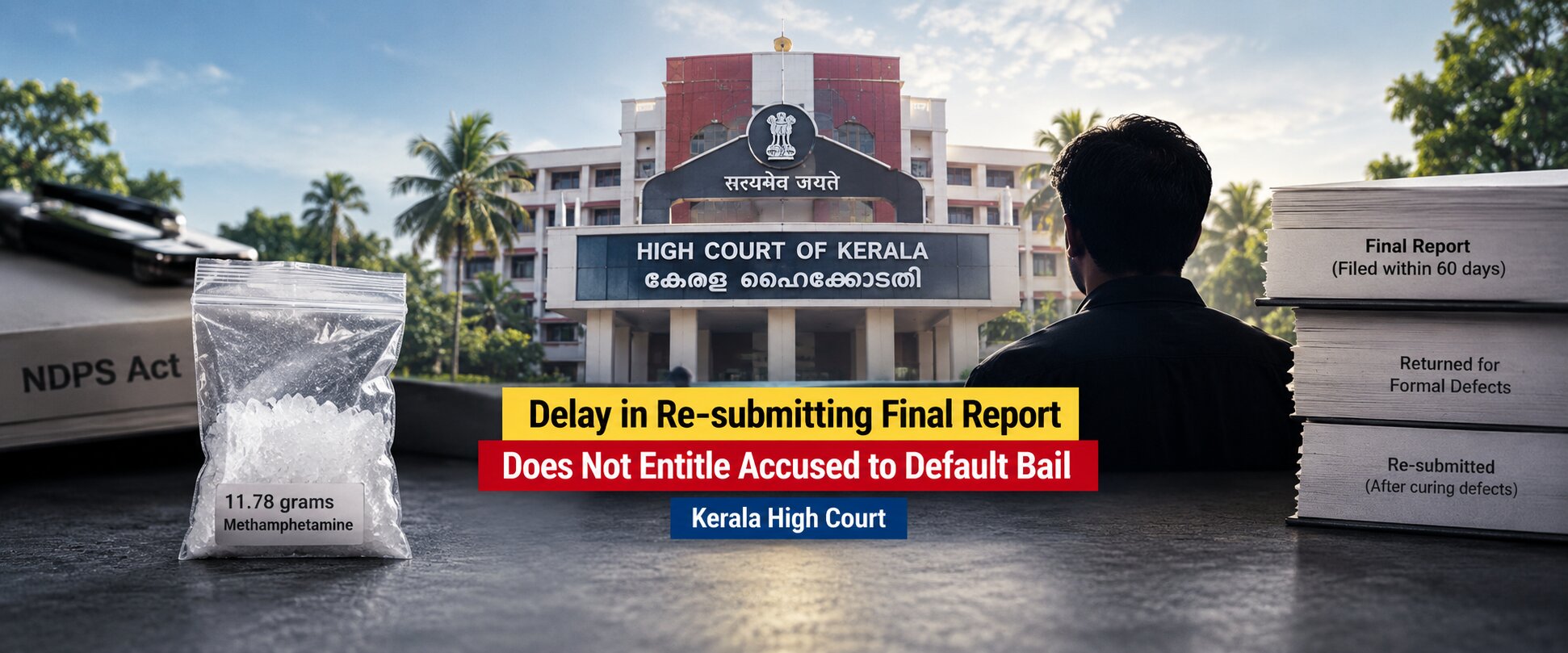
Re-submission after curing such defects relates back to the original date of filing, provided that no further investigation was required or undertaken.
Judgement Details
Court
High Court of Kerala
Date of Decision
18 September 2026
Judges
Dr. Justice Kauser Edappagath
Citation
Acts / Provisions
Facts of the Case
-
The petitioner was the sole accused in an NDPS case.
-
The prosecution alleged that the accused was found in possession of 11.78 grams of methamphetamine.
-
The accused was arrested on 08.06.2026.
-
The accused challenged the legality of the investigation, including alleged violations relating to search, arrest, and seizure.
-
A final report was initially filed by the investigating agency on 21.07.2026.
-
The final report was filed within the applicable statutory period.
-
However, the report was subsequently returned for curing formal defects, including the inclusion of certain unconnected documents.
-
After curing the defects, the prosecution re-submitted the final report on 17.08.2026.
-
The accused contended that the re-submission was beyond the statutory period and therefore claimed entitlement to default/statutory bail.
-
The accused argued that because the defective report had been returned and the corrected report was submitted only on 17.08.2026, the statutory period should be treated as having expired before completion of the investigation.
-
The prosecution maintained that the investigation had already been completed and the final report had been filed within the prescribed period, with the subsequent process involving only the correction of formal defects.
Issues
-
Whether a final report filed within the statutory period under Section 187 of the BNSS, but subsequently returned for curing formal defects and re-submitted after expiry of the statutory period, entitles the accused to default bail?
-
Whether the re-submission of a final report after curing formal defects relates back to the original date of filing when no further investigation was undertaken during the intervening period?
-
Whether mere delay in re-submitting a final report after curing formal defects constitutes non-completion of investigation within the statutory period prescribed under Section 187(2) of the BNSS?
-
Whether an accused becomes entitled to default bail when the initial final report was filed within the statutory period but was returned only for curing formal defects?
Judgement
-
The Kerala High Court dismissed the bail application filed by the accused.
-
The Court held that the decisive consideration for default bail is completion of the investigation within the statutory period, rather than the mere procedural fact of when a formally corrected final report was re-submitted.
-
The Court observed that the expression “final report” does not itself appear in Section 167(2) CrPC or Section 187(2) BNSS.
-
According to the Court, where a final report demonstrates that the investigation has been completed in all material respects, minor or formal defects in the report do not, by themselves, create a right to default bail.
-
The Court distinguished between a report that contains only formal defects and a report filed without completion of the investigation.
-
Where the report is returned merely for curing formal defects, the permission to re-submit operates to allow correction of those defects.
-
Once the defects are cured and the report is re-presented without any further investigation, the re-submission relates back to the original filing date.
-
The Court therefore held that it was immaterial that the formal defects were cured and the report was re-submitted after the period originally granted for curing them.
-
The Court also relied upon the principles stated in Vimal K. Mohanan v. State of Kerala, as well as Supreme Court decisions including Central Bureau of Investigation v. Kapil Wadhawan, Narendra Kumar Amin v. Central Bureau of Investigation and Others, and Shaurya Sunil Kumar Singh v. Central Bureau of Investigation.
-
On the facts, the Court found that the final report had originally been filed within the statutory period and had been returned only for curing formal defects.
-
Consequently, the Court concluded that the accused had not acquired a right to statutory/default bail merely because the corrected report was submitted later.
Held
-
The Court held that filing a final report within the statutory period is sufficient where the investigation has actually been completed and the report is subsequently returned only for curing formal defects.
-
Delay in curing or re-submitting formal defects, by itself, does not create a right to default bail.
-
However, where the initial report is filed without completing the investigation and is returned for further investigation, the position is different; failure to complete and re-submit the final report within the statutory period can give rise to the accused's right to default bail.
-
On the facts of Sagesh, the accused was therefore not entitled to statutory/default bail.
Analysis
-
Court’s reasoning: The Court focused on the substance of the investigative process rather than treating the filing of a technically defective document as equivalent to failure to complete the investigation.
-
Completion of investigation is central: The judgment reinforces the principle that default bail is connected with the investigating agency's failure to complete the investigation within the statutory period. The mere presence of curable formal defects in an otherwise completed investigation does not necessarily trigger that right.
-
Distinction between formal defects and incomplete investigation: This is the key distinction in the judgment. A report may be returned because of a technical or formal defect even though the investigation itself is complete. That situation is materially different from filing a report while investigation remains incomplete.
-
Relation-back principle: When the report is re-submitted after curing formal defects without conducting additional investigation, the corrected report is treated as relating back to the original filing date. This prevents the statutory-bail question from turning solely on the administrative time taken to correct a defect.
-
Protection against circumvention: The Court nevertheless recognized that the principle cannot be used to defeat the accused's statutory right. If an investigating agency files an incomplete report merely to avoid the expiry of the statutory period and the report requires further investigation, the accused may claim default bail if the investigation is not completed within the prescribed period.
-
Application to the present case: Since the report in Sagesh was filed within the statutory period and was returned only for formal correction, the Court treated the original filing as legally significant despite the later re-submission.
-
Significance under BNSS: The judgment applies the established principles concerning Section 167(2) CrPC to the corresponding statutory-bail framework under Section 187 BNSS, providing guidance on how courts may approach defective final reports under the new procedural legislation.
-
Practical legal significance: The decision indicates that an accused seeking default bail cannot rely solely on the date of re-submission. The court will examine why the report was returned and whether the investigation had actually been completed within the statutory period.