
Sagar v. State of Haryana, 2026
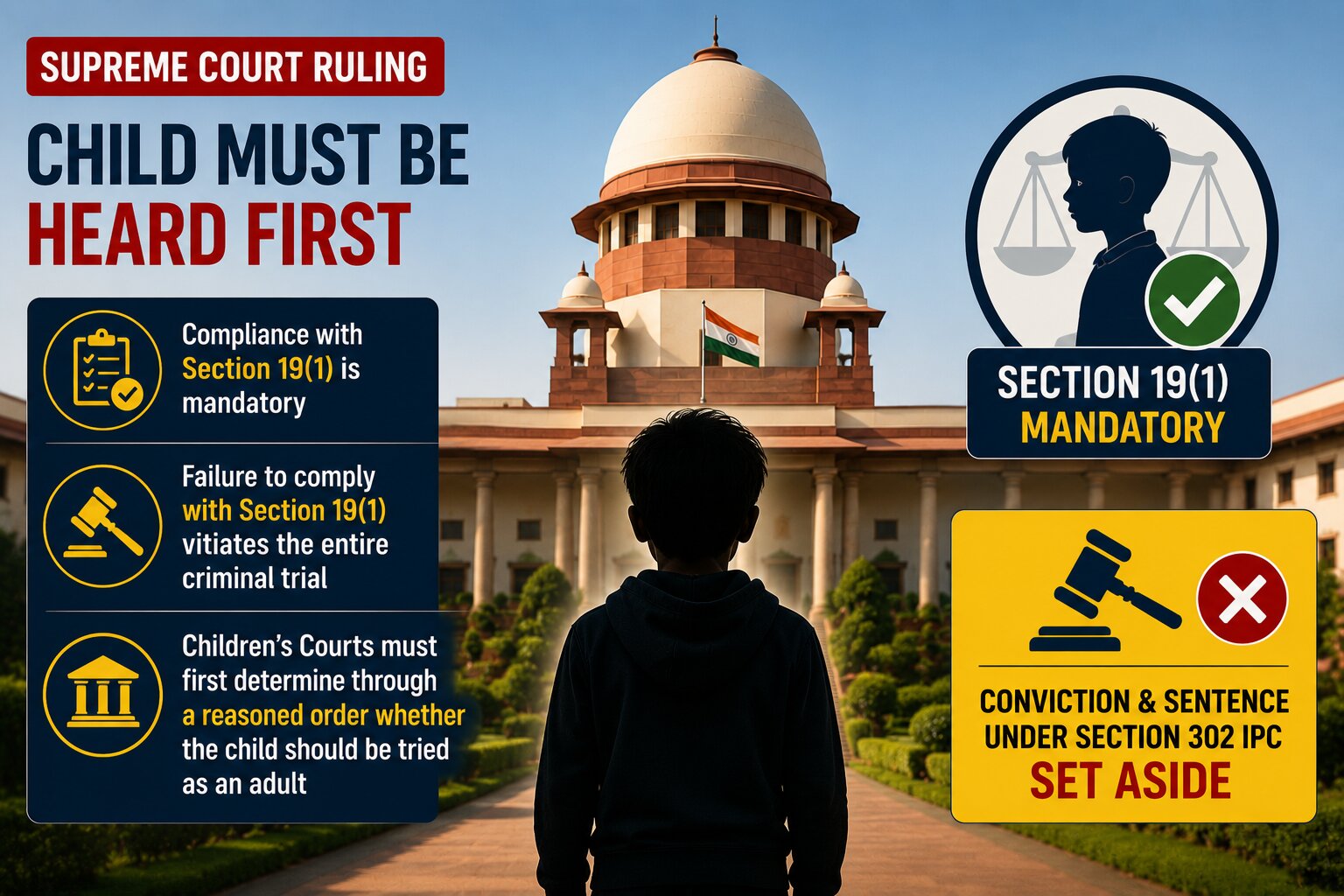
A Children's Court cannot try a child as an adult without first passing a reasoned order under Section 19(1) of the Juvenile Justice Act.
Judgement Details
Court
Supreme Court of India
Date of Decision
13 July 2026
Judges
Justice Aravind Kumar & Justice Prasanna B. Varale
Citation
Acts / Provisions
Facts of the Case
-
The appellant, Sagar, was approximately 16 years and 6 months old when the alleged offence occurred in October 2018 in Haryana.
-
He was accused of participating in an assault that resulted in the death of a person.
-
Since the appellant was above sixteen years of age and the allegation involved a heinous offence, the Juvenile Justice Board conducted a preliminary assessment under Section 15 of the Juvenile Justice Act.
-
The Board concluded that the appellant possessed sufficient mental and physical capacity to commit the offence.
-
Consequently, the Board transferred the matter to the Children's Court under Section 18(3) for trial as an adult.
-
After receiving the case, the Children's Court directly proceeded with the Sessions trial without first passing an order under Section 19(1) of the Act.
-
The Children's Court convicted the appellant under Section 302 IPC and sentenced him to 14 years' rigorous imprisonment.
-
The High Court affirmed the conviction.
-
The appellant challenged the conviction before the Supreme Court, contending that the Children's Court had failed to comply with the mandatory statutory procedure under Section 19(1).
Issues
-
Whether a Children's Court can proceed to try a child in conflict with law as an adult without first passing a reasoned order under Section 19(1) of the Juvenile Justice (Care and Protection of Children) Act, 2015?
-
Whether non-compliance with Section 19(1) of the Juvenile Justice Act vitiates the entire criminal trial?
-
Whether the appellant's conviction under Section 302 IPC could be sustained despite the Children's Court not complying with the mandatory procedure prescribed under the Act?
Judgement
-
The Supreme Court allowed the appeal and set aside the conviction.
-
The Court held that Section 19(1) imposes a mandatory obligation upon the Children's Court before proceeding further with the trial.
-
The Bench observed that after receiving the matter from the Juvenile Justice Board under Section 18(3), the Children's Court must first conduct an independent assessment and pass a reasoned order deciding whether the child should be tried as an adult.
-
The Court held that this determination governs the nature of further proceedings and cannot be bypassed.
-
Relying upon Thirumoorthy v. State, 2024 LiveLaw (SC) 262, the Court reiterated that failure to comply with Section 19(1) renders the subsequent trial legally unsustainable.
-
The Court observed that in the absence of compliance with Section 19(1), the entire trial stood vitiated.
-
Consequently, the conviction recorded by the Children's Court and affirmed by the High Court was set aside.
-
The appellant was acquitted.
-
The Supreme Court also issued an important direction to Children's Courts across the country, requiring them to invariably pass a reasoned order under Section 19(1) before commencing the trial of a child transferred by the Juvenile Justice Board.
Held
-
Compliance with Section 19(1) is mandatory, not merely procedural.
-
Failure to comply with Section 19(1) vitiates the entire criminal trial.
-
Children's Courts throughout the country must first determine, through a reasoned order, whether the child should be tried as an adult before proceeding further.
-
The appellant's conviction and sentence under Section 302 IPC were set aside.
Analysis
-
The judgment reinforces the statutory safeguards incorporated in the Juvenile Justice (Care and Protection of Children) Act, 2015, recognizing that children in conflict with law are entitled to special procedural protections.
-
The Court clarified that the preliminary assessment by the Juvenile Justice Board under Section 15 does not automatically authorize an adult trial; the Children's Court must independently apply its mind under Section 19(1).
-
By treating Section 19(1) as mandatory, the Court ensured that Children's Courts cannot mechanically proceed with Sessions trials merely because the Board has transferred the matter.
-
The ruling strengthens the principles of fair trial and due process, emphasizing that statutory procedures affecting juveniles must be strictly followed.
-
The judgment also establishes a uniform procedural standard for Children's Courts across India, thereby preventing inconsistent practices.
-
By relying on Thirumoorthy v. State, the Supreme Court reaffirmed that procedural violations affecting juvenile rights are not curable irregularities but go to the root of the trial.
-
The decision is significant because it balances society's interest in prosecuting heinous offences with the legislative objective of protecting the rights and rehabilitation of children in conflict with law.