
S v. M & Anr., 2026
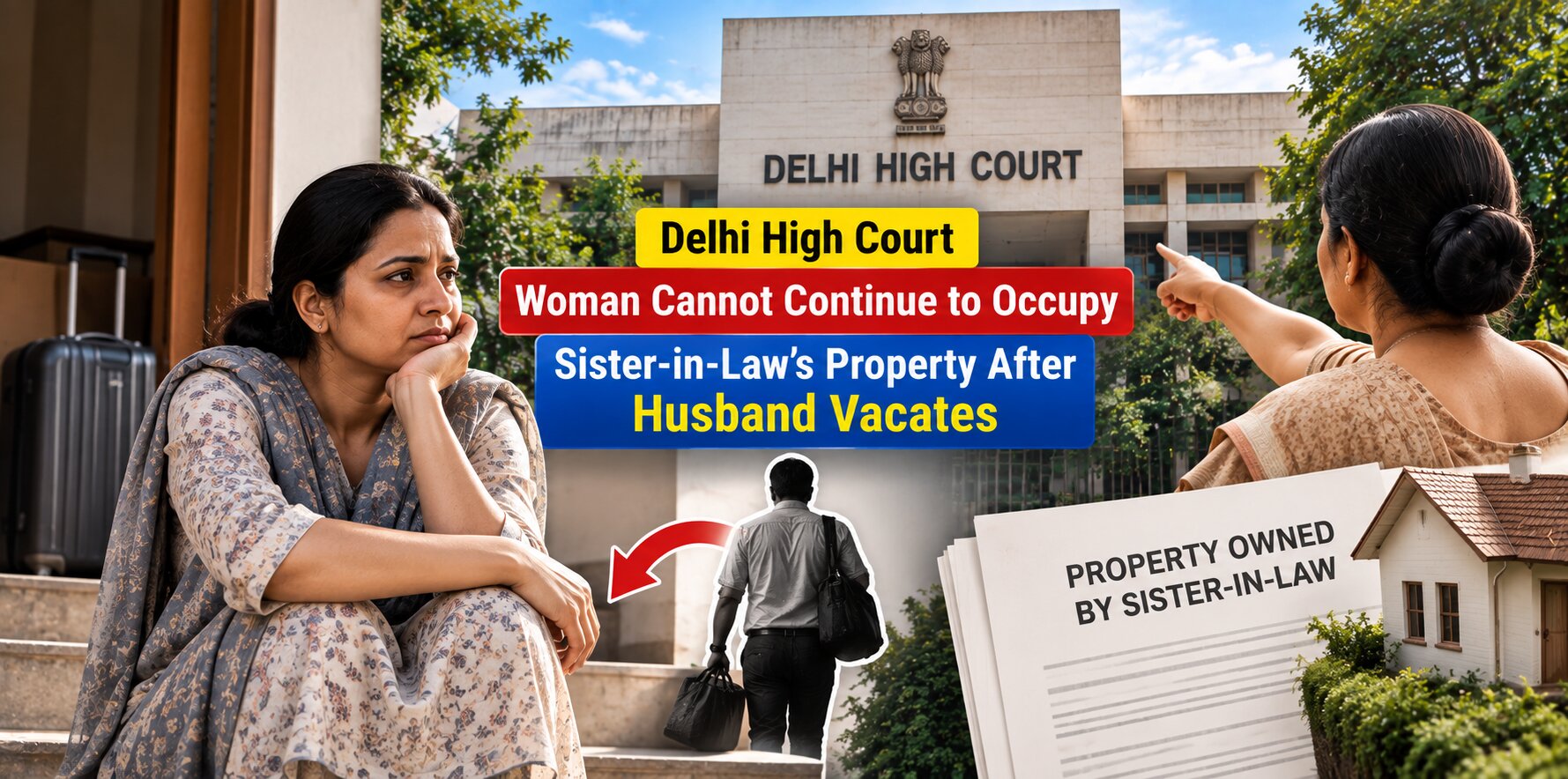
The Court held that once the owner's permission to the husband was withdrawn and the husband vacated the premises, the appellant had no independent right to continue in possession.
Judgement Details
Court
High Court of Delhi
Date of Decision
6 September 2026
Judges
Justice Neena Bansal Krishna
Citation
Acts / Provisions
Facts of the Case
-
The dispute concerned a property belonging to the respondent, who was the sister-in-law of the appellant.
-
The respondent had permitted her brother, who was the appellant's husband, to reside in the property.
-
The husband's occupation was therefore based upon permission granted by the owner and was not based upon ownership or an independent proprietary right.
-
After the appellant married the brother, she also began residing in the property with her husband.
-
The appellant claimed that the property became her place of residence and subsequently asserted a right to continue living there.
-
According to the respondent, disputes arose after the appellant's marriage.
-
The respondent subsequently withdrew the permission that had been granted to her brother and called upon him and the appellant to vacate the premises.
-
The appellant's husband ultimately vacated the property.
-
Despite the husband's departure, the appellant continued to remain in possession of the premises.
-
The appellant claimed that she had a right to reside in the property as her matrimonial/shared household.
-
The respondent instituted proceedings seeking mandatory and permanent injunction against the appellant and sought recovery of possession.
-
The trial court found in favour of the respondent and directed the appellant to vacate the property.
-
The appellant challenged the decision before the first appellate court.
-
The first appellate court affirmed the trial court's findings.
-
The appellant thereafter approached the Delhi High Court by way of a second appeal under RSA No. 22/2022.
-
Before the High Court, the appellant argued that the courts below had failed to properly consider her claimed right of residence in the property.
-
She contended that the premises constituted her shared household/matrimonial home and therefore she could not be directed to vacate merely because her husband had left.
-
The respondent maintained that the appellant had entered the property only because her husband had been permitted to reside there.
-
According to the respondent, once the husband's permission was withdrawn and he himself vacated the premises, the appellant had no independent right, title or interest permitting her to continue occupying the property.
Issues
-
Whether the appellant acquired an independent legal right to continue occupying the property merely because she had resided there with her husband?
-
Whether the appellant could claim a right of residence in the property as a shared household when her husband himself had occupied the premises only as a permissive occupant?
-
Whether withdrawal of the permission granted by the owner to the appellant's husband also extinguished the appellant's basis for continued occupation of the property?
-
Whether the appellant could continue to occupy the property after her husband had vacated it despite having no independent title, ownership or possessory right in the premises?
-
Whether the courts below were justified in directing the appellant to vacate the property and granting mandatory and permanent injunction in favour of the owner?
-
Whether the appellant had established any substantial question of law warranting interference by the High Court in the second appeal?
Judgement
-
The Delhi High Court dismissed the second appeal filed by the appellant.
-
The Court examined the nature of the appellant's entry into and occupation of the disputed property.
-
It found that the appellant's husband had originally been permitted by the owner to reside in the property.
-
The appellant had entered the property only after her marriage and had joined her husband there as a family member.
-
The Court therefore found that the appellant's occupation was derivative of the permission granted to her husband.
-
The Court observed that the appellant did not have any independent right, title or interest in the property.
-
Once the owner withdrew the permission granted to the husband, the basis upon which the husband was entitled to occupy the property came to an end.
-
The husband subsequently vacated the premises.
-
The Court held that the appellant could not acquire a better right to possession than the person through whom she had entered the property.
-
The Court rejected the argument that her status as the wife of the permissive occupant automatically entitled her to remain in the property after her husband's permission had been withdrawn and he had vacated it.
-
The Court observed that the appellant had come to reside in the property with her husband as a permissive user.
-
Once the permission was withdrawn, she had no independent legal basis to continue occupying the property.
-
The Court also observed that disputes between the husband and wife could not operate as a penalty against the sister-in-law who had originally permitted the family to occupy her property.
-
The Court accordingly upheld the concurrent findings of the trial court and first appellate court.
-
The decree directing the appellant to vacate the property was therefore allowed to stand.
-
The second appeal was dismissed.
Held
-
The Court held that the appellant's occupation of the property originated solely through her husband's permissive occupation.
-
The Court held that the appellant did not acquire an independent proprietary or possessory right merely by residing in the property after her marriage.
-
The Court held that the appellant could not claim a better right to possession than the husband through whom she had entered the property.
-
The Court upheld the orders of the courts below directing the appellant to vacate the property.
-
The Court consequently dismissed RSA No. 22/2022.
Analysis
-
Nature of possession: The central issue was the legal character of the appellant's possession. The Court treated her occupation as derivative because she entered the property through her husband, who himself had only been permitted to occupy it by the owner.
-
No independent proprietary right: Mere residence in another person's property does not, by itself, create ownership or an independent possessory title. The Court found no independent legal interest of the appellant in the disputed property.
-
Effect of withdrawal of permission: Once the owner withdrew the permission granted to the husband, the legal basis for the husband's permissive occupation came to an end. Since the appellant's occupation was connected to that permission, she could not continue indefinitely after its withdrawal.
-
Husband's subsequent vacation: The husband's actual departure from the premises was an important factual circumstance. The Court treated the appellant's continued occupation after his departure as insufficiently supported by an independent legal right.
-
Shared-household argument: The appellant relied upon the concept of a matrimonial/shared household. The Court, however, examined the particular facts concerning ownership and permissive occupation and did not accept that the appellant's residence with her husband created an unrestricted right to remain in property belonging to her sister-in-law.
-
Distinction between residence and title: The judgment illustrates that the fact that a person has lived in a property as a family residence does not necessarily establish ownership or a permanent right of possession against the property's owner.
-
Protection of owner's rights: The Court recognized that the owner who had voluntarily permitted relatives to occupy the property could subsequently seek possession after withdrawing that permission, subject to applicable law.
-
No penalty for sister-in-law: The Court specifically emphasized that disputes between the husband and wife should not result in an indefinite burden upon the sister-in-law who had allowed them to stay in her property.
-
Concurrent findings: Both the trial court and the first appellate court had reached substantially the same conclusion. In a second appeal, the High Court's jurisdiction is limited and ordinarily focuses on a substantial question of law rather than reassessing factual findings as if hearing the matter for the first time.
-
Practical significance: The judgment is relevant to disputes where a married woman resides in property belonging to her husband's relative and later claims an independent right to remain after the husband's own permissive occupation has ended.
-
Important qualification: The decision should not be read as establishing a general rule that a married woman can never claim residence in property belonging to her husband's relatives. Rights under applicable matrimonial and domestic-violence laws depend upon the specific facts, statutory requirements and the nature of the property and relationship.
-
Core legal principle: The central principle emerging from the judgment is that a person's continued occupation cannot be sustained merely from a derivative permission when the underlying permissive right has been terminated, unless the occupant can establish an independent legal basis for possession.