
S v. A, 2026
Post-decree reconciliation is a relevant subsequent development that a matrimonial court can take into account while deciding an appeal.
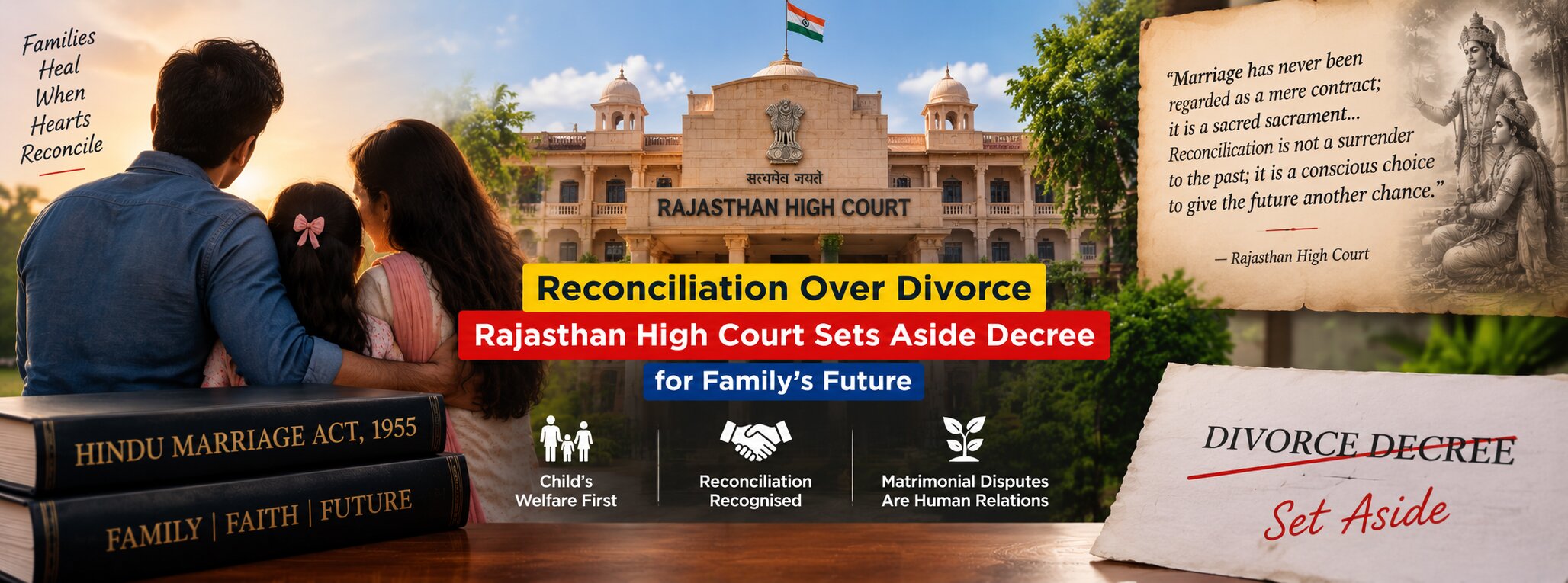
Judgement Details
Court
Rajasthan High Court
Date of Decision
18 September 2026
Judges
Justice Uma Shanker Vyas and Justice Sameer Jain
Citation
Acts / Provisions
Facts of the Case
- The matter arose from an appeal against a divorce decree passed by the Family Court.
-
After the divorce decree had been passed, the parties underwent a change in circumstances and arrived at a mutual understanding.
-
The husband and wife subsequently settled their disputes and expressed their willingness to restore their matrimonial relationship.
-
The parties decided to resume their family life rather than allow the earlier matrimonial dispute to permanently end their relationship.
-
A significant consideration before the High Court was the welfare and future of their minor daughter.
-
Both parties expressed the intention to provide their daughter with the love, affection, care, companionship and emotional security of both parents.
-
The Court noted that the dispute was essentially personal and matrimonial in nature.
-
There was no indication that restoration of the matrimonial relationship would adversely affect third-party rights or any larger public interest.
-
The Court considered the fact that the parties themselves had voluntarily chosen reconciliation after the divorce decree.
-
The Bench examined whether this subsequent reconciliation could be given legal effect despite the earlier decree of divorce.
-
The Court emphasised that matrimonial litigation concerns not merely legal rights and competing claims but also human relationships and the lives of families.
-
While discussing the nature of Hindu marriage, the Court referred to the traditional understanding of marriage as a sacred sacrament or sanskara, rather than merely a contractual arrangement.
-
The Court also invoked the broader wisdom associated with the Mahabharata while discussing reconciliation and restoration of family relationships.
-
The Court concluded that the subsequent reconciliation was a material development that had to be considered while determining the appropriate relief.
Issues
-
Whether a matrimonial court can take into account a subsequent reconciliation between spouses that occurs after a divorce decree has already been passed?
-
Whether the subsequent voluntary decision of the parties to restore their matrimonial relationship can justify setting aside a previously passed divorce decree?
-
Whether the welfare and emotional security of a minor child can be considered as a relevant circumstance while determining the effect of post-decree reconciliation between the parents?
-
Whether matrimonial adjudication should take into account subsequent developments that materially alter the circumstances existing when the original decree was passed?
-
Whether the Court should facilitate reconciliation where the parties themselves have voluntarily resolved their disputes and there are no competing third-party rights or wider public consequences?
-
Whether the continuation of a divorce decree would be appropriate when both spouses have consciously chosen to restore their matrimonial relationship and rebuild their family life?
Judgement
-
The Rajasthan High Court allowed the appeal filed against the divorce decree.
-
The Court set aside the divorce decree passed by the Family Court.
-
The Court gave legal effect to the post-decree reconciliation reached between the parties.
-
The matrimonial relationship between the parties was consequently restored.
-
The Court placed considerable importance on the parties' mutual decision to rebuild their family life.
-
The welfare of the minor daughter was an important consideration in assessing the subsequent reconciliation.
-
The Court observed that the child's welfare is better served when parental differences are replaced by understanding, responsibility and mutual respect, where reconciliation is voluntarily chosen by the parents.
-
The Court held that matrimonial litigation cannot always be viewed merely as a contest involving competing legal claims.
-
Matrimonial disputes also involve emotional, social and familial dimensions, which courts should not lose sight of while administering justice.
-
The Court stated that where parties have themselves found a path from discord to reconciliation, the law should, wherever legally permissible, facilitate peace rather than unnecessarily perpetuate conflict.
-
The Bench emphasised that reconciliation does not necessarily represent surrender to past disputes but can represent a conscious decision to give the future another opportunity.
-
The Court also considered the absence of any larger public consequences or third-party rights that would prevent giving effect to the parties' settlement.
-
The judgment therefore gave priority to the subsequent development of reconciliation while determining the appropriate relief.
Held
-
Where spouses have voluntarily resolved their disputes and genuinely intend to restore their marriage, the Court may, where permitted by law, facilitate such reconciliation.
-
The welfare of a minor child is a relevant consideration when assessing the consequences of restoring the matrimonial relationship.
-
Matrimonial adjudication concerns not only legal rights but also human relationships and family life.
-
Courts should not unnecessarily allow matrimonial litigation to become an irreversible barrier to reconciliation when the parties themselves have chosen to restore their relationship.
-
The law should respond not only to the circumstances existing when the original dispute arose but also to subsequent events having a material bearing on the relief sought.
-
Where no third-party rights or overriding public consequences are involved, the Court may give appropriate weight to a mutual settlement and reconciliation between spouses.
-
The divorce decree was set aside, and the parties' matrimonial relationship was restored.
-
The appeal was therefore allowed.
Analysis
-
The judgment demonstrates the importance of the doctrine of subsequent events in matrimonial adjudication. A court deciding an appeal need not remain confined to circumstances that existed when the original decree was passed if later developments materially affect the appropriate relief.
-
The Court treated the parties' reconciliation as a significant factual development because the very objective of matrimonial adjudication may change when spouses voluntarily decide to resume their relationship.
-
The reasoning reflects the distinction between adjudicating a past matrimonial wrong and determining what relief is appropriate in light of the parties' present circumstances.
-
The Court's emphasis on the minor daughter's welfare places the child's emotional security and family environment within the broader framework of matrimonial justice.
-
The Court recognised that a matrimonial dispute has dimensions beyond the strictly legal relationship between husband and wife. It can directly affect the emotional and social well-being of children and the wider family.
-
The reference to the Mahabharata and Hindu conception of marriage as a sanskara was used to provide cultural and philosophical context to the Court's discussion of reconciliation.
-
The judgment does not suggest that reconciliation must always override a legally established divorce. Rather, the Court considered reconciliation significant because the parties themselves had voluntarily chosen to restore their relationship and the circumstances permitted the Court to give effect to that choice.
-
The absence of third-party rights or broader public consequences was important because restoration of the matrimonial relationship would primarily affect the parties and their child.
-
The decision reflects a restorative approach to matrimonial adjudication, where legally permissible, rather than treating the original litigation as necessarily determinative of the parties' future relationship.
-
The Court's reasoning also demonstrates that judicial relief should remain responsive to changed circumstances, particularly where those circumstances are directly connected with the relief sought.
-
The judgment reinforces the idea that matrimonial justice may sometimes involve facilitating a humane resolution, rather than merely declaring which party succeeded on the original legal dispute.
-
At the same time, the Court's approach remains dependent on the voluntary nature of reconciliation and the absence of circumstances that would make restoration legally impermissible or harmful to protected rights.
-
The broader significance of the judgment lies in recognising that family litigation is dynamic and that courts may need to consider the present reality of the parties when deciding an appellate remedy.