
S. Sangeetha & Ors. v. Tmt. P. Ponni, 2026
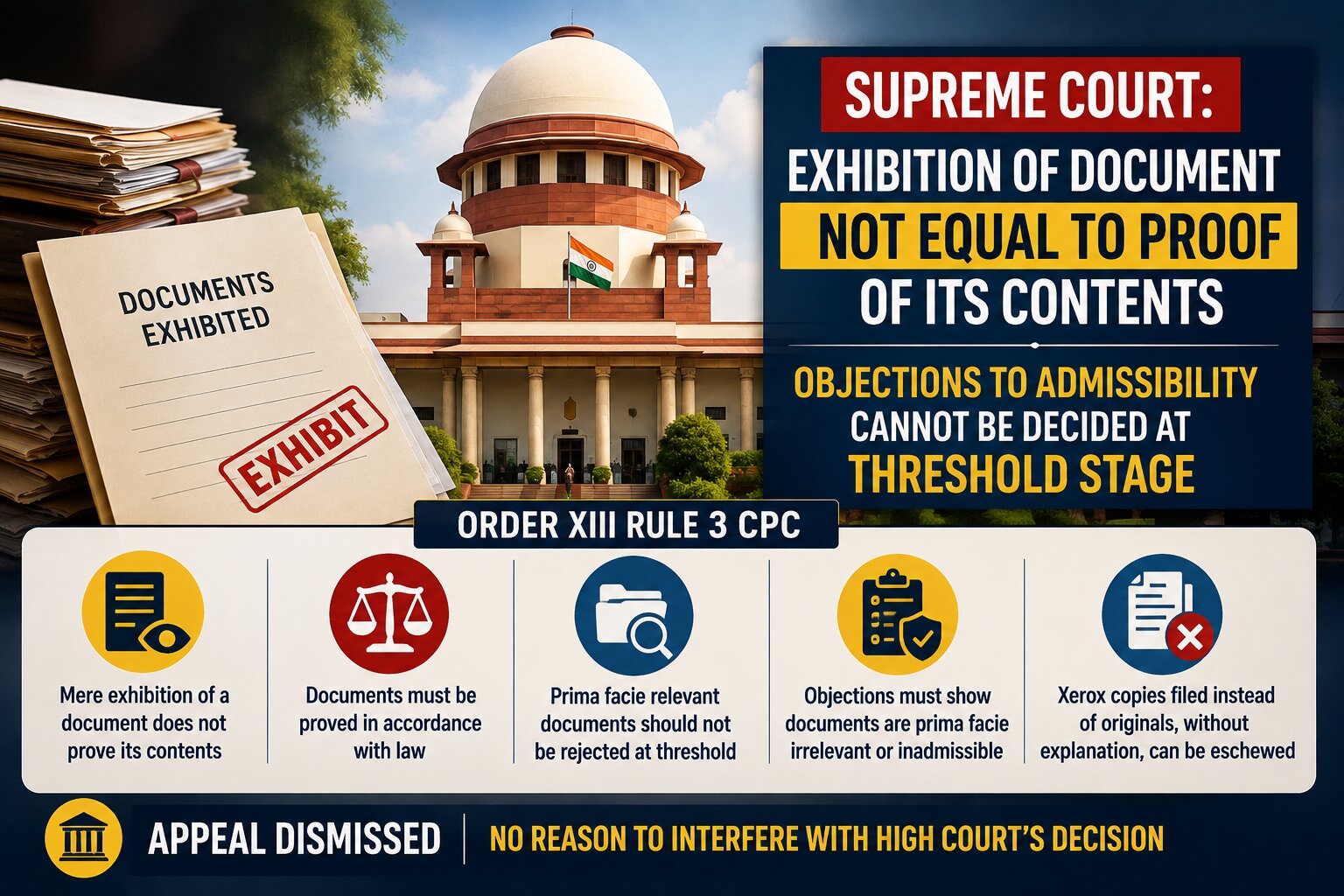
Mere marking or exhibition of a document does not prove the contents of the document.
Judgement Details
Court
Supreme Court of India
Date of Decision
7 August 2026
Judges
Justice Sanjay Karol & Justice Nongmeikapam Kotiswar Singh
Citation
Acts / Provisions
Facts of the Case
-
The dispute arose from a probate proceeding involving disputes concerning family matters, pending litigation and property transactions.
-
The respondent-plaintiff relied upon various documents and exhibited them through her proof affidavit.
-
The appellant-defendant objected to the admissibility and exhibition of certain documents.
-
The appellant sought exercise of power under Order XIII Rule 3 CPC to have the disputed documents eschewed.
-
The matter had earlier been considered by the Madras High Court.
-
The High Court declined to exercise its power under Order XIII Rule 3 CPC to reject the documents at the threshold.
-
Certain documents were photocopies rather than originals.
-
The High Court eschewed the photocopied documents where no explanation had been provided for filing copies instead of originals.
-
However, the High Court permitted exhibition of other documents relating to family disputes, pending litigation and property transactions.
-
The appellant challenged this approach before the Supreme Court.
-
The appellant contended that the disputed documents should not have been permitted to remain on record because of objections concerning their admissibility.
-
The Supreme Court considered whether such objections could properly be decided at the threshold merely because the documents had been exhibited.
-
The Court emphasized that marking or exhibiting a document does not by itself prove the contents of that document.
-
The Court further observed that documents which are prima facie relevant to the adjudication of the suit should not ordinarily be rejected at the threshold where their relevance or evidentiary significance may become important during adjudication.
-
The Court ultimately found no reason to interfere with the reasoning of the Courts below.
Issues
-
Whether a document that is prima facie relevant to the adjudication of a suit can ordinarily be rejected at the threshold under Order XIII Rule 3 CPC merely because objections have been raised regarding its admissibility?
-
Whether mere marking or exhibition of a document amounts to proof of the contents of that document?
-
Whether documents relating to family disputes, pending litigation and property transactions can be eschewed at the threshold when they are prima facie relevant to the properties involved in the suit?
-
Whether the power under Order XIII Rule 3 CPC should be exercised to reject documents where the objections raised do not establish that the documents are prima facie irrelevant or inadmissible in law?
-
Whether photocopied documents filed instead of originals, without any explanation for the absence of originals, can be eschewed from consideration?
Judgement
-
The Supreme Court dismissed the appeal.
-
The Court upheld the reasoning of the Courts below concerning the documents in dispute.
-
The Court held that a document that is prima facie relevant to the adjudication of a suit should not ordinarily be rejected at the threshold merely because objections have been raised against its admissibility.
-
The Court emphasized that mere exhibition or marking of a document does not constitute proof of its contents.
-
The contents of the exhibited documents would still have to be proved in accordance with law.
-
The Court therefore found no reason to eschew the relevant documents at that stage of the proceedings.
-
The Court agreed with the decision to eschew the documents where xerox copies had been filed instead of originals without any explanation.
-
With respect to the remaining documents, the Court found that the objections did not make them prima facie inadmissible in law or irrelevant to the properties involved in the suit.
-
Consequently, the Court held that exercise of the power under Order XIII Rule 3 CPC was not warranted in the circumstances.
-
The appeal was accordingly dismissed.
Held
-
An exhibited document must still be proved in accordance with law.
-
A document that is prima facie relevant to the adjudication of the suit should not ordinarily be rejected at the threshold merely because objections have been raised against it.
-
The power under Order XIII Rule 3 CPC should not be exercised where the objections do not establish that the document is prima facie irrelevant or inadmissible.
-
Documents that may become important or indispensable for adjudication should ordinarily be allowed to remain on record, subject to their subsequent proof in accordance with law.
-
Photocopies filed instead of originals, particularly where no explanation is provided for the absence of the originals, may properly be eschewed.
-
Exhibition of a document does not automatically establish its authenticity, truthfulness or contents.
-
The Supreme Court found no reason to interfere with the decision of the Courts below.
-
The appeal was dismissed.
Analysis
-
Exhibition is not proof: The most important principle emerging from the judgment is the distinction between admitting/marking a document as an exhibit and proving its contents. Merely giving a document an exhibit number does not establish that its contents are true.
-
Proof must comply with law: Even after a document has been exhibited, the party relying upon it must establish its contents in accordance with the applicable rules of evidence and procedure.
-
Threshold rejection should be approached cautiously: The Court's reasoning indicates that Order XIII Rule 3 CPC should not ordinarily be used prematurely when a document is prima facie relevant and its evidentiary significance may become apparent during the adjudication of the suit.
-
Relevance to adjudication: The Court attached importance to whether the documents had a connection with the properties and issues involved in the dispute. Documents concerning family disputes, pending litigation and property transactions were not considered prima facie irrelevant merely because objections had been raised against them.
-
Distinction between admissibility and evidentiary weight: A document being allowed to remain on record does not mean that the Court has accepted its truth or authenticity. Its ultimate evidentiary value remains subject to proof and assessment during the proceedings.
-
Order XIII Rule 3 CPC: The provision gives the Court power to reject irrelevant or otherwise inadmissible documents. However, the judgment demonstrates that this power must be exercised carefully, particularly where the document may have relevance to the ultimate adjudication.
-
Treatment of photocopies: The Court accepted the approach of eschewing xerox copies where originals were not produced and there was no explanation for their absence. This demonstrates that the Court distinguished between documents having substantive relevance and documents whose form raised a clear evidentiary problem.
-
Procedural fairness: Allowing a prima facie relevant document to remain on record does not unfairly prejudice the opposing party because the opposing party retains the opportunity to challenge its proof, authenticity and evidentiary value.
-
Impact on trial proceedings: The judgment discourages parties from treating exhibition of documents as a final determination of their evidentiary status. Objections concerning proof and authenticity may continue to be considered at the appropriate stage.
-
Practical significance for litigants: A party should not assume that merely getting a document exhibited establishes its case. Conversely, an opposing party should understand that the mere exhibition of a document does not prevent it from challenging the document's contents or evidentiary value.
-
Overall legal significance: The judgment reinforces a procedural balance: prima facie relevant documents should not be prematurely excluded, but exhibition does not equal proof. The ultimate admissibility, authenticity and evidentiary value of the document remain matters to be determined in accordance with law.