
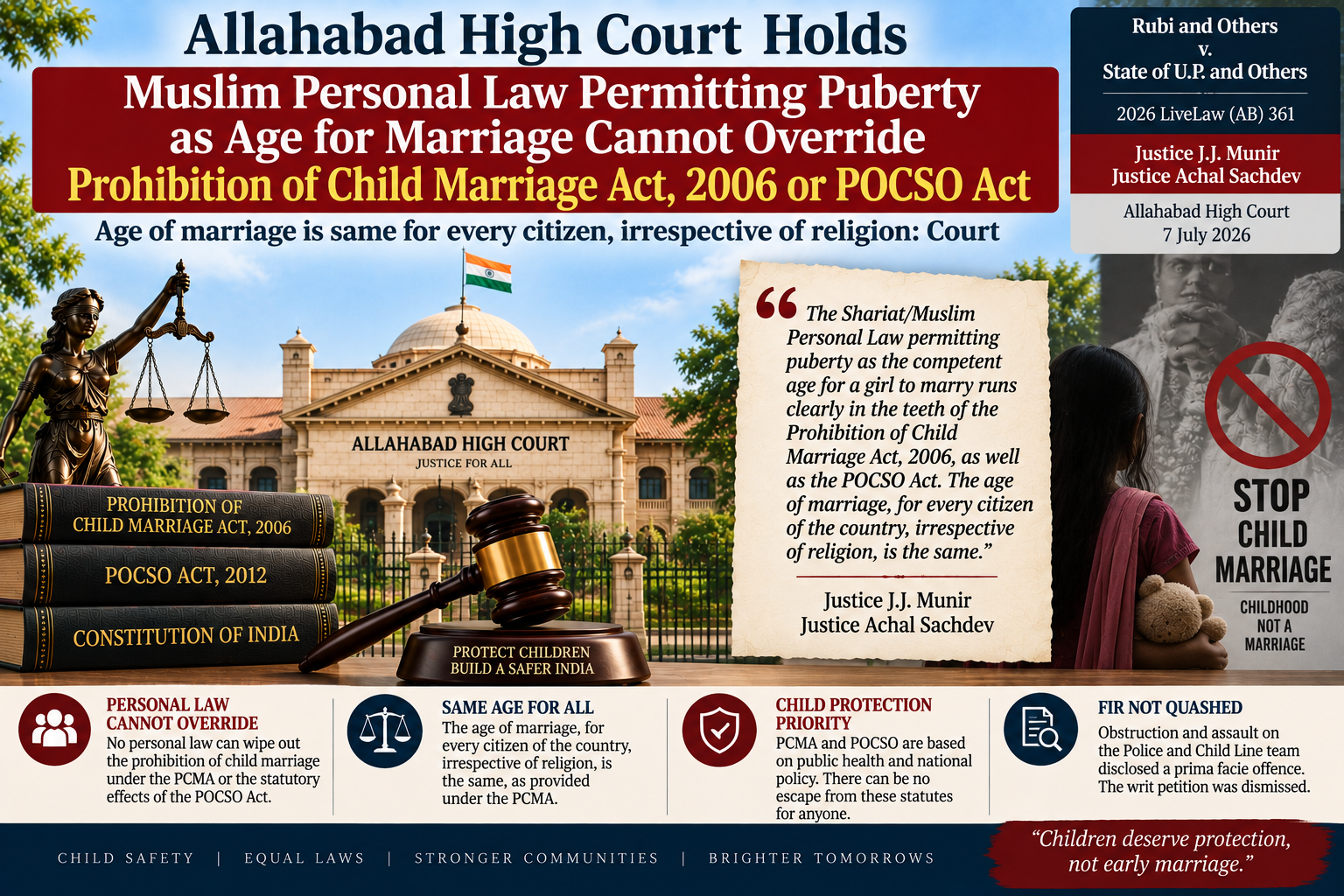
Rubi and Others v. State of U.P. and Others, 2026
Personal law cannot override statutory child-protection legislation enacted by Parliament.
Judgement Details
Court
Allahabad High Court
Date of Decision
4 August 2026
Judges
Justice J.J. Munir and Justice Achal Sachdev
Citation
Acts / Provisions
Facts of the Case
- The case arose from an attempt to solemnize the marriage of a 16-year-old Muslim girl in Bulandshahr, Uttar Pradesh.
-
Police and Child Line officials intervened to rescue the minor and prevent the proposed child marriage.
-
The petitioners allegedly obstructed and assaulted the rescue team, abused and threatened officials, and forcibly took the minor away from their custody.
-
A criminal FIR was registered against 19 individuals.
-
The petitioners approached the High Court seeking quashing of the FIR.
-
They argued that under Muslim Personal Law/Shariat, a girl attaining puberty could be competent to marry and that personal law should prevail over the Prohibition of Child Marriage Act.
-
The State opposed the petition and relied upon the statutory protection available to children under the PCMA and POCSO Act.
Issues
-
Whether Muslim Personal Law permitting marriage after puberty can override the statutory prohibition of child marriage under the Prohibition of Child Marriage Act, 2006?
-
Whether a marriage involving a person below 18 years of age can be protected by personal law when such marriage may attract the statutory consequences of the POCSO Act?
-
Whether the FIR alleging obstruction, assault and interference with the rescue of a minor girl could be quashed at the threshold?
Judgement
-
The High Court dismissed the writ petition seeking quashing of the FIR.
-
The Court held that personal law cannot override the statutory prohibition against child marriage contained in the Prohibition of Child Marriage Act, 2006.
-
It observed that the statutory age of marriage applies irrespective of religion.
-
The Court rejected the argument that attainment of puberty under Muslim Personal Law makes a girl legally competent to marry below the statutory age.
-
The Court further observed that permitting marriage below 18 could have consequences under the POCSO Act, particularly because sexual relations with a person below 18 are statutorily regulated by POCSO.
-
The Court agreed with the reasoning of the Kerala High Court that personal law cannot defeat the statutory prohibition against child marriage.
-
The Court also commended the Police and Child Line team for intervening to protect the minor.
-
Since the FIR disclosed a prima facie case of obstruction of government officials and other offences, the Court declined to interfere with the investigation.
-
The writ petition was consequently dismissed.
Held
-
The prohibition on child marriage under the PCMA applies irrespective of religion.
-
A claim that puberty constitutes the competent age for marriage under Muslim Personal Law cannot be used to defeat the statutory protection available to a child.
-
Marriage involving a person below 18 years can attract the consequences contemplated under the POCSO framework.
-
The PCMA and POCSO are legislation based upon public health, child protection and national policy.
-
Courts must give effect to the statutory safeguards protecting children rather than permitting personal law to nullify them.
-
The rescue of a minor from an impending child marriage was considered a bona fide discharge of official duty.
-
Where an FIR discloses a prima facie offence and investigation is still required, the High Court should not ordinarily interfere at the threshold.
-
The FIR against the petitioners therefore could not be quashed.
Analysis
-
The judgment addresses the important conflict between personal law and secular child-protection legislation.
-
The Court's central reasoning is that personal law cannot be invoked to defeat a statutory prohibition enacted to protect children.
-
The ruling treats the PCMA and POCSO as protective legislation with a public-policy foundation, rather than merely as rules regulating private matrimonial relationships.
-
The judgment is particularly significant because the Court expressly rejected the proposition that the age of marriage can differ depending upon the religion of the individual.
-
The Court also connected the prohibition on child marriage with the protective framework of POCSO, highlighting the statutory consequences that may arise from sexual activity involving a child.
-
The decision gives considerable importance to the welfare and protection of the minor, rather than to the asserted customary or personal-law right of adults arranging the marriage.
-
The Court also exercised restraint in relation to the criminal FIR. At the stage of considering quashing, it did not conduct a detailed trial on the allegations against the petitioners.
-
Since the FIR alleged that the rescue team was abused, threatened, obstructed and forcibly deprived of custody of the minor, the Court found sufficient prima facie material to permit investigation to continue.
-
The judgment therefore has two distinct dimensions: protection of minors from child marriage and protection of public officials carrying out lawful rescue operations.
-
The Court also noted the absence of a definitive Supreme Court ruling settling the precise conflict between personal law and the PCMA, while relying upon the reasoning of the Kerala High Court.
-
Overall, the ruling emphasises that child-protection statutes prevail over personal-law practices inconsistent with their mandatory provisions, while leaving the criminal allegations against the petitioners to be tested through the investigation and subsequent proceedings.