
Rohit Joshi v. State of Rajasthan & Ors., 2026
A Magistrate or Special Judge has a duty to examine compliance with Article 22(1) at the stage of first remand.
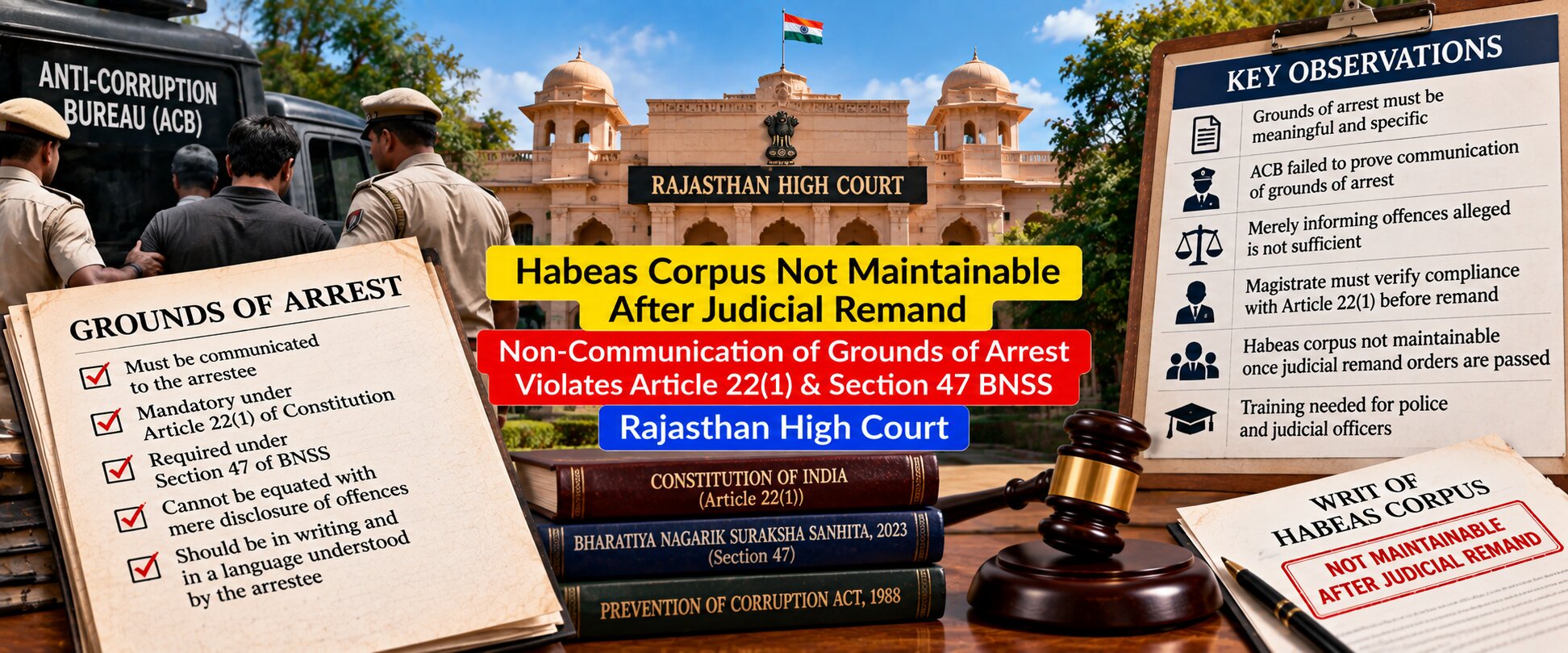
Judgement Details
Court
Rajasthan High Court
Date of Decision
4 September 2026
Judges
Justice Uma Shanker Vyas and Justice Ashok Kumar Jain
Citation
Acts / Provisions
Facts of the Case
-
The petition was filed before the Rajasthan High Court by Rohit Joshi, son of former Rajasthan Minister Dr. Mahesh Joshi.
-
The petition challenged the detention of Dr. Mahesh Joshi following his arrest by the Anti-Corruption Bureau (ACB) in connection with a corruption case.
-
The petitioner alleged that the ACB had failed to communicate the grounds of arrest to the detenue at the time of arrest.
-
It was further alleged that the grounds of arrest were not properly communicated even to the family members of the detenue.
-
The petitioner contended that this amounted to a violation of Article 22(1) of the Constitution and Section 47 BNSS.
-
At the stage of the first production before the Special Judge, an objection was raised concerning the alleged non-compliance with the mandatory safeguards relating to arrest.
-
According to the petitioner, the Special Judge did not decide that objection before authorising police custody.
-
The detenue thereafter remained in custody pursuant to successive remand orders.
-
The State opposed the habeas corpus petition, contending that the grounds of arrest had substantially been communicated and that the presence of the detenue's counsel during the remand proceedings demonstrated sufficient knowledge of the proceedings.
-
The State further argued that once a competent court had passed orders authorising detention, a writ of habeas corpus could not ordinarily be used to challenge the legality of the original arrest.
-
The State relied upon Supreme Court precedents including State of Maharashtra v. Tasneem Rizwan Siddiquee and V. Senthil Balaji v. State.
-
The High Court examined the arrest record and the material produced by the ACB.
-
The Court found that the ACB had not produced any document demonstrating that the specific grounds of arrest had been communicated in writing to the detenue.
-
The Bench drew an important distinction between informing an arrested person about the offences alleged against him and communicating the grounds of arrest.
-
According to the Court, merely telling an accused which offences have been registered does not necessarily satisfy the constitutional requirement of communicating the grounds on which his liberty has actually been curtailed.
-
The Court also noticed inconsistencies in the ACB's different explanations concerning the communication of the grounds of arrest.
-
Despite finding non-compliance with the mandatory arrest safeguards, the Court ultimately declined to issue habeas corpus because the detenue was by then in custody pursuant to successive judicial remand orders.
Issues
-
Whether failure to communicate the grounds of arrest to an arrested person violates the mandatory safeguard contained in Article 22(1) of the Constitution and Section 47 of the BNSS?
-
Whether merely informing an arrested person about the offences alleged against him amounts to sufficient communication of the grounds of arrest?
-
Whether a writ of habeas corpus can be maintained to challenge the legality of an arrest on the ground of non-communication of grounds of arrest after a competent court has passed judicial remand orders?
-
Whether the Magistrate or Special Judge authorising remand is required to independently examine compliance with Article 22(1) before authorising custody?
-
Whether successive judicial remand orders alter the nature of custody so as to restrict the availability of habeas corpus proceedings against the original arrest?
-
Whether the High Court should exercise its writ jurisdiction where the legality of the arrest has subsequently been considered and decided by the competent Special Court?
Judgement
-
The Rajasthan High Court dismissed the habeas corpus petition.
-
However, the Court made an important finding that there had been non-compliance with the mandatory requirement of communicating the grounds of arrest.
-
The Bench found that neither the detenue nor his family had been shown to have received the specific grounds of arrest in the manner required by law.
-
The Court emphasised that “grounds of arrest” and “reasons for arrest” are not interchangeable concepts.
-
Merely informing an accused about the offences for which he has been arrested does not necessarily constitute communication of the grounds of arrest.
-
The grounds must meaningfully disclose the basis for depriving the individual of personal liberty so that the arrested person can understand the case against him and effectively exercise his legal rights.
-
The Court relied upon the Supreme Court's decisions in Pankaj Bansal, Prabir Purkayastha, Vihaan Kumar and Mihir Rajesh Shah concerning the mandatory nature of the safeguard under Article 22(1).
-
The Court also observed that the ACB had failed to produce convincing documentary material establishing that the grounds of arrest had actually been furnished to the detenue.
-
The Bench expressed serious concern regarding the different versions put forward by the investigating agency concerning communication of the grounds.
-
The Court was particularly critical of the fact that the investigating agency appeared to have misunderstood the basic distinction between the grounds of arrest and the reasons for arrest.
-
The Court further held that the Special Judge had a duty to examine the legality of the arrest before authorising police custody.
-
According to the Court, the judicial officer could not simply authorise remand without ensuring compliance with the constitutional safeguards governing arrest.
-
The Court relied upon Vihaan Kumar in emphasising the responsibility of the Magistrate or Judge at the initial remand stage.
-
Nevertheless, the Court held that the habeas corpus jurisdiction could not be used to grant release in the circumstances that had subsequently developed.
-
The detenue had already been subjected to several judicial remand orders passed by a competent court.
-
The Special Judge had also subsequently decided the application challenging the legality of the arrest.
-
In view of the settled limitations on habeas corpus where custody is pursuant to judicial orders, the High Court declined to examine the legality of the detention through the habeas corpus petition.
-
The Court clarified that the petitioner was free to challenge the Special Judge's order through appropriate legal proceedings.
-
The Court directed that a copy of its judgment be placed before the Chief Justice of the Rajasthan High Court and the Additional Chief Secretary (Home), Government of Rajasthan.
-
The Court further directed attention to the need for training of police officers and judicial officers concerning the Supreme Court's directions in Vihaan Kumar and Mihir Rajesh Shah.
Held
-
Communication of the grounds of arrest is a mandatory constitutional safeguard under Article 22(1).
-
Section 47 BNSS reinforces the statutory obligation concerning communication of grounds of arrest.
-
Merely communicating the offences alleged against an accused does not necessarily amount to communicating the grounds of arrest.
-
The grounds of arrest must be meaningful and sufficiently specific to enable the arrested person to understand why his liberty has been curtailed.
-
The Court found that, in the present case, the ACB had failed to establish that the grounds of arrest were properly communicated.
Analysis
- An objection concerning illegal arrest should not be mechanically ignored while authorising police custody.
-
However, once a competent court has passed successive judicial remand orders, habeas corpus ordinarily cannot be used to challenge the continued detention merely by attacking the legality of the original arrest.
-
The appropriate remedy in such circumstances is to challenge the relevant remand or subsequent judicial order through the statutory legal remedies available to the accused.
-
The High Court nevertheless retains the power to record and address serious violations of constitutional safeguards even when the particular habeas corpus relief sought cannot ultimately be granted.
-
Police and judicial officers must ensure meaningful compliance with the Supreme Court's jurisprudence concerning Article 22(1) at the earliest stage of arrest.