
Rishi Malhotra & Anr. v. Union of India, 2026
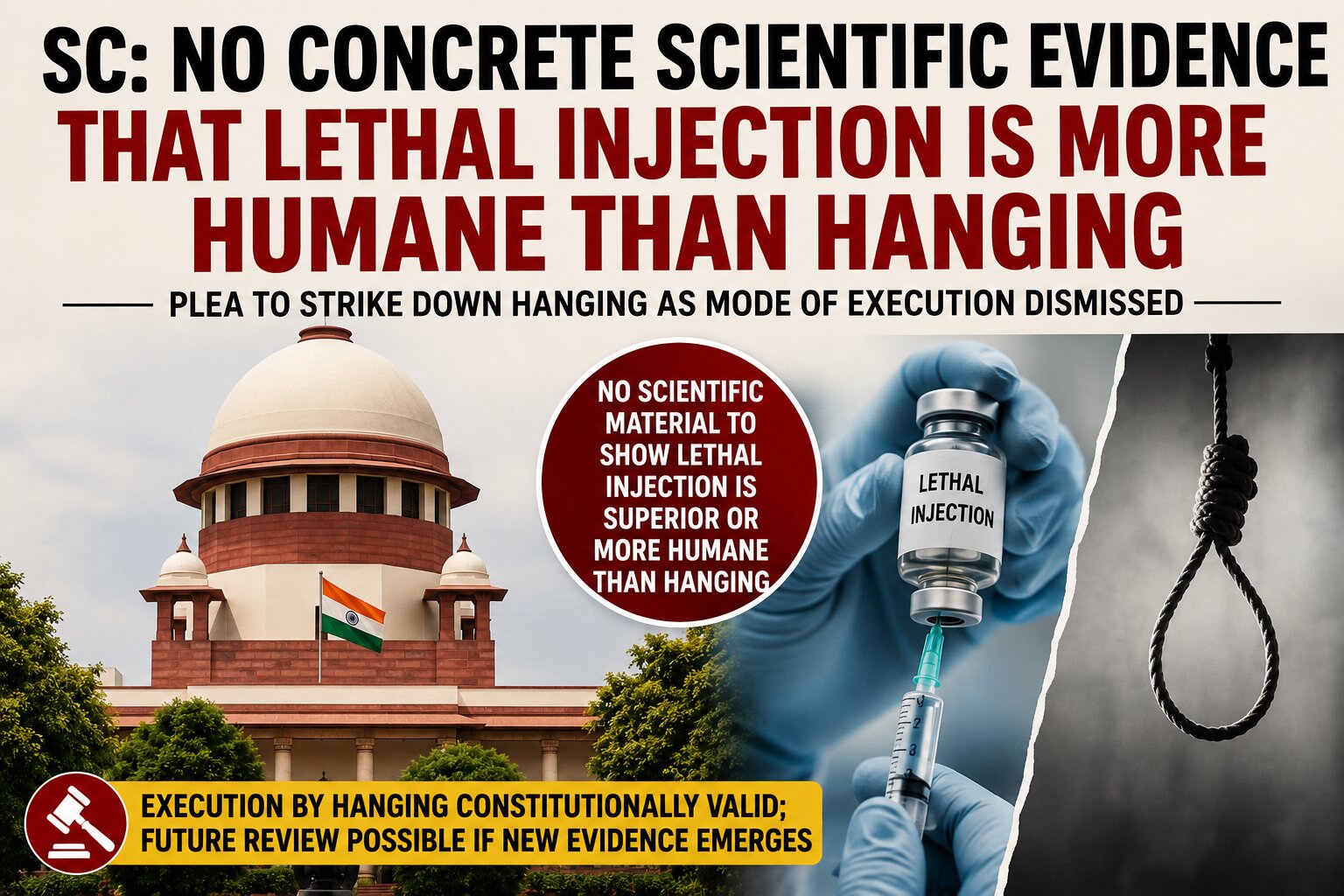
Hanging remains a constitutionally valid statutory method of executing death sentences.
Judgement Details
Court
Supreme Court of India
Date of Decision
20 August 2026
Judges
Justice Vikram Nath and Justice Sandeep Mehta
Citation
Acts / Provisions
Facts of the Case
-
The petitioner challenged the constitutional validity of Section 354(5) CrPC, which prescribes hanging as the method of execution of a death sentence.
-
The petitioner argued that execution by hanging is cruel, barbaric and inconsistent with the constitutional guarantee of dignity under Article 21.
-
He contended that lethal injection would constitute a more scientific, painless and humane method of execution.
-
The petitioner sought reconsideration of the Supreme Court's earlier decision in Deena v. Union of India (1983).
-
Project 39A, NLU Delhi placed scientific and empirical material before the Court concerning the difficulties and risks associated with lethal injection.
-
The material included evidence concerning botched executions in the United States.
-
The Union Government opposed the challenge and argued that there was no sufficient evidence establishing lethal injection as a superior method.
-
The Court examined whether subsequent scientific and constitutional developments had displaced the reasoning adopted in Deena.
-
The Court also considered whether the matter should be referred to a larger Bench.
Issues
-
Whether execution of a death sentence by hanging under Section 354(5) CrPC violates Articles 14 and 21 of the Constitution?
-
Whether hanging is demonstrably more cruel, painful or inhuman than alternative methods of executing a death sentence?
-
Whether lethal injection has been scientifically established as a more humane and reliable method of execution than hanging?
-
Whether the judgment in Deena v. Union of India requires reconsideration by a larger Bench in light of subsequent scientific and constitutional developments?
-
Whether the statutory prescription of hanging as the method of execution should be declared unconstitutional?
-
Whether the Union Government should undertake an expert review of alternative methods of execution?
Judgement
-
The Supreme Court dismissed the writ petition.
-
The Court declined to refer Deena v. Union of India to a larger Bench.
-
It held that there was no compelling scientific or empirical material establishing that lethal injection is demonstrably more humane than hanging.
-
The Court noted that the material placed before it actually demonstrated significant practical difficulties associated with lethal injection.
-
The Court held that Deena had already considered several alternative methods, including lethal injection, electrocution, lethal gas and shooting.
-
The petitioner failed to demonstrate that the factual foundation of Deena had been materially displaced.
-
The Court therefore found no sufficient basis to reconsider the constitutional validity of hanging.
-
The Court emphasized the importance of precedent and judicial discipline, particularly where the earlier decision was rendered by a larger Bench.
-
The Court nevertheless left open the possibility of future constitutional scrutiny if compelling new scientific or medical evidence becomes available.
-
The Union Government may also consider examining alternative methods through an appropriate expert mechanism.
Held
-
The petitioner failed to establish that hanging violates Articles 14 or 21.
-
There is presently insufficient scientific evidence to establish that lethal injection is demonstrably more humane than hanging.
-
The earlier decision in Deena remains binding and did not warrant reconsideration by a larger Bench.
-
A smaller Bench cannot depart from a larger Bench precedent without compelling justification.
-
The constitutional question may be reconsidered in the future if significant new scientific, medical or empirical evidence emerges.
-
The Union Government is not prevented from independently examining alternative execution methods.
-
The writ petition was dismissed.
Analysis
-
Article 21 and dignity: The case directly engages with the constitutional requirement that even the execution of a death sentence must comply with standards of dignity and fairness.
-
Scientific evidence was decisive: The Court did not simply assume that lethal injection is more humane because it is technologically newer. The petitioner was required to establish that proposition with reliable scientific and empirical evidence.
-
Lethal injection not proven superior: The evidence concerning failed executions and difficulties in administering lethal injection weakened the claim that it provides a consistently painless or reliable alternative.
-
Importance of precedent: Deena was decided by a three-Judge Bench. The present Bench emphasized that a smaller Bench should not unsettle an established larger-Bench precedent without compelling reasons.
-
No automatic acceptance of foreign practice: Evidence from other countries, particularly the United States, could inform the debate but did not by itself establish what method is constitutionally required in India.
-
Constitutional threshold: The judgment illustrates that demonstrating that a method may cause suffering is different from establishing that the method has become constitutionally impermissible.
-
Future review remains possible: The Court did not declare that hanging can never be reconsidered. A substantial change in scientific knowledge could potentially justify renewed constitutional scrutiny.
-
Role of the Government: The Court left room for the Union Government to conduct a comprehensive expert review of alternative methods while the existing statutory framework remains in force.
-
Significance under BNSS: Since Section 393(5) BNSS corresponds to Section 354(5) CrPC, the judgment continues to have direct relevance under India's current criminal procedure framework.