
Raziya Begum & Ors. v. Nafisa Begum Abdul Hamid & Ors., 2026
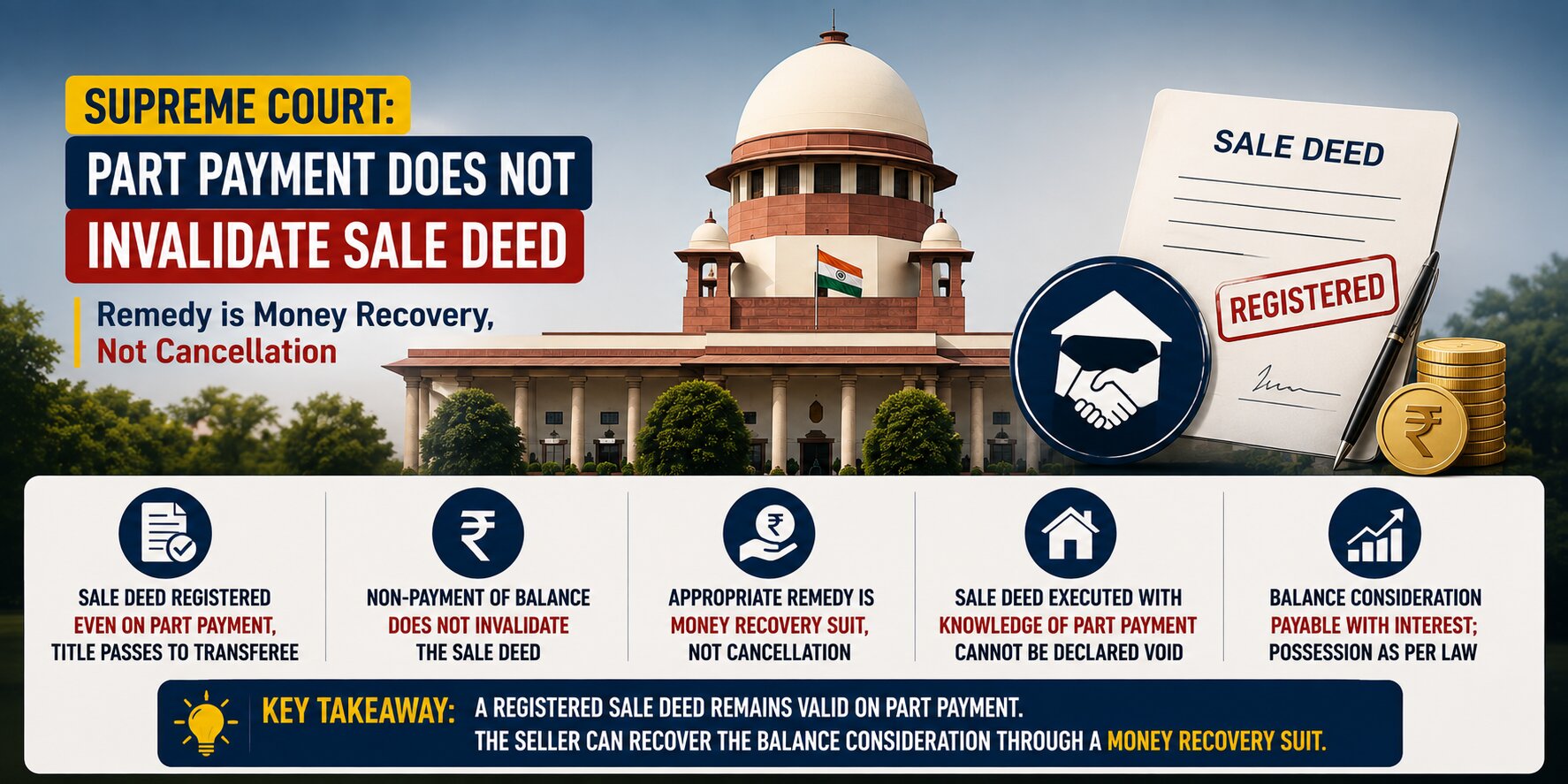
A registered sale deed does not become invalid merely because the entire sale consideration has not been paid at the time of execution.
Judgement Details
Court
Supreme Court of India
Date of Decision
6 August 2026
Judges
Justice J.B. Pardiwala & Justice K. Vinod Chandran
Citation
Acts / Provisions
Facts of the Case
-
The dispute arose out of two sale deeds executed by the original plaintiffs in favour of the original defendant.
-
The total sale consideration fixed for each property was ₹7,000.
-
At the time of execution of each sale deed, ₹2,500 was paid.
-
The remaining ₹4,500 for each property was retained for the purpose of settling dues payable by the plaintiffs to various financial institutions and government departments.
-
The sale deeds were executed and registered with knowledge that only part of the sale consideration had been paid directly.
-
The plaintiffs subsequently instituted a suit seeking a declaration that the sale deeds were void and inoperative.
-
They also sought cancellation of the sale deeds.
-
The plaintiffs further sought a declaration of their ownership over the properties.
-
A permanent injunction was also sought against the defendant.
-
The Trial Court dismissed the plaintiffs' suit.
-
The First Appellate Court affirmed the decision of the Trial Court.
-
The plaintiffs thereafter filed a second appeal before the Bombay High Court, Nagpur Bench.
-
The High Court interfered with the concurrent findings of the Trial Court and First Appellate Court.
-
The High Court's decision effectively treated the part-payment issue as affecting the validity of the sale deed.
-
The defendants challenged the High Court's decision before the Supreme Court.
-
The Supreme Court considered whether a registered sale deed becomes invalid merely because the entire sale consideration has not been paid at the time of execution.
-
The Supreme Court held that actual payment of the entire sale consideration at the time of execution is not necessary for completion of the sale.
-
The Court found that title could pass to the transferee upon registration of the sale deed even where only part of the consideration had been paid.
-
The Court held that the seller's remedy for non-payment of the remaining consideration is generally to recover the unpaid amount, rather than seek cancellation of the sale deed merely on that ground.
-
The Court restored the decision of the Trial Court.
-
The Court also clarified that the defendants would have to pay the remaining sale consideration with interest and could seek possession of the property if they desired.
-
The Court did not disturb the concurrent findings concerning the possession of the respondent-plaintiffs.
Issues
-
Whether a registered sale deed becomes invalid merely because the entire sale consideration has not been paid at the time of its execution?
-
Whether title to the property passes to the transferee when a sale deed is registered despite only part of the agreed sale consideration having been paid?
-
Whether non-payment of the balance sale consideration provides a ground for cancellation of a registered sale deed?
-
Whether the remedy of a seller for non-payment of the remaining sale consideration is a suit for recovery of money rather than cancellation of the sale deed?
-
Whether the Bombay High Court was justified in interfering with the concurrent findings of the Trial Court and First Appellate Court regarding the validity of the sale deeds?
-
Whether the purchasers are liable to pay the remaining sale consideration with interest despite the validity of the registered sale deeds?
Judgement
-
The Supreme Court allowed the appeal filed by the defendants.
-
The Court set aside the Bombay High Court's judgment.
-
The Court restored the decision of the Trial Court, which had dismissed the plaintiffs' suit.
-
The Court held that registration of a sale deed can result in the passing of title even where only part of the sale consideration has been paid.
-
The Court held that non-payment of the remaining sale consideration does not by itself invalidate the registered sale deed.
-
The Court rejected the proposition that the sellers could seek cancellation of the sale deed merely because the balance consideration had not been paid.
-
The Court held that the appropriate remedy against non-payment of the balance amount is a money recovery suit.
-
The Court observed that the sale deed had been executed with full knowledge that only part of the consideration had been paid.
-
The promise to pay the remaining consideration had also been incorporated into the sale deed.
-
Therefore, the failure to fulfil that promise did not make the sale deed void or inoperative.
-
The Court clarified that the defendants would have to pay the balance sale consideration along with interest.
-
If the defendants desired possession of the property, they could seek it in accordance with law.
-
The Court did not interfere with the findings of the Trial Court and First Appellate Court concerning the possession of the respondent-plaintiffs.
Held
- Where a sale deed is registered after part payment of the sale price, title can pass to the transferee.
-
Non-payment of the remaining sale consideration does not, by itself, justify cancellation of the sale deed.
-
The seller's appropriate remedy for unpaid balance consideration is to pursue recovery of the balance amount.
-
A registered sale deed executed with knowledge of part-payment cannot ordinarily be declared void merely because the promised balance payment was subsequently not made.
-
The obligation to pay the balance consideration creates a monetary claim, rather than automatically invalidating the transfer.
-
The purchasers remain liable to pay the balance consideration with interest.
-
The Supreme Court restored the Trial Court's decision and rejected the High Court's interference with the concurrent findings.
-
The appeal was therefore allowed.
Analysis
-
Part-payment does not automatically invalidate sale: The principal legal principle is that payment of the entire sale consideration at the precise moment of execution is not, by itself, essential to make a registered sale effective.
-
Passing of title: The Court emphasized that once the sale deed is registered, title can pass to the transferee even though part of the agreed consideration remains unpaid.
-
Debt versus validity of sale: The judgment distinguishes between the validity of the transfer and the purchaser's obligation to pay money. Failure to pay the remaining amount creates a monetary claim but does not automatically undo the completed transfer.
-
Proper remedy is recovery: The seller's remedy for unpaid consideration is to seek recovery of the balance amount, rather than treating the registered sale deed as void solely because the purchaser has not paid the entire consideration.
-
Cancellation is not the appropriate consequence: The Court rejected cancellation of the sale deed as the appropriate remedy in circumstances where the parties knowingly executed the registered instrument after part payment and the remaining payment obligation was incorporated into the deed.
-
Importance of the parties' knowledge: The Court specifically noted that the sale deeds were executed with full knowledge that only part of the consideration had been paid. This was important to the Court's conclusion that the deeds could not subsequently be treated as void merely because the balance remained unpaid.
-
Contractual promise to pay: The remaining consideration was promised in the sale deed itself. The Court treated the failure to fulfil that promise as an obligation capable of enforcement through monetary recovery.
-
Concurrent findings: The Trial Court and First Appellate Court had both rejected the plaintiffs' challenge. The Supreme Court restored those findings after finding that the High Court had improperly interfered with them.
-
Interest on balance amount: Although the sale deed remained valid, the purchasers were not relieved of their financial obligation. The Court clarified that the balance consideration would have to be paid with interest.
-
Possession remains separate: The Court did not disturb the existing position regarding possession of the property. Thus, validity of the sale deed and entitlement to immediate possession were treated as distinct matters.
-
Practical significance: The judgment provides an important distinction for property disputes: non-payment of sale consideration and invalidity of the sale are not necessarily the same thing.
-
Overall significance: The decision reinforces the principle that a registered sale deed should not ordinarily be cancelled merely because part of the consideration remains unpaid. The appropriate remedy is to enforce the monetary obligation and recover the unpaid balance.