
Ravi Kant Gupta v. State of Uttar Pradesh & Ors., 2026
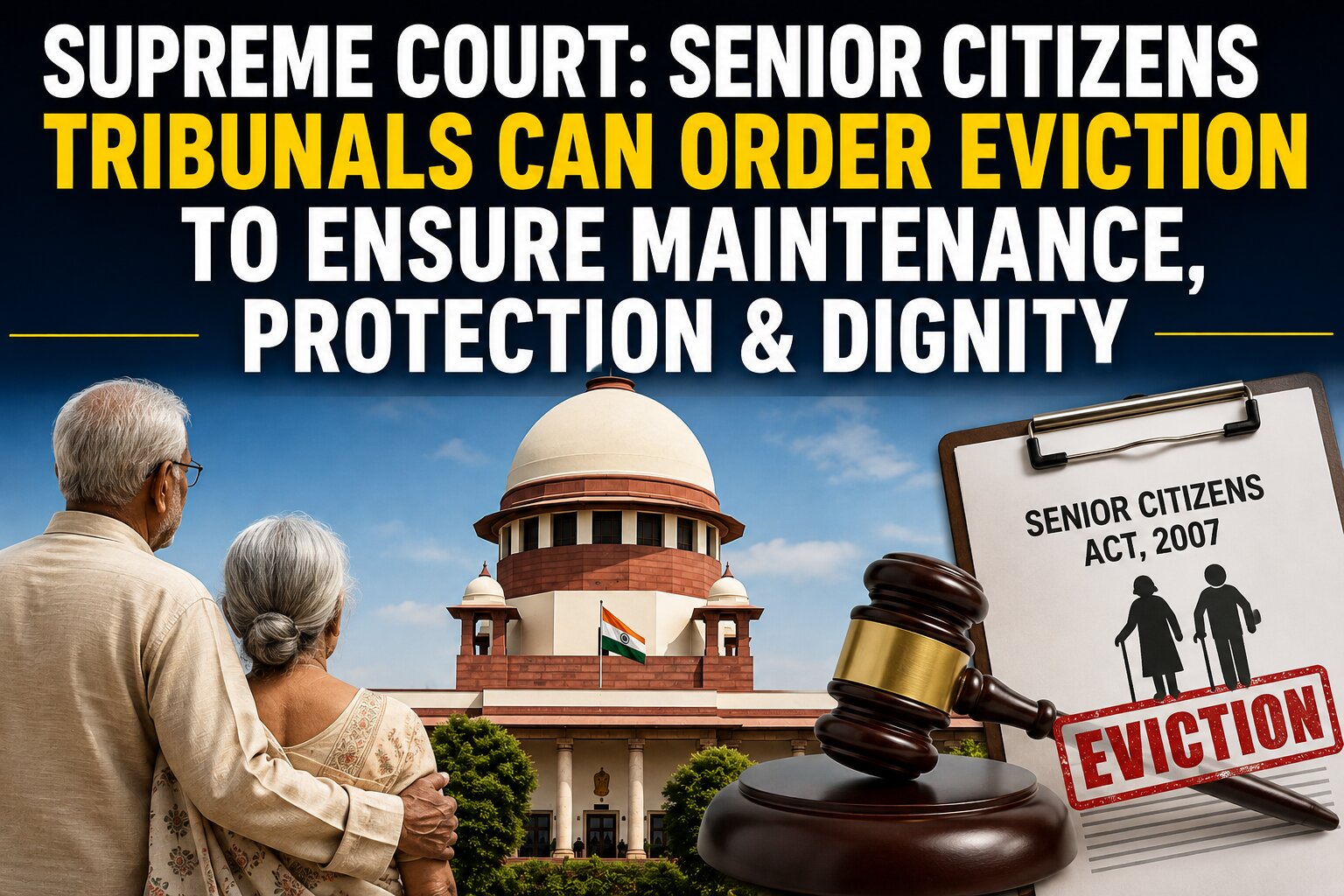
A Senior Citizens Tribunal can order eviction of children from a parent's property when eviction is necessary to ensure the parent's maintenance, protection and dignity.
Judgement Details
Court
Supreme Court of India
Date of Decision
20 August 2026
Judges
Justice Pamidighantam Sri Narasimha and Justice Alok Aradhe
Citation
Acts / Provisions
Facts of the Case
-
Ravi Kant Gupta was the owner of a residential property in Vikas Nagar, Lucknow.
-
His mother, aged about 81 years, was allegedly forced to leave the property and reside in an old-age facility.
-
Gupta approached the District Magistrate under the 2007 Act seeking eviction of his son from the property.
-
The Sub-Divisional Magistrate found that the property was Gupta's self-acquired property.
-
The SDM also recorded that the son had not permitted his grandmother to stay in the house and had created nuisance.
-
The SDM directed eviction of the son.
-
The District Magistrate subsequently affirmed the eviction order and directed the son and daughter-in-law to hand over possession.
-
The son and daughter-in-law challenged the orders before the Allahabad High Court.
-
The High Court relied upon its earlier decision and held that authorities under the Senior Citizens Act did not have the power to order eviction.
-
The High Court consequently quashed the eviction orders.
-
Gupta approached the Supreme Court challenging the High Court's decision.
Issues
-
Whether a Maintenance Tribunal constituted under the Maintenance and Welfare of Parents and Senior Citizens Act, 2007 has the power to order eviction of children from a senior citizen's property?
-
Whether eviction of children can be ordered when such eviction is necessary for the maintenance and protection of a senior citizen?
-
Whether the powers conferred upon the Tribunal under Sections 7 and 8 of the Act include the incidental power to order eviction?
-
Whether the Allahabad High Court was justified in holding that the Senior Citizens Act does not empower the authorities to order eviction?
-
Whether the Tribunal's power to protect a senior citizen's maintenance and dignity can extend to directing removal of persons causing hardship or obstruction?
Judgement
-
The Supreme Court allowed the appeal.
-
It set aside the Allahabad High Court's judgment and review order.
-
The Court restored the eviction orders passed by the authorities under the Senior Citizens Act.
-
It held that the Tribunal constituted under the Act has the power to order eviction where such eviction is necessary to ensure the maintenance or protection of a senior citizen.
-
The Court relied upon Sections 7 and 8, which confer jurisdiction and inquiry powers upon the Tribunal.
-
It observed that when legislation confers jurisdiction upon a statutory authority, it also carries the incidental powers necessary to effectively exercise that jurisdiction.
-
The Court relied upon earlier decisions, including S. Vanitha v. Deputy Commissioner, Samtola Devi v. State of U.P., and Kamalakant Mishra v. Additional Collector.
-
The Court held that the Allahabad High Court's reliance on its earlier contrary view was misconceived.
-
The eviction orders were consequently restored.
Held
-
Senior Citizens Tribunals have the power to order eviction of children or other occupants where necessary to protect the senior citizen.
-
Such eviction is an incident of enforcing the senior citizen's right to maintenance and protection.
-
The power is not an unrestricted power to evict children in every dispute.
-
The Tribunal must connect the eviction with the statutory objective of maintenance, protection and welfare of the senior citizen.
-
Sections 7 and 8 provide the Tribunal with the necessary jurisdiction and procedural powers.
-
The Supreme Court restored the eviction orders against the son and daughter-in-law.
-
The appeal was allowed without any order as to costs.
Analysis
-
Purpose of the Act: The Court treated the Senior Citizens Act as welfare legislation intended to provide an effective and speedy remedy to elderly persons facing neglect, insecurity or indignity.
-
Incidental powers: The important legal principle is that when a statute grants jurisdiction to a Tribunal, it implicitly grants powers necessary to make that jurisdiction effective. The Tribunal's authority to protect a senior citizen would be substantially weakened if it could not remove an occupant whose presence defeats that protection.
-
Eviction is not an independent right: The judgment should not be read as creating an automatic right for every parent to evict a child. Eviction must be connected with the statutory purpose of ensuring the senior citizen's maintenance or protection.
-
Protection and dignity: The Court placed the statutory scheme within the constitutional framework of Article 21 and emphasized the elderly person's right to live with dignity and security.
-
Civil court jurisdiction: Section 27 expressly bars the jurisdiction of civil courts in matters covered by the Act. This reinforces the need for the Tribunal to possess sufficient powers to effectively enforce the rights created by the legislation.
-
Earlier Supreme Court precedent: The Court followed the principle expressed in S. Vanitha that eviction may be ordered where it is necessary and expedient to ensure the maintenance and protection of a senior citizen.
-
Correction of conflicting High Court view: The Supreme Court expressly rejected the Allahabad High Court's contrary interpretation and restored the statutory authorities' eviction orders.
-
Welfare-oriented interpretation: The judgment adopts a purposive interpretation rather than a narrowly technical reading of the Tribunal's powers.
-
Balance of rights: Although children may have legitimate claims concerning residence or property, those claims cannot override the statutory protection available to a senior citizen where the statutory conditions for eviction are satisfied.