
Rashmirekha Tripathy & Anr. v. The Branch Manager (Legal Claims), Sriram General Insurance Company Limited & Ors., 2026
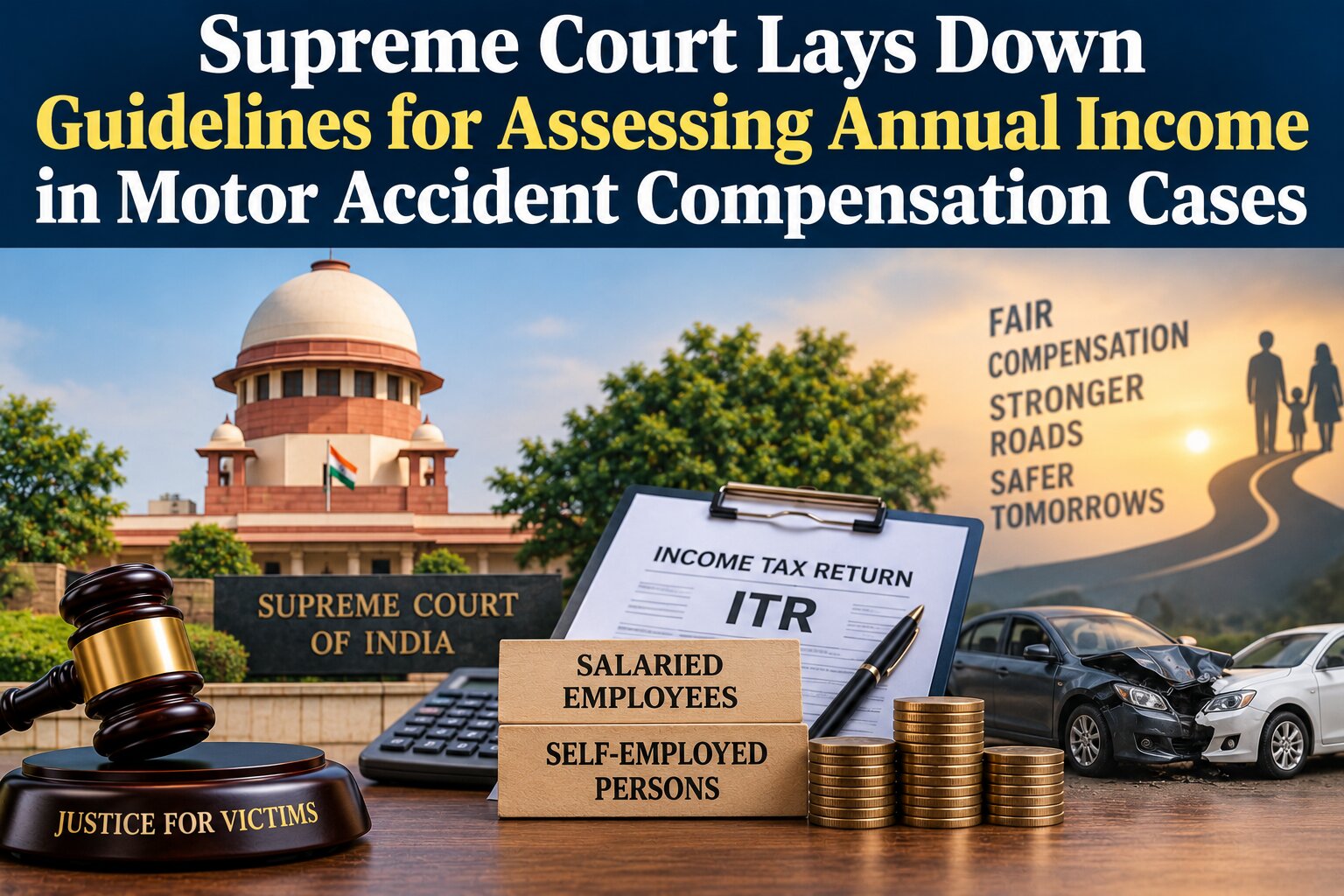
There must be a clear bifurcation between salaried and self-employed persons when determining annual income for motor accident compensation.
Judgement Details
Court
Supreme Court of India
Date of Decision
5 August 2026
Judges
Justice Sanjay Karol and Justice Nongmeikapam Kotiswar Singh
Citation
Acts / Provisions
Facts of the Case
- The Supreme Court was dealing with a batch of motor accident compensation appeals concerning the appropriate method for determining the annual income of deceased victims where Income Tax Returns (ITRs) were available.
-
The lead appeal arose from the death of Manoranjan Pandey, a 39-year-old self-employed person running a construction business, who died in a road accident on 29 May 2018.
-
The Motor Accident Claims Tribunal awarded compensation based on the deceased's income, while the High Court adopted a different approach and averaged available ITRs.
-
Similar inconsistencies arose in the other appeals involving self-employed persons, with different courts relying on either the latest ITR or averages of multiple years.
-
The Supreme Court therefore considered whether the previous year's ITR or an average of the previous two or three years' ITRs should ordinarily be used for determining annual income.
-
The Court recognised that a uniform approach would not be appropriate for salaried employees and self-employed persons because their income patterns are materially different.
Issues
-
Whether the immediately preceding year's ITR should ordinarily be used to determine the annual income of a salaried employee for motor accident compensation?
-
Whether the average income reflected in up to three preceding years' ITRs should ordinarily be considered for self-employed persons and business owners?
-
Whether surrounding circumstances of the business, including its nature, growth pattern and potential profitability, should be considered while determining the income of a self-employed deceased?
-
Whether an ITR filed after the death of the deceased can be relied upon for determining annual income, and what safeguards should be applied in such cases?
-
Whether the compensation awarded in the three appeals required modification in light of a consistent methodology for assessment of annual income?
Judgement
-
The Supreme Court laid down a distinct methodology for salaried and self-employed persons while determining annual income for motor accident compensation.
-
For salaried individuals, the Court held that the ITR of the immediately preceding assessment year would ordinarily be sufficient to establish annual salary income.
-
Where a promotion or salary revision occurred shortly before the accident and was not fully reflected in the preceding ITR, the Court may consider the promotion letter and other corroborative financial material.
-
For self-employed persons and business owners, the Court held that the average income reflected in the ITRs of up to the previous three years should ordinarily be taken as the reference point.
-
The Court held that this three-year approach is subject to the surrounding circumstances of the business and the evidence available in each case.
-
Relevant considerations include the nature and location of the business, growth pattern, impact of the deceased's death, future growth potential, initial losses and other relevant financial circumstances.
-
The Court also cautioned that ITRs filed after the death of the deceased require careful scrutiny, particularly where there is a possibility of income being artificially enhanced.
-
Applying these principles, the Supreme Court modified the compensation awards in the three appeals.
Held
-
For a salaried employee, the immediately preceding year's ITR should ordinarily be considered.
-
For a self-employed person or business owner, the average income reflected in up to the preceding three years' ITRs should ordinarily be used.
-
The three-year average is not an inflexible mathematical formula; tribunals must consider the surrounding circumstances of the business.
-
Relevant circumstances include the nature of business, geographical location, growth pattern, impact of death, future earning potential and initial business losses.
-
An ITR filed after the death of the deceased is not automatically inadmissible, but its contents should be examined against supporting financial material and surrounding circumstances.
-
The ultimate objective under the Motor Vehicles Act is to determine just and fair compensation, and the income assessment must therefore reflect the deceased's realistic earning capacity rather than merely apply a mechanical formula.
Analysis
-
The judgment provides an important degree of uniformity in MACT proceedings, where tribunals had previously adopted inconsistent methods for calculating income from ITRs.
-
The Supreme Court correctly distinguished salaried employment from self-employment. Salaries generally have greater predictability, whereas business income may fluctuate substantially from year to year.
-
For salaried persons, the latest available ITR ordinarily gives the most relevant indication of income immediately before the accident, particularly because promotions and increments may significantly change earning capacity.
-
For business owners, relying exclusively on a single year's return may produce an artificially high or low figure. The three-year average provides a more balanced reference point while still allowing courts to examine the specific circumstances.
-
Importantly, the Court did not make the three-year average an absolute rule. Factors such as business expansion, initial losses, geographical conditions and the effect of the deceased's death on the enterprise can justify departure from a simple average.
-
The judgment also addresses the problem of post-death ITRs. Such returns cannot be rejected automatically, but courts must examine whether the income declared is supported by financial statements and other evidence.
-
The approach ultimately seeks to ensure that compensation reflects the deceased's actual and reasonably foreseeable earning capacity, rather than being determined through an arbitrary or inconsistent calculation.
-
The ruling is particularly significant because income assessment directly affects the multiplier-based computation of loss of dependency and, consequently, the overall compensation payable to the victim's family.
-
By establishing differentiated principles while preserving judicial discretion based on surrounding circumstances, the Supreme Court has created a more consistent yet flexible framework for determining income in motor accident claims.