
Rapti v. State of Uttarakhand & Another, 2026
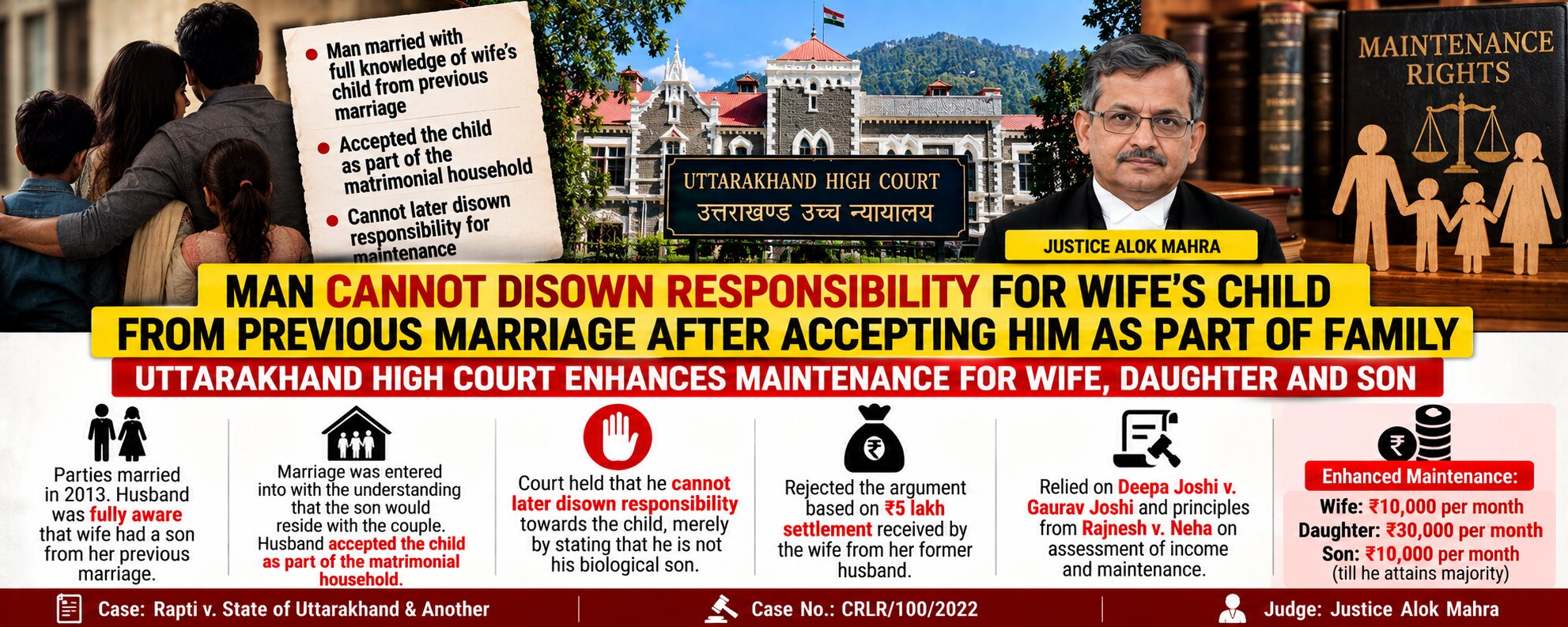
A settlement between the wife and her former husband could not, by itself, absolve the respondent of the responsibility he had assumed in the subsequent matrimonial relationship.
Judgement Details
Court
Uttarakhand High Court
Date of Decision
29 September 2026
Judges
Justice Alok Mahra
Citation
Acts / Provisions
Facts of the Case
-
The revisionist-wife had married the respondent in 2013.
-
At the time of the marriage, the respondent was fully aware that the wife had a son from her previous marriage.
-
The marriage was entered into with the understanding that the wife's son would reside with the couple.
-
The son consequently became part of the matrimonial household and lived with the parties as a member of the family.
-
The wife and her children sought maintenance from the respondent.
-
The Family Court, Haridwar awarded ₹8,000 per month to the wife and ₹6,000 per month to the minor daughter.
-
The Family Court, however, denied maintenance to the son, primarily on the ground that the respondent was not his biological father.
-
The wife and children challenged the Family Court's order before the Uttarakhand High Court.
-
The revisionists contended that the respondent had knowingly married the wife with full knowledge of the son's existence and had voluntarily accepted the child as part of the matrimonial household.
-
It was therefore argued that the respondent could not subsequently avoid responsibility towards the child merely by asserting that he was not the child's biological father.
-
The revisionists also relied upon the respondent's November 2025 salary slip, which showed a gross salary of approximately ₹2,01,843 and a net salary of approximately ₹1,06,654 after deductions.
-
They argued that certain deductions should not be treated as reducing the respondent's effective income for determining maintenance.
-
The wife contended that the respondent's effective monthly income was more than ₹1.50 lakh and that the maintenance awarded by the Family Court was therefore inadequate.
-
The respondent argued that the wife was herself employed and earned approximately ₹55,000–₹58,000 per month.
-
He also contended that the wife was residing in a flat owned by him and had voluntarily withdrawn from his company.
-
With respect to the daughter, the respondent argued that the responsibility of maintaining a minor child rested upon both parents.
-
The respondent further relied upon a ₹5 lakh settlement allegedly received by the wife from her former husband towards her stridhan and the maintenance of the son.
Issues
-
Whether a man who knowingly marries a woman having a child from a previous marriage and accepts that child as part of the matrimonial household can subsequently evade responsibility towards the child's maintenance merely because he is not the biological father?
-
Whether the respondent's knowledge of the child's existence and his voluntary acceptance of the child into the matrimonial household are relevant circumstances in determining his responsibility towards the child's maintenance?
-
Whether a settlement between the wife and her former husband can, by itself, absolve the respondent from the responsibility voluntarily undertaken towards the wife's child after the subsequent marriage?
-
Whether the Family Court was justified in denying maintenance to the son solely on the ground that the respondent was not his biological father?
-
Whether the maintenance awarded to the wife and daughter required enhancement in view of the respondent's disclosed income, assets, liabilities and overall financial capacity?
-
Whether deductions from the respondent's salary could substantially reduce his assessable income where such deductions related to liabilities or repayments that did not take precedence over his maintenance obligations?
Judgement
-
The Uttarakhand High Court allowed the criminal revision and modified the Family Court's order.
-
The Court held that the respondent's knowledge of the son's existence at the time of marriage was a significant circumstance.
-
The Court noted that the marriage had been solemnised with the understanding that the wife's son would reside with the couple.
-
Having knowingly entered into the matrimonial relationship and accepted the child as part of the matrimonial household, the respondent could not subsequently seek to completely disown the responsibility he had voluntarily undertaken towards the child.
-
The Court rejected the argument that the child's lack of biological relationship with the respondent, by itself, justified denying maintenance.
-
The subsequent assertion that the son was not the respondent's biological child could not, by itself, provide sufficient justification for completely abandoning responsibility towards the child's maintenance.
-
The High Court held that the Family Court had erred in denying maintenance to the son solely on the ground of biological parentage.
-
The Court also rejected the respondent's reliance upon the ₹5 lakh settlement between the wife and her former husband.
-
According to the High Court, an arrangement between the wife and her former husband could not, by itself, extinguish the responsibility voluntarily assumed by the respondent after marrying the wife with full knowledge of her existing child.
-
The Court further examined the respondent's income and financial capacity.
-
It considered the salary slip showing gross earnings of approximately ₹2,01,843 per month and examined the deductions claimed by the respondent.
-
The Court relied upon the principles stated in Deepa Joshi v. Gaurav Joshi concerning the primary and continuing obligation to maintain one's spouse.
-
The Court also considered the affidavits relating to assets, income and liabilities filed by the parties in accordance with the principles laid down in Rajnesh v. Neha.
-
The High Court found that the respondent did not have any substantial independent liability that materially impaired his ability to pay maintenance.
-
The Court consequently found the maintenance awarded by the Family Court to the wife and daughter to be on the lower side.
-
The High Court enhanced the wife's maintenance from ₹8,000 to ₹10,000 per month.
-
The maintenance payable to the minor daughter was enhanced from ₹6,000 to ₹30,000 per month.
-
The Court directed that the son would receive ₹10,000 per month from the date of filing of the maintenance application until he attains majority.
Held
-
A person who knowingly enters into a marriage with a woman having a child from a previous marriage and accepts that child as part of the matrimonial household cannot subsequently rely solely on the absence of biological parentage to completely disown the responsibility voluntarily undertaken towards the child.
-
The respondent's knowledge of the son's existence at the time of marriage was a material circumstance.
-
The fact that the son was to reside with the couple as part of the matrimonial household was also significant.
-
The respondent's subsequent plea that the child was not his biological son could not, by itself, justify complete denial of maintenance.
-
The Family Court therefore erred in refusing maintenance to the son solely because the respondent was not his biological father.
-
The financial capacity of the person liable to pay maintenance must be assessed on the basis of relevant income, assets and liabilities.
-
Salary deductions cannot automatically be treated as reducing assessable income where the underlying liabilities do not take precedence over the statutory obligation to maintain dependants.
-
The principles in Rajnesh v. Neha require proper disclosure and consideration of income, assets and liabilities while determining maintenance.
-
The Family Court's award to the wife and daughter was inadequate in light of the respondent's disclosed financial circumstances.
-
The revised maintenance was fixed at:
-
Wife — ₹10,000 per month
-
Minor daughter — ₹30,000 per month
-
Son — ₹10,000 per month until attaining majority
-
Analysis
-
The judgment demonstrates that maintenance disputes involving children from previous marriages may require examination of the actual circumstances of the subsequent matrimonial relationship.
-
It also reinforces that financial obligations cannot be determined solely by looking at formal relationships while ignoring the conduct and arrangements voluntarily undertaken by the parties.
-
At the same time, the decision is fact-specific. The Court's reasoning turned significantly upon the respondent's knowledge of the child, the understanding that the child would reside with the couple, and his acceptance of the child within the matrimonial household.
-
The judgment emphasizes the importance of conduct, knowledge and voluntary acceptance when determining maintenance responsibility in a subsequent matrimonial relationship.
-
It prevents a person from relying solely upon the absence of biological parentage to disregard circumstances in which he knowingly accepted a child as part of his matrimonial family.
-
It reinforces the principle that a former spouse's settlement cannot automatically extinguish obligations arising from a subsequent matrimonial relationship.
-
It also strengthens the requirement that maintenance awards should reflect the payer's actual financial capacity, rather than merely the amount of net salary after every claimed deduction.
-
The decision reinforces the importance of financial disclosure under Rajnesh v. Neha in maintenance proceedings.