
Ranchhodbhai Jesingbhai Since Dead Through His Heirs and LRs & Ors. v. Anchhibhai Kavjibhai Chaudhari Since Dead Through His Heirs and LRs & Ors., 2026
Succession rights of a Scheduled Tribe woman over property inherited from her husband and her ability to dispose of such property by Will.
Judgement Details
Court
High Court of Gujarat
Date of Decision
16 September 2026
Judges
Justice Maulik J. Shelat
Citation
Acts / Provisions
Facts of the Case
-
The original plaintiff claimed to be the brother of Chhaniben, a woman belonging to the Scheduled Tribe community.
-
Chhaniben died issueless on 15 July 1991.
-
Chhaniben was married to Jivlabhai, who held agricultural lands by way of tenancy rights.
-
Jivlabhai died issueless before Chhaniben.
-
Following the death of her husband, Chhaniben, being his widow, inherited the properties in question.
-
Her name was consequently entered in the relevant revenue records in respect of the agricultural properties.
-
The plaintiff claimed that Chhaniben had earlier executed a registered Will dated 24 July 1972 in favour of the plaintiff's son, Raysangbhai.
-
However, the alleged 1972 Will was not brought on record before the Court.
-
Subsequently, Chhaniben executed another registered Will dated 1 July 1991 in favour of the defendant.
-
Through this Will, Chhaniben purported to bequeath the agricultural properties in question to the defendant.
-
The plaintiff instituted a suit in 2002 seeking declaration and injunction against the defendant.
-
The plaintiff contended that Chhaniben did not have the legal authority to execute the Will in favour of the defendant.
-
The plaintiff claimed that, as the brother of Chhaniben, he was entitled to inherit the properties under the alleged customary rule of survivorship.
-
The plaintiff therefore sought a declaration that he was the sole owner of the suit properties.
-
The plaintiff also sought a declaration that the Will executed by Chhaniben in favour of the defendant was illegal and ineffective.
-
The plaintiff claimed that he belonged to the Scheduled Tribe/Chaudhari community and therefore the Hindu Succession Act did not apply to the parties because of Section 2(2) of the Act.
-
The Trial Court examined whether the plaintiff had established the alleged custom under which the property of an issueless tribal widow would devolve upon her brother.
-
The Trial Court found that the plaintiff had failed to plead and prove such a custom.
-
The Trial Court nevertheless considered the principles of old Hindu law because the Hindu Succession Act was not applicable to the parties.
-
According to the Trial Court, under the applicable principles of old Hindu law, where a widow died issueless after inheriting property from her husband, the property would pass to the next heir of the male from whom she had inherited the property.
-
The Trial Court noted that Kavlabhai, the elder brother of Chhaniben's husband Jivlabhai, was alive when Chhaniben died.
-
Kavlabhai was therefore considered a relevant reversioner under the principles applied by the Trial Court.
-
The Trial Court consequently rejected the plaintiff's claim that he was entitled to become the sole owner by survivorship.
-
The Trial Court also declined to accept the plaintiff's challenge to Chhaniben's Will.
-
The matter ultimately came before the Gujarat High Court in the present second appeal.
-
The High Court examined the applicability of the Hindu Succession Act, the alleged tribal custom, Chhaniben's ownership of the property and the validity and effect of the Will executed by her.
Issues
-
Whether a Scheduled Tribe woman who inherits property from her deceased husband acquires such property as her own property in the absence of a proved customary restriction upon her rights?
-
Whether the exclusion contained in Section 2(2) of the Hindu Succession Act, 1956 prevented the parties from relying upon the statutory rules of succession contained in the Act in the absence of a notification issued by the Central Government?
-
Whether the plaintiff had proved the existence of a customary rule among the relevant tribal community under which the property of an issueless widow inherited from her husband devolved upon her brother by survivorship?
-
Whether Chhaniben, having inherited the suit properties from her deceased husband, was legally competent to execute a Will bequeathing those properties to the defendant?
-
Whether the existence of the deceased husband's elder brother, Kavlabhai, affected the plaintiff's claim to ownership of the suit properties under the alleged doctrine of survivorship?
-
Whether the registered Will dated 1 July 1991 executed by Chhaniben in favour of the defendant was legally effective in the absence of any proved custom prohibiting Chhaniben from disposing of the inherited property by Will?
-
Whether the appeal challenging the concurrent findings of the courts below disclosed any substantial ground warranting interference by the High Court?
-
Whether the State Government should initiate steps for issuance of an appropriate notification under Section 2(2) of the Hindu Succession Act to provide a clear framework for succession to the property of Scheduled Tribe members who die intestate?
Judgement
-
The Gujarat High Court dismissed the second appeal.
-
The Court found no sufficient ground to interfere with the findings of the courts below concerning the plaintiff's claim to ownership of the properties.
-
The Court noted that Section 2(2) of the Hindu Succession Act excludes Scheduled Tribe members from the operation of the Act unless the Central Government issues an appropriate notification.
-
In the circumstances of the case, the Hindu Succession Act was therefore not applicable to the parties.
-
The Court considered whether the plaintiff could nevertheless establish a customary rule under which an issueless tribal widow's property inherited from her husband would pass exclusively to her brother.
-
The Court found that the plaintiff had neither specifically pleaded nor proved such a custom.
-
The Court noted that no evidence had been produced establishing a customary rule under which a widowed sister's property would necessarily pass to her birth family or brother.
-
The Court observed that the defendant's evidence indicated that the relevant community followed Hindu traditions.
-
The Court further noted that Chhaniben had inherited the properties from her husband.
-
Once Chhaniben inherited the properties from her husband, the Court treated the property as having become her self-acquired property in the circumstances of the case.
-
The Court found no proved customary restriction preventing Chhaniben from disposing of her property through a Will.
-
The registered Will dated 1 July 1991 in favour of the defendant had been duly proved before the Trial Court.
-
The defendant consequently derived the suit properties through the Will.
-
The Court also noted that the defendant's name had subsequently been mutated in the revenue records without objection.
-
The Court considered the fact that Kavlabhai, the elder brother of Chhaniben's husband, was alive when Chhaniben died.
-
Since no custom had been established under which the property of an issueless widow would pass exclusively to her birth family, the plaintiff could not claim the property merely because he was Chhaniben's brother.
-
The Court therefore upheld the conclusion that the plaintiff had no right to challenge the Will or claim sole ownership through survivorship.
-
The appeal was consequently dismissed.
-
Before concluding the matter, the Court made an important observation concerning the broader statutory position applicable to Scheduled Tribe women.
-
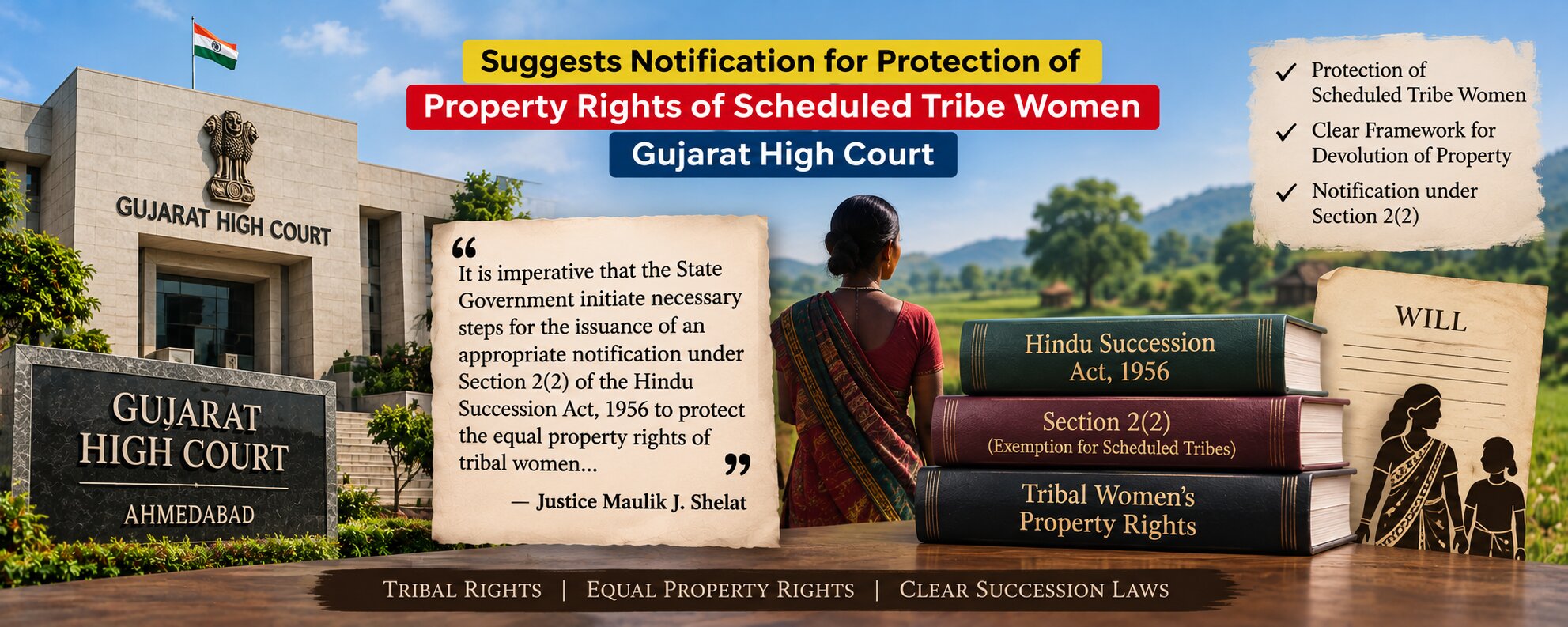
The Court suggested that the State Government should consider initiating appropriate steps for issuance of a notification by the Central Government under Section 2(2) of the Hindu Succession Act.
-
The Court observed that such a measure could help provide a clearer framework for devolution of property of Scheduled Tribe members who die intestate, particularly members of tribes following Hindu traditions.
Held
-
A Scheduled Tribe woman is not automatically deprived of ownership rights merely because the Hindu Succession Act does not apply to her community.
-
In the present case, Chhaniben had inherited the property from her deceased husband.
-
The High Court treated the property inherited by Chhaniben as her own property, in the absence of a proved customary restriction.
-
The plaintiff failed to establish a custom under which an issueless widow's inherited property necessarily devolved upon her brother.
-
The plaintiff therefore could not claim ownership merely by relying upon the alleged rule of survivorship.
-
The existence of Chhaniben's husband's elder brother, Kavlabhai, further undermined the plaintiff's claim under the principles of succession considered by the Trial Court.
-
Chhaniben was not shown to be legally prohibited by any proved custom from executing a Will concerning her property.
-
The registered Will dated 1 July 1991 in favour of the defendant was duly proved.
-
The defendant therefore acquired the suit properties through the Will.
-
The plaintiff's challenge to the Will and claim of sole ownership were consequently rejected.
-
The second appeal was dismissed.
-
The High Court additionally suggested that appropriate steps be taken towards a Central Government notification under Section 2(2) of the Hindu Succession Act to clarify succession rights concerning Scheduled Tribe members, particularly tribal women and persons following Hindu traditions.
Analysis
-
The Court's reasoning principally turned on the interaction between statutory succession law and customary law applicable to Scheduled Tribes.
-
Section 2(2) of the Hindu Succession Act excludes Scheduled Tribes from the Act's operation unless the Central Government directs otherwise through notification.
-
Therefore, the Court could not simply apply the ordinary statutory succession provisions of the Hindu Succession Act to the parties.
-
The plaintiff attempted to overcome this difficulty by relying upon an alleged customary rule of survivorship.
-
However, the Court found that the plaintiff had failed to specifically plead and prove the existence of such a custom.
-
A claim based upon custom cannot succeed merely because the claimant asserts that the custom exists. The existence and applicability of the alleged custom must be established through appropriate pleadings and evidence.
-
The Court therefore rejected the plaintiff's claim that being Chhaniben's brother automatically made him the owner of the property.
-
The Court also considered the source from which Chhaniben had acquired the property.
-
The property had originally been held by her husband, Jivlabhai, and Chhaniben had inherited it following his death.
-
In the absence of a proved restriction preventing her from dealing with the property, the Court treated her interest as her own property.
-
Consequently, the Court found no established legal or customary prohibition against her executing a Will.
-
The registered Will in favour of the defendant had also been proved before the Trial Court.
-
Therefore, the Court concluded that the defendant's title derived from the Will could not be displaced merely through the plaintiff's assertion of survivorship.