
Ramlaxman Meena v. State of Rajasthan & Ors., 2026
A spouse is not automatically liable for the financial or legal liabilities of the other spouse.
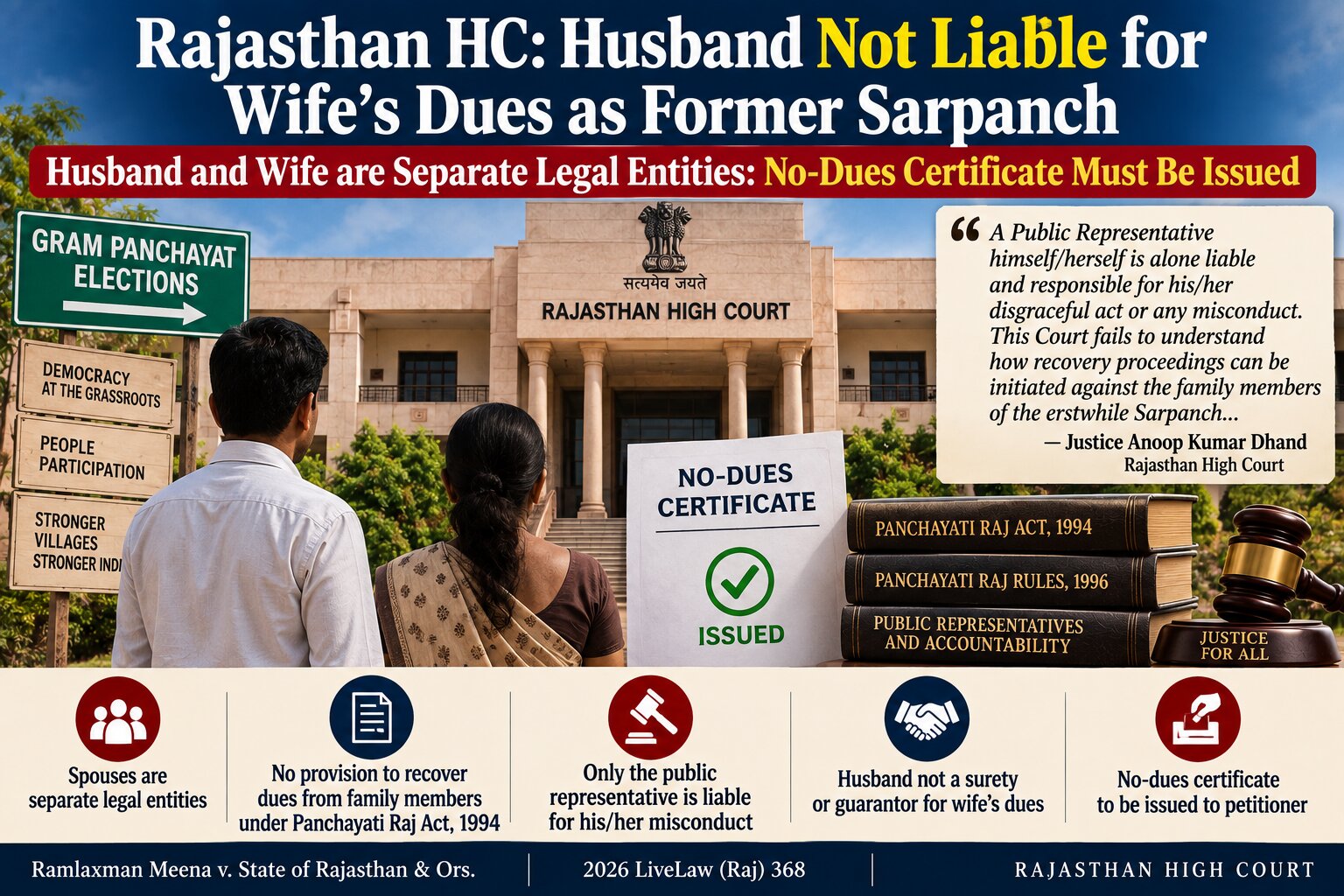
Judgement Details
Court
Rajasthan High Court
Date of Decision
9 September 2026
Judges
Justice Anoop Kumar Dhand
Citation
Acts / Provisions
Facts of the Case
-
The petitioner intended to contest the Panchayati Raj election for Gram Panchayat, Falenda.
-
For contesting the election, he was required to obtain a no-dues certificate from the concerned government department.
-
The authorities refused to issue the certificate to the petitioner.
-
The refusal was based upon alleged outstanding dues recoverable from the petitioner's wife.
-
The dues related to certain works undertaken during the wife's tenure as Sarpanch of Gram Panchayat, Falenda, between 1995 and 2000.
-
Recovery proceedings, including auction and attachment proceedings, had been initiated against the wife in relation to those alleged dues.
-
The wife had challenged the recovery proceedings before the Court.
-
An interim order had been passed staying the auction proceedings, and the wife's petition was still pending.
-
The petitioner contended that his wife's alleged dues could not be used as a ground to prevent him from contesting an election.
-
He argued that there was no provision under the Rajasthan Panchayati Raj Act, 1994 making a person ineligible to contest an election merely because dues were allegedly outstanding against his or her spouse.
-
The petitioner further contended that he had neither undertaken responsibility for his wife's dues nor acted as her surety or guarantor.
-
The State opposed the petition and argued that the husband was duty-bound to clear the dues owed by his wife.
-
The High Court examined whether the State could lawfully transfer the financial liability of a former public representative to her spouse merely because they were husband and wife.
-
The Court also examined whether the Panchayati Raj Act, 1994 or the Panchayati Raj Rules, 1996 contained any provision authorising recovery of such dues from the family members of a former Sarpanch.
-
The Court found no such statutory provision in the material placed before it.
-
The Court further considered whether the petitioner himself had participated in the Panchayat work or in the alleged misconduct of his wife.
-
No such involvement had been established against the petitioner.
Issues
-
Whether the husband of a former Sarpanch can be made liable for dues allegedly recoverable from the wife in connection with her tenure as a public representative?
-
Whether the State can deny a no-dues certificate to a person merely because outstanding dues are allegedly payable by his or her spouse?
-
Whether the Rajasthan Panchayati Raj Act, 1994 or the Rajasthan Panchayati Raj Rules, 1996 authorise recovery of a former Sarpanch's dues from his or her family members?
-
Whether the petitioner could be compelled to discharge his wife's alleged liability when he was neither a surety nor a guarantor for the dues?
-
Whether the petitioner could be prevented from contesting the Panchayati Raj election on account of dues allegedly payable by his wife in the absence of a statutory provision creating such disqualification?
-
Whether the husband could be held liable for his wife's alleged misconduct or disgraceful acts merely by virtue of the marital relationship, without proof of his own involvement?
Judgement
-
The Rajasthan High Court allowed the petition filed by Ramlaxman Meena.
-
The Court held that a husband and wife are separate legal entities and one spouse cannot ordinarily be held liable for the acts or financial liabilities of the other merely because of the marital relationship.
-
The Court held that a public representative is personally responsible for his or her own misconduct or disgraceful acts committed in that capacity.
-
Any recovery arising from such misconduct must ordinarily be pursued against the person responsible for the misconduct, unless lawfully established liability exists against another person.
-
The Court found that the petitioner was neither a surety nor a guarantor for the dues allegedly payable by his wife.
-
Therefore, the State could not compel him to clear the outstanding amount.
-
The Court observed that neither the Rajasthan Panchayati Raj Act, 1994 nor the Panchayati Raj Rules, 1996 contained a provision authorising recovery of such dues from family members of a former Sarpanch.
-
The Court further held that a person's failure to discharge his or her own dues cannot automatically create a civil or penal liability for family members.
-
The Court observed that the petitioner could not be denied a no-dues certificate merely because of the alleged dues of his wife.
-
The Court further held that unless an enquiry established that the petitioner himself had participated in the Panchayat works or in the alleged misconduct or disgraceful acts of his wife, he could not be held liable.
-
The Court characterised the action of the authorities as a case of non-application of mind.
-
The State authorities were accordingly directed to issue the no-dues certificate to the petitioner.
-
The petitioner was therefore not required to clear his wife's alleged dues as a condition for obtaining the certificate.
Held
-
A former public representative is personally responsible for misconduct or disgraceful acts committed in his or her capacity as a public representative.
-
Recovery proceedings cannot ordinarily be initiated against family members merely because they are related to the person against whom the dues are outstanding.
-
A spouse cannot be compelled to pay the other spouse's dues merely because of the marital relationship.
-
A surety or guarantor may be liable for another person's dues where a legally valid guarantee or surety obligation exists.
-
In the present case, the petitioner was neither a surety nor a guarantor for his wife's alleged dues.
-
The Rajasthan Panchayati Raj Act, 1994 and the Panchayati Raj Rules, 1996 did not authorise recovery of the former Sarpanch's dues from her husband or other family members.
-
A person's personal liability cannot automatically be converted into a civil or penal liability of family members.
-
A spouse cannot be denied an election-related no-dues certificate merely because dues are allegedly outstanding against the other spouse.
-
Liability could arise against the petitioner only if it were established through appropriate enquiry that he himself had participated in the relevant Panchayat work or misconduct.
-
The authorities were directed to issue the no-dues certificate to the petitioner.
Analysis
-
Separate legal personality of spouses: The central principle of the judgment is that marriage does not merge the legal identities or liabilities of two individuals. The husband cannot automatically inherit the legal or financial liability of the wife.
-
Personal responsibility of public representatives: The Court emphasised that misconduct committed by a Sarpanch in the discharge of public functions is primarily attributable to the person who committed or participated in that misconduct.
-
No vicarious liability merely through marriage: The judgment rejects the idea that a spouse can be made financially responsible simply because he or she is married to the person against whom recovery proceedings are pending.
-
Requirement of statutory authority: A government authority seeking to recover money from an individual must identify a lawful basis for imposing that liability. Administrative convenience or the existence of a marital relationship cannot substitute for statutory authority.
-
Surety and guarantor distinction: The Court recognised that a person may become responsible for another person's debt where the person has legally undertaken liability as a surety or guarantor. The petitioner, however, had undertaken no such obligation.
-
Election rights: The case also has significance for electoral participation. A person cannot be prevented from contesting an election on the basis of a disqualification that is not supported by the governing legislation.
-
No-dues certificate: The Court effectively held that the purpose of a no-dues certificate cannot be expanded to include liabilities belonging exclusively to another person unless the law specifically permits such recovery.
-
Need for individual enquiry: If authorities believed that the petitioner himself had participated in the Panchayat works or misconduct, they were required to establish that fact through an appropriate enquiry rather than presume liability from the marital relationship.
-
Administrative non-application of mind: The Court criticised the authorities for forcing the petitioner to satisfy a liability that was allegedly owed by his wife without establishing any independent liability against him.
-
Protection against arbitrary recovery: The decision reinforces the principle that State authorities cannot transfer financial liability from one individual to another without a legal basis.
-
Broader significance: The judgment is relevant to situations involving public representatives because it makes clear that personal misconduct and financial liability do not automatically extend to spouses or other family members.
-
Overall legal principle: Unless there is a statutory provision, contractual undertaking, guarantee, proven participation or other legally recognised basis for liability, one spouse cannot be compelled to discharge the dues of the other spouse.