
Rameshkumar Hanjarimal Rathod v. Smt. Kantabai Lalchand Gandhi, 2026
Power of the First Appellate Court to enhance the rate of interest awarded by the trial court even in the absence of an appeal or cross-objection by the plaintiff.
Judgement Details
Court
Bombay High Court
Date of Decision
10 July 2026
Judges
Justice Sandesh D. Patil
Citation
Acts / Provisions
Facts of the Case
-
The plaintiff instituted a suit for recovery of ₹3,05,045 together with interest against the defendant.
-
The claim was based on an agreement dated 1 April 1993, under which the defendant agreed to pay interest at the rate of 18% per annum.
-
The defendant subsequently issued a balance confirmation letter in 1999, acknowledging the outstanding liability.
-
The Trial Court decreed the suit in favour of the plaintiff but awarded interest at the rate of 15% per annum instead of the contractual rate of 18% per annum.
-
Aggrieved by the decree, the defendant preferred a first appeal before the District Judge.
-
During the first appeal, the plaintiff requested the appellate court to exercise its powers under Order XLI Rule 33 CPC and award the contractual rate of interest.
-
The First Appellate Court dismissed the defendant's appeal and enhanced the rate of interest from 15% to 18% per annum, despite the plaintiff not having filed any appeal or cross-objection.
-
The defendant challenged the appellate decree before the Bombay High Court through a second appeal under Section 100 CPC.
Issues
-
Whether the First Appellate Court can enhance the rate of interest under Order XLI Rule 33 of the Code of Civil Procedure, 1908, even in the absence of an appeal or cross-objection by the plaintiff?
-
Whether the exercise of powers under Order XLI Rule 33 CPC was valid when the issue was specifically raised before the appellate court and both parties were heard?
-
Whether the testimony of the plaintiff's power-of-attorney holder was admissible despite the challenge by the defendant?
-
Whether the suit was barred by limitation?
-
Whether any substantial question of law arose warranting interference under Section 100 CPC?
Judgement
-
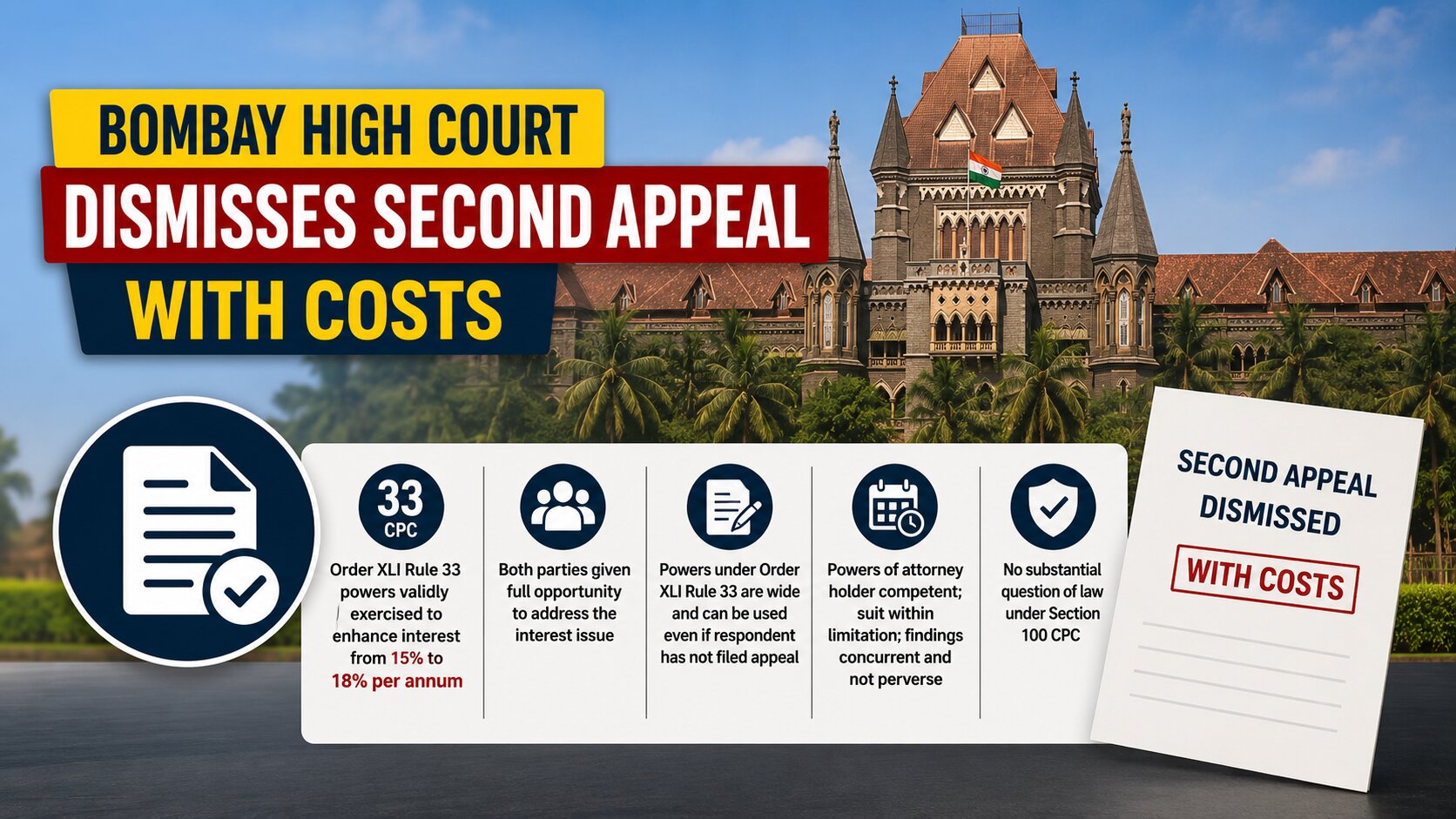
The Bombay High Court dismissed the second appeal with costs.
-
The Court held that the First Appellate Court validly exercised its powers under Order XLI Rule 33 CPC in enhancing the rate of interest from 15% to 18% per annum.
-
The Court observed that the plaintiff had specifically invited the appellate court to exercise its powers under Order XLI Rule 33.
-
The Court noted that the appellate court had framed a specific point for determination regarding the contractual rate of interest.
-
The Court held that both parties had been afforded a full opportunity to address the issue before the appellate court.
-
The Court observed that Order XLI Rule 33 confers wide discretionary powers upon the appellate court to grant appropriate relief even to a respondent who has not filed an appeal or cross-objection.
-
The Court upheld the concurrent finding that the power-of-attorney holder possessed personal knowledge of the transactions and was therefore competent to depose.
-
The Court affirmed the concurrent finding that the suit was filed within the prescribed period of limitation.
-
The Court held that the concurrent findings of fact suffered from no perversity.
-
The Court concluded that no substantial question of law arose under Section 100 CPC to justify interference.
Held
-
The second appeal was dismissed with costs.
-
A First Appellate Court may enhance the relief granted by the trial court under Order XLI Rule 33 CPC, even if the respondent has not filed an appeal or cross-objection.
-
Such power can be exercised where the issue is specifically raised, appropriate points are framed, both parties are heard, and the court consciously exercises its jurisdiction.
-
A power-of-attorney holder having personal knowledge of the relevant transactions is a competent witness.
-
No substantial question of law arose under Section 100 CPC.
Analysis
-
The judgment reiterates the broad and equitable powers conferred upon appellate courts under Order XLI Rule 33 CPC to render complete justice between the parties.
-
The Court clarified that the absence of an appeal or cross-objection by the successful party does not prevent the appellate court from granting appropriate relief where the circumstances justify such exercise of power.
-
The decision emphasizes that procedural technicalities should not defeat substantive justice when both parties have been given adequate opportunity to address the issue.
-
By requiring that the issue be specifically raised and determined after hearing both parties, the Court safeguarded the principles of natural justice while exercising appellate powers.
-
The judgment reinforces the principle laid down by the Supreme Court in Man Kaur (Dead) by LRs v. Hartar Singh Sangha that a power-of-attorney holder may validly testify regarding matters within his personal knowledge.
-
The decision also illustrates the limited scope of interference in a second appeal under Section 100 CPC, where concurrent findings of fact are ordinarily immune from review unless a substantial question of law arises.
-
The ruling strengthens judicial discretion to mould appropriate relief and ensures that appellate courts can correct omissions in the interest of complete justice.