
Ramesh Singh Nagarkoti v. State of Uttarakhand, 2026
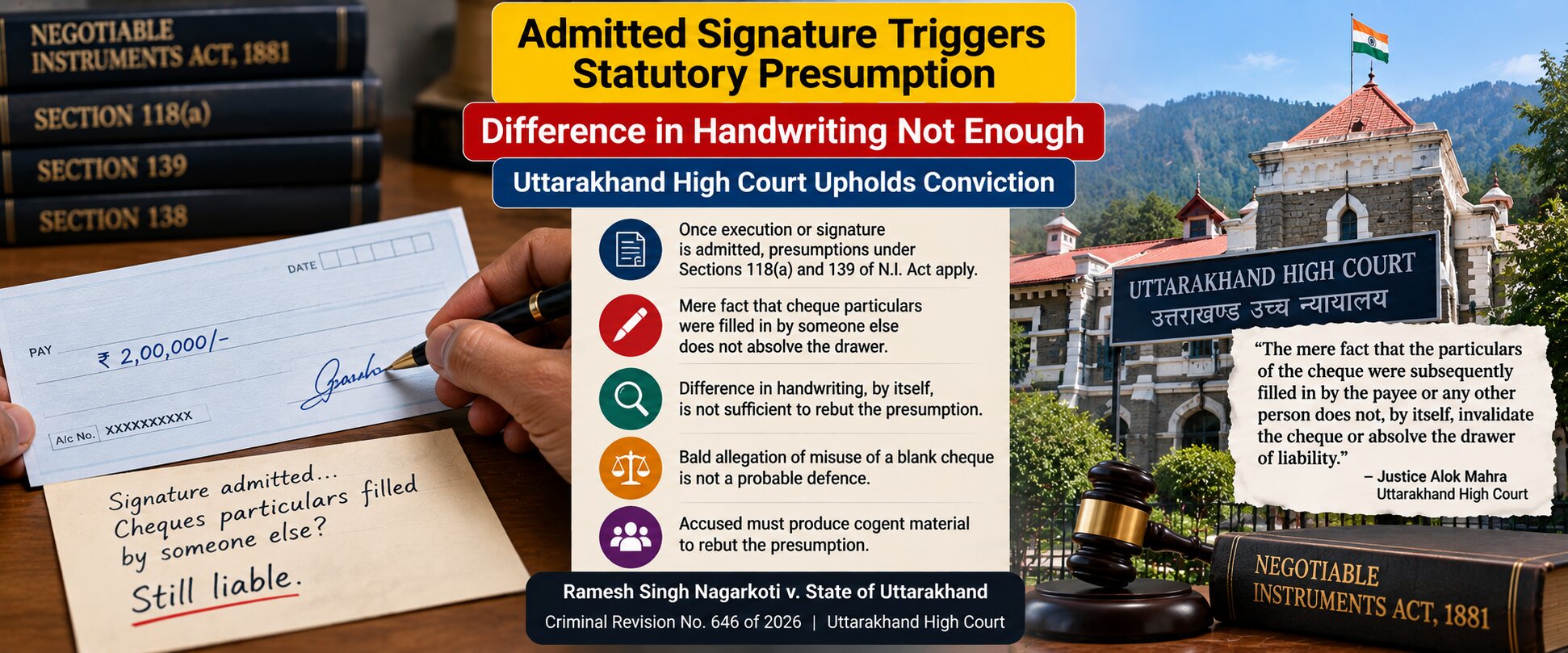
Once the signature or execution of a cheque is admitted, Sections 118(a) and 139 of the N.I. Act raise statutory presumptions in favour of the holder.
Judgement Details
Court
High Court of Uttarakhand
Date of Decision
19 September 2026
Judges
Justice Alok Mahra
Citation
Acts / Provisions
Facts of the Case
-
The revisionist, Ramesh Singh Nagarkoti, was prosecuted under Section 138 of the Negotiable Instruments Act, 1881.
-
The case arose from a cheque for ₹2,00,000 issued in favour of Respondent No. 2.
-
The cheque was presented for encashment but was dishonoured with the endorsement “Insufficient Funds.”
-
Despite service of the statutory notice, the cheque amount was allegedly not paid.
-
Criminal proceedings were consequently initiated against the revisionist.
-
The Trial Court convicted the revisionist under Section 138 of the N.I. Act.
-
The Trial Court sentenced him to one year of simple imprisonment and imposed a fine of ₹2,20,000.
-
The revisionist challenged the conviction before the Sessions Court, but his appeal was dismissed.
-
He thereafter approached the Uttarakhand High Court through the present criminal revision.
-
Before the High Court, the revisionist contended that the cheque was a blank signed cheque that had been handed over to one Kuldeep Bisht.
-
He alleged that the cheque had subsequently been misused.
-
It was argued that Respondent No. 2 had filled in the cheque particulars himself.
-
The revisionist also relied upon the fact that the handwriting of the cheque's other particulars was different from the handwriting of his admitted signature.
-
The High Court noted that the revisionist admitted the signature appearing on the cheque.
-
The Court therefore examined whether the admitted signature was sufficient to trigger the statutory presumptions under Sections 118(a) and 139 of the N.I. Act.
-
The Court further considered whether the revisionist had produced sufficient material to rebut those presumptions.
Issues
-
Whether admission of the signature or execution of a cheque attracts the statutory presumptions under Sections 118(a) and 139 of the Negotiable Instruments Act, 1881?
-
Whether the fact that the particulars of a cheque were filled in by someone other than the drawer is sufficient, by itself, to rebut the statutory presumption under Section 139 of the Negotiable Instruments Act?
-
Whether a difference in handwriting between the admitted signature and the other particulars appearing on the cheque is sufficient to establish that the cheque was misused and thereby rebut the statutory presumptions?
-
Whether a mere assertion that a blank signed cheque was handed over to a third person and subsequently misused constitutes a probable defence sufficient to rebut the presumption under Section 139 of the Negotiable Instruments Act?
-
Whether the revisionist had produced sufficient cogent and convincing material to rebut the statutory presumption that the cheque was issued in discharge of a legally enforceable debt or liability?
-
Whether the conviction under Section 138 of the Negotiable Instruments Act and the dismissal of the appeal by the Sessions Court warranted interference by the High Court?
Judgement
-
The Uttarakhand High Court dismissed the criminal revision.
-
The Court upheld the conviction of the revisionist under Section 138 of the Negotiable Instruments Act.
-
The Court noted that the revisionist's signature on the cheque was admitted.
-
Once execution or signature on the cheque is admitted, the statutory presumptions under Sections 118(a) and 139 come into operation.
-
The Court held that Section 139 creates a presumption that the cheque was received by the holder for the discharge, wholly or partly, of a debt or other legally enforceable liability.
-
The Court rejected the argument that the difference in handwriting between the signature and the other particulars of the cheque was, by itself, sufficient to rebut the statutory presumption.
-
The Court relied upon the Supreme Court's decision in Bir Singh v. Mukesh Kumar.
-
Applying that principle, the Court held that a cheque does not become invalid merely because its particulars were subsequently filled in by the payee or another person.
-
The Court further held that the drawer does not escape liability merely because someone other than the drawer filled in the cheque.
-
The revisionist's assertion that he had handed over a blank signed cheque to Kuldeep Bisht was not supported by sufficient cogent and convincing material.
-
The revisionist failed to establish that the cheque had been given for a purpose wholly unconnected with any liability towards Respondent No. 2.
-
A mere denial or bald allegation of misuse was insufficient to rebut the statutory presumption.
-
The Court therefore found no ground to interfere with the conviction and the Sessions Court's order.
-
The criminal revision was accordingly dismissed.
Held
-
The presumption under Section 139 is that the cheque was received in discharge of a debt or other legally enforceable liability.
-
The fact that the cheque particulars were filled in by another person does not, by itself, invalidate the cheque or discharge the drawer from liability.
-
A difference between the handwriting of the signature and the handwriting of the other cheque particulars is not, by itself, sufficient to rebut the statutory presumption.
-
A bare allegation that a blank signed cheque was misused does not constitute sufficient rebuttal.
-
The accused must raise a probable defence supported by appropriate material to rebut the statutory presumption.
-
Since the revisionist failed to provide cogent material establishing misuse or a transaction wholly unrelated to any legally enforceable liability, the presumption remained unrebutted.
-
The conviction under Section 138 of the N.I. Act was therefore sustained.
-
The criminal revision was dismissed.
Analysis
-
Effect of admitted signature: The most significant aspect of the decision is that an admitted signature on a cheque activates the statutory presumptions under Sections 118(a) and 139. The accused cannot avoid those presumptions merely by asserting that somebody else completed the cheque.
-
Blank cheque defence: The judgment reinforces the principle that voluntarily signing and handing over a cheque carries legal consequences. A defence that the cheque was blank when delivered must be supported by evidence demonstrating the circumstances in which it was delivered and why the eventual presentation was unrelated to any legally enforceable liability.
-
Handwriting difference: The Court specifically rejected the proposition that different handwriting on the body of the cheque automatically establishes misuse. The identity of the person who physically filled in the particulars does not, by itself, determine whether the cheque was issued towards a legally enforceable liability.
-
Section 139 presumption: Section 139 creates a statutory presumption in favour of the cheque holder. The accused can rebut it, but a mere denial is insufficient. The defence must raise a probable explanation supported by circumstances or material on record.
-
Burden of rebuttal: The accused does not necessarily have to prove the defence beyond reasonable doubt in the same manner as the prosecution proves guilt. However, the statutory presumption cannot be displaced merely through an unsupported assertion of misuse.
-
Reliance on Supreme Court precedent: The High Court relied upon Bir Singh v. Mukesh Kumar, which addresses the legal effect of a signed cheque where the particulars are subsequently filled in by another person.
-
Difference between issuance and handwriting: The judgment underscores that the legally significant question is not simply who wrote the cheque, but whether the drawer voluntarily signed and delivered it and whether the accused has successfully rebutted the presumption of legally enforceable liability.
-
Practical significance: For cheque-dishonour cases, the decision demonstrates that an accused relying on a blank-cheque or misuse defence should place specific and credible material before the court rather than relying solely on differences in handwriting or a general denial.
-
Scope of the ruling: The decision does not mean that every admitted-signature case automatically results in conviction. The statutory presumptions are rebuttable. A sufficiently probable defence supported by credible evidence can displace the presumption.