
Ramesh Chand Sachdeva v. Alok Prakash, 2026
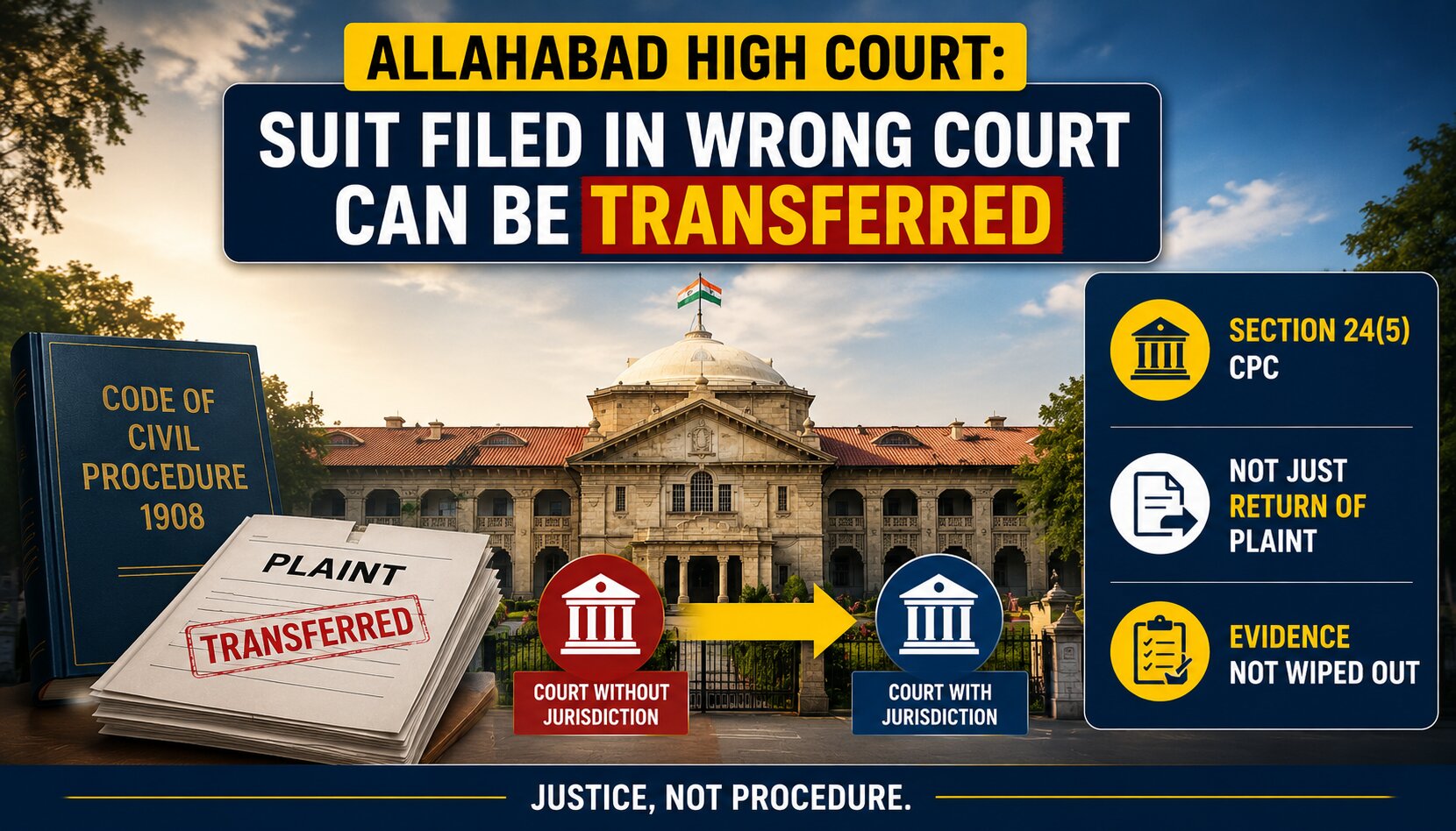
The judgment harmonizes Section 24 CPC and Order VII Rule 10 CPC, ensuring neither provision is rendered redundant.
Judgement Details
Court
Allahabad High Court
Date of Decision
29 July 2026
Judges
Dr. Justice Yogendra Kumar Srivastava
Citation
Acts / Provisions
Facts of the Case
-
The petitioner was a tenant of a shop located at 34, Banshipura (Classic Sports), Suraj Kund Road, Meerut City, paying rent of ₹8,000 per month.
-
The landlord-tenant relationship between the parties was admitted.
-
The respondent-landlord filed S.C.C. Suit No. 69 of 2020 before the Judge, Small Causes Court, Meerut seeking eviction on the ground of default in payment of rent.
-
The tenant denied the allegation of default in his written statement.
-
Both parties led evidence, and the matter reached the stage of final arguments.
-
At that stage, the tenant moved an application under Order VI Rule 17 CPC seeking amendment of the written statement, raising an objection that the suit valuation of ₹1,06,806.45 exceeded the pecuniary jurisdiction of the Small Causes Court (limited to ₹1,00,000).
-
The landlord thereafter moved an application before the District Judge under Section 24(5) CPC seeking transfer of the suit to a competent court.
-
The District Judge allowed the application and transferred the suit to the Court of the Additional District Judge, Court No. 2, Meerut.
-
The tenant challenged the transfer order before the High Court under Article 227 of the Constitution of India.
-
The tenant argued that the plaint ought to have been returned under Order VII Rule 10 CPC and that evidence already recorded stood vitiated after transfer.
-
The High Court examined the interplay between Section 24 CPC and Order VII Rule 10 CPC and the effect of transfer on ongoing proceedings.
Issues
-
Whether a suit instituted before a court lacking pecuniary jurisdiction can be transferred to a competent court under Section 24(5) CPC instead of returning the plaint under Order VII Rule 10 CPC?
-
Whether return of plaint under Order VII Rule 10 CPC is the only mandatory consequence when a defect of pecuniary jurisdiction is discovered?
-
Whether evidence recorded by a court lacking pecuniary jurisdiction becomes invalid upon transfer of the suit?
-
Whether the transferee court has discretion under Section 24(2) CPC to proceed from the stage of transfer or to conduct a fresh trial?
-
Whether the District Judge acted within jurisdiction under Section 24(5) CPC in transferring the suit?
-
Whether the transfer order was liable to be interfered with under Article 227 of the Constitution of India?
Judgement
-
The High Court dismissed the petition filed by the tenant.
-
The Court held that Order VII Rule 10 CPC is not the only mandatory consequence when a jurisdictional defect is discovered.
-
The Bench held that Section 24(5) CPC expressly permits transfer of a suit even from a court lacking jurisdiction to a competent court.
-
The Court observed that insisting on return of plaint in every case would defeat the object of Section 24 CPC and elevate procedural form over substantive justice.
-
The Court held that Section 24 CPC and Order VII Rule 10 CPC operate in distinct but complementary fields.
-
The Court emphasized that Section 24 CPC is a remedial provision intended to avoid multiplicity of proceedings and procedural complications.
-
The Bench rejected the argument that evidence recorded before the Small Causes Court stood automatically obliterated after transfer.
-
The Court held that under Section 24(2) CPC, the transferee court may either retry the suit or proceed from the stage at which it was transferred.
-
The Court clarified that decisions regarding reliance on earlier evidence, recall of witnesses, or fresh trial lie within the discretion of the transferee court.
-
The Court held that procedural provisions cannot be interpreted in a manner that defeats substantive justice.
-
The Court found no prejudice caused to the petitioner due to the transfer.
-
The Court held that supervisory jurisdiction under Article 227 cannot be exercised merely because another view is possible.
Held
-
The petition under Article 227 of the Constitution of India was dismissed.
-
The order of the District Judge transferring the suit under Section 24(5) CPC was upheld.
-
The Court held that return of plaint under Order VII Rule 10 CPC is not mandatory where transfer under Section 24(5) CPC is invoked.
-
The Court held that evidence already recorded is not automatically nullified upon transfer.
-
The transferee court has discretion under Section 24(2) CPC to continue from the existing stage or conduct a fresh trial.
-
The Court reaffirmed that procedural law must serve the ends of justice and not frustrate them.
Analysis
-
The Court adopted a purposive interpretation of Section 24 CPC to ensure effective administration of justice.
-
It strengthens the principle that procedural law is handmaiden of justice and not its mistress.
-
The ruling promotes judicial efficiency and avoids duplication of proceedings.
-
The decision clarifies that jurisdictional defects can be cured through transfer rather than restarting litigation.
-
The Court preserved the discretion of the transferee court under Section 24(2) CPC, ensuring flexibility in trial management.
-
The judgment limits unnecessary interference under Article 227, reinforcing its supervisory—not appellate—nature.
-
It prevents abuse of procedural objections to delay proceedings at advanced stages of trial.
-
The ruling is significant for cases involving pecuniary jurisdiction disputes and transfer of suits.
-
The decision reinforces the modern judicial approach of prioritizing substantive justice over technical objections.