
Ramasrey @ Fakkad v. State of Uttar Pradesh & Connected Matters, 2026
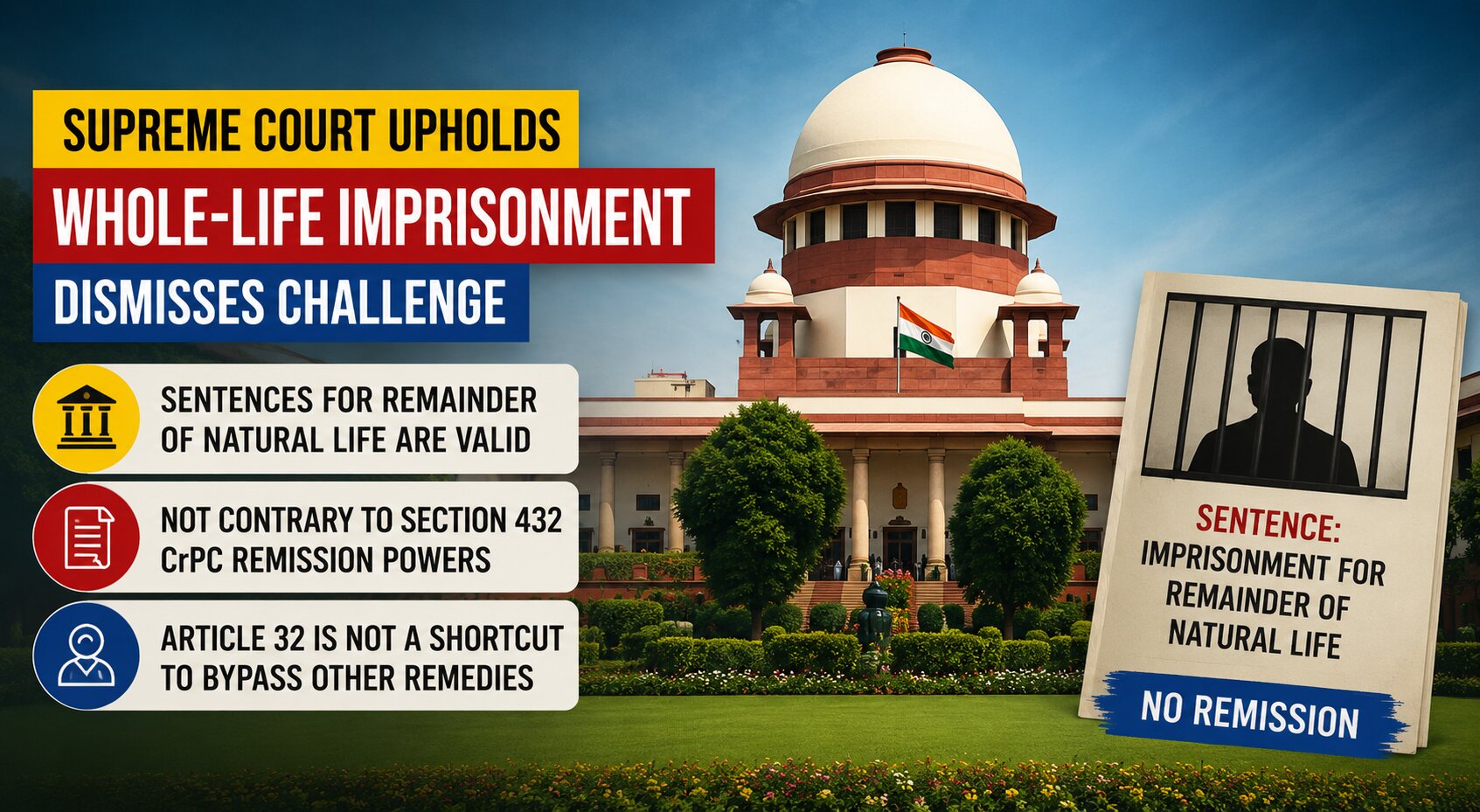
A competent court can, in an appropriate case, impose a special-category life sentence requiring incarceration until the end of the convict's natural life.
Judgement Details
Court
Supreme Court of India
Date of Decision
1 August 2026
Judges
Justice Sanjay Karol and Justice Augustine George Masih
Citation
Acts / Provisions
Facts of the Case
-
The Supreme Court was dealing with a batch of four writ petitions filed by convicts challenging sentences requiring them to remain imprisoned for the remainder of their natural lives.
-
The petitioners included persons whose death sentences had either been commuted by constitutional authorities or whose death sentences had been modified by courts into imprisonment for the remainder of their natural lives.
-
In the case of Ramasrey @ Fakkad, the Allahabad High Court had upheld his conviction and modified the death sentence to rigorous imprisonment for life extending to the whole of his natural life.
-
Ramasrey challenged the sentence under Article 32 of the Constitution, contending that such a punishment was not contemplated by Section 302 IPC.
-
The petitioners argued that Section 302 IPC contemplated only death or life imprisonment for murder and that a separate sentence requiring incarceration for the convict's entire natural life was impermissible.
-
They further argued that such sentences effectively eliminated the possibility of remission available under Sections 432 and 433 CrPC.
-
According to the petitioners, the statutory remission framework could not be overridden by a court through the use of expressions such as “remainder of natural life” or “without remission.”
-
The petitioners also questioned the constitutional validity of imposing imprisonment without any meaningful possibility of release.
-
The Supreme Court examined the issue in light of the Constitution Bench decision in Union of India v. V. Sriharan alias Murugan (2016).
-
In Sriharan, the Constitution Bench had recognized the validity of a special category of life imprisonment requiring incarceration for the remainder of the convict's natural life in appropriate cases.
-
That principle originated in the earlier Constitution Bench-era jurisprudence concerning Swamy Shraddananda (2) v. State of Karnataka (2008).
-
The special category was developed particularly for cases in which the court considers the death penalty inappropriate but considers ordinary life imprisonment, with the possibility of premature release, insufficient having regard to the gravity of the crime.
-
The petitioners nevertheless sought to reopen the constitutional validity of such sentences before the two-judge Bench.
-
The State and Union authorities relied upon the binding Constitution Bench judgment in V. Sriharan and contended that the issue had already been conclusively settled.
-
The Supreme Court also considered the circumstances in which the President or Governor had already exercised constitutional clemency powers in respect of certain petitioners.
-
The Court examined whether such executive decisions could be indirectly challenged by invoking Article 32 when the petitioners had not exhausted other available statutory or constitutional remedies.
-
The Court ultimately dismissed all the connected writ petitions.
Issues
-
Whether a sentence directing imprisonment for the remainder of a convict's natural life is constitutionally valid even though Section 302 of the Indian Penal Code prescribes death or imprisonment for life as punishments for murder?
-
Whether a court can impose imprisonment for the remainder of the convict's natural life without remission as a special category of life imprisonment in appropriate cases?
-
Whether a sentence requiring imprisonment for the remainder of natural life without remission is inconsistent with the statutory remission powers available to the appropriate government under Sections 432 and 433 of the Code of Criminal Procedure, 1973?
-
Whether the judicially imposed special category of imprisonment for the remainder of natural life is contrary to the law declared by the Constitution Bench in Union of India v. V. Sriharan alias Murugan?
-
Whether a petitioner can invoke the Supreme Court's jurisdiction under Article 32 to challenge a sentence or seek relief without first exhausting the statutory and constitutional remedies available under the law?
-
Whether the Supreme Court can ordinarily interfere under Article 32 with the exercise of the President's or Governor's constitutional clemency powers under Articles 72 and 161 in the absence of recognized grounds for judicial review?
-
Whether the petitioners could successfully challenge sentences or clemency decisions that had already been considered by competent courts or constitutional authorities by relying upon the same legal grounds that had previously been settled by binding precedent?
Judgement
-
The Supreme Court dismissed the batch of writ petitions challenging sentences requiring imprisonment for the remainder of the convicts' natural lives.
-
The Court upheld the constitutional validity of the special category of imprisonment for the remainder of natural life.
-
The Court relied heavily upon the binding Constitution Bench decision in Union of India v. V. Sriharan alias Murugan (2016).
-
The Court noted that the Constitution Bench had already recognized the validity of such special-category sentences.
-
The Court observed that the issue could not appropriately be reopened before a two-judge Bench after having been conclusively decided by a five-judge Constitution Bench.
-
The Court characterized the attempt to reopen the settled issue as a misuse, if not abuse, of the process of law.
-
The Court rejected the argument that the existence of statutory remission powers automatically invalidates a judicial sentence requiring imprisonment for the remainder of natural life.
-
The Court clarified that where a sentence is simply life imprisonment, without the categorical addition of “without remission,” the appropriate government's power under Section 432 CrPC remains available.
-
Thus, an eligible prisoner may approach the appropriate government for suspension or remission where the sentence itself does not expressly exclude remission.
-
However, where a competent court has imposed the special-category sentence requiring incarceration for the remainder of natural life, the ordinary remission framework cannot be used to defeat that judicial direction.
-
The Court also considered the constitutional clemency powers under Articles 72 and 161.
-
The Court emphasized that the powers of the President and Governor are constitutionally conferred executive powers and are not subject to appellate review by the courts.
-
Judicial review of such clemency decisions remains limited to recognized constitutional grounds and cannot be converted into an appellate examination of the merits of the decision.
-
The Court therefore refused to treat Article 32 as a shortcut for bypassing other available remedies.
-
The petitions were accordingly dismissed.
Held
-
Imprisonment for the remainder of a convict's natural life is constitutionally valid.
-
Such a sentence is not unconstitutional merely because ordinary life imprisonment may ordinarily be subject to remission.
-
The existence of Section 432 CrPC does not invalidate a judicial sentence specifically requiring imprisonment for the remainder of natural life without remission.
-
Where the sentence is ordinary life imprisonment without the express qualification “without remission,” the appropriate government's statutory remission power under Section 432 CrPC remains unaffected.
-
The legal position established by the Constitution Bench in Union of India v. V. Sriharan is binding and cannot ordinarily be reopened by a smaller Bench.
-
Article 32 cannot be used as a shortcut to bypass other statutory or constitutional remedies.
-
The President's power under Article 72 and the Governor's power under Article 161 cannot ordinarily be treated as appellate proceedings before the Supreme Court.
-
Judicial review of clemency decisions is limited and does not permit the Court to sit in appeal over the merits of the President's or Governor's decision.
-
The connected writ petitions were therefore dismissed.
Analysis
-
Validity of whole-life imprisonment: The principal significance of the judgment is that the Supreme Court reaffirmed that imprisonment for the remainder of a convict's natural life is a legally permissible form of punishment.
-
Special category of life imprisonment: The judgment reinforces the distinction between ordinary life imprisonment and the special category of life imprisonment that requires the convict to remain incarcerated for the rest of his natural life. This category was developed to occupy the constitutional space between ordinary life imprisonment and the death penalty.
-
Role of V. Sriharan: The decision is substantially controlled by the Constitution Bench judgment in Union of India v. V. Sriharan. The present Bench considered itself bound by that authoritative determination and rejected an attempt to reopen the same constitutional question.
-
Relationship with remission: One of the most important aspects of the judgment is its treatment of Section 432 CrPC. The Court did not hold that remission powers disappear in every case involving life imprisonment. Instead, it distinguished between ordinary life imprisonment and a sentence expressly requiring imprisonment for the remainder of natural life without remission.
-
Ordinary life imprisonment: Where the court merely awards life imprisonment without adding a specific restriction on remission, the statutory power of the appropriate government under Section 432 CrPC continues to operate.
-
Whole-life sentence without remission: Where the sentence itself falls within the special category recognized by the Supreme Court and requires imprisonment for the remainder of natural life without remission, the prisoner cannot rely upon the ordinary statutory remission mechanism to nullify that judicial sentence.
-
Constitutional versus statutory powers: The judgment emphasizes the distinction between judicial sentencing, statutory remission and constitutional clemency. These operate in different legal spheres and cannot simply be treated as interchangeable remedies.
-
Article 32: The Court reaffirmed the importance of Article 32 but made clear that its status as a fundamental constitutional remedy does not mean that every grievance can bypass the legal procedure otherwise prescribed.
-
“Heart and soul” of the Constitution: Although Article 32 is famously described as the “heart and soul” of the Constitution, the judgment clarifies that this does not transform it into an unrestricted alternative remedy whenever another statutory or constitutional mechanism is available.
-
President and Governor's clemency powers: The Court placed significant emphasis on Articles 72 and 161. Where constitutional authorities have exercised their clemency jurisdiction, the Court does not ordinarily reassess the merits of the executive decision as though hearing an appeal.
-
Judicial review of clemency: The Court's approach preserves the distinction between judicial review and appellate review. Courts may examine constitutionally recognized defects in clemency decisions, but they cannot simply substitute their own assessment for that of the President or Governor.
-
Binding precedent: The Court's strong criticism of the petitioners' attempt to reopen the issue demonstrates the importance of the doctrine of precedent and judicial discipline. A two-judge Bench cannot ordinarily disregard a binding Constitution Bench ruling.
-
Death penalty and alternative punishment: The special category of whole-life imprisonment has an important sentencing function. It provides courts with an option between the death penalty and ordinary life imprisonment where the circumstances of the crime are exceptionally grave.
-
Proportionality: The jurisprudence behind the special category attempts to address proportionality in sentencing. It recognizes that some cases may justify extremely stringent punishment while nevertheless not warranting the irreversible penalty of death.
-
Impact on prisoners: The decision limits the ability of prisoners serving special-category whole-life sentences to challenge the sentence merely on the ground that remission exists under Section 432 CrPC.
-
Impact on sentencing courts: The judgment reinforces the authority of constitutional courts to formulate an appropriate sentence within the framework recognized by binding Supreme Court precedent, including a direction that imprisonment extend for the convict's natural life in appropriate cases.
-
Important distinction: The judgment should not be read to mean that every life sentence automatically means imprisonment without any possibility of remission. The Court specifically recognized the continuing operation of Section 432 CrPC where the sentence does not contain the categorical “without remission” restriction.
-
Overall significance: The decision strengthens the established jurisprudence permitting whole-life imprisonment as a special category of punishment, while preserving the distinction between ordinary remission, judicial sentencing and constitutional clemency.