
Ram Singh v. The State of Himachal Pradesh, 2026
The Court held that the prosecution evidence was insufficient to establish guilt beyond reasonable doubt.
Judgement Details
Court
Supreme Court of India
Date of Decision
17 August 2026
Judges
Justice Ujjal Bhuyan and Justice Atul S. Chandurkar
Citation
Acts / Provisions
Facts of the Case
-
The case concerned allegations of sexual assault against a 4½-year-old girl.
-
According to the prosecution, the child returned from a neighbour's house and informed her mother about the alleged incident.
-
The prosecution alleged that bloodstains were noticed on the child's clothes.
-
An FIR was subsequently registered against the appellant.
-
The alleged incident was said to have occurred at a particular location within the house, but the prosecution evidence contained inconsistencies regarding the precise place of occurrence.
-
The child stated that the alleged sexual act occurred on a cot on which Jaidev Sharma used to sleep.
-
The investigating officer, however, stated that the alleged incident occurred in the kitchen.
-
The investigating officer also stated that there was no cot or bed in the kitchen.
-
The child was medically examined within approximately 12 hours of the alleged occurrence.
-
The medical examination did not reveal injury, inflammation, bruising, redness or laceration.
-
The medical evidence recorded that the hymen was intact and did not indicate evidence of penetration.
-
The final medical report confirmed the absence of the injuries alleged by the prosecution.
-
The FSL report, including the result of the Benzidine test, did not establish the presence of blood on the victim's clothes or the appellant's undergarment.
-
The FSL evidence also did not establish the presence of semen on the victim's clothes.
-
The prosecution relied substantially on the statements of the relevant prosecution witnesses concerning the alleged injuries and bloodstains.
-
The trial court acquitted the appellant in 2010, finding that the prosecution had not established the charge beyond reasonable doubt.
-
The Himachal Pradesh High Court subsequently reversed the acquittal, convicted the appellant and sentenced him to 10 years' rigorous imprisonment.
-
The appellant challenged the High Court's judgment before the Supreme Court.
-
The Supreme Court examined whether the High Court had properly considered the medical and forensic evidence while overturning the trial court's acquittal.
Issues
-
Whether the prosecution proved the charge against the appellant beyond reasonable doubt in light of the medical and forensic evidence?
-
Whether the absence of injuries on the victim's body, despite the allegation of sexual assault by an adult male, created a reasonable doubt regarding the prosecution's version?
-
Whether the absence of blood on the victim's clothes and the appellant's undergarment, as reflected in the FSL report, was a material circumstance relevant to the prosecution's case?
-
Whether the presence of semen traces on the appellant's undergarment, by itself, was sufficient to establish the prosecution's case in the circumstances of the matter?
-
Whether the inconsistencies regarding the place of occurrence created a serious doubt about the prosecution's version?
-
Whether the High Court was justified in reversing the trial court's acquittal without adequately considering the medical and forensic evidence?
-
Whether the evidence on record was sufficient to sustain the appellant's conviction when the material evidence created a reasonable doubt regarding the prosecution's case?
Judgement
-
The Supreme Court allowed the appeal filed by Ram Singh.
-
The Court set aside the judgment of the Himachal Pradesh High Court that had reversed the trial court's acquittal.
-
The Court restored the trial court's judgment acquitting the appellant.
-
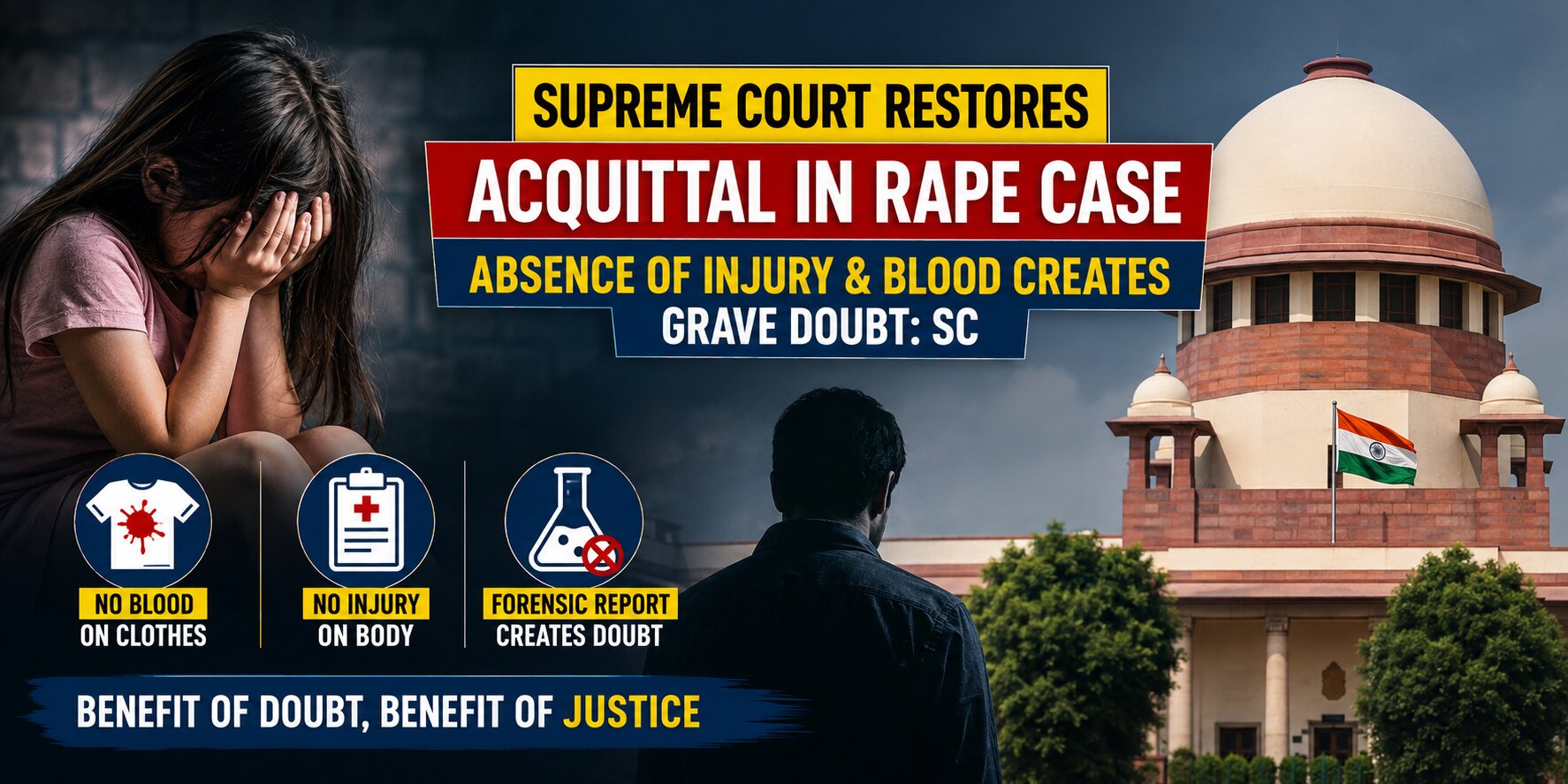
The Court gave significant weight to the medical examination and FSL report.
-
The medical examination conducted within hours of the alleged occurrence did not reveal any injury, inflammation, bruising, redness or laceration on the victim.
-
The final medical report confirmed the findings of the preliminary examination.
-
The Court noted that the prosecution had alleged bloodstains on the victim's clothes, but the FSL examination did not detect blood on those clothes.
-
The Benzidine test also did not establish blood on the appellant's undergarment.
-
The Court observed that the alleged presence of semen traces on the appellant's undergarment, by itself, was not sufficient to establish the prosecution's case in the factual circumstances.
-
The Court also considered the inconsistency concerning the place of occurrence, particularly the contradiction between the alleged cot and the kitchen.
-
The Court found that the prosecution evidence, when considered as a whole, created a grave and serious doubt regarding the alleged occurrence.
-
The Court held that the prosecution had failed to meet the required standard of proof beyond reasonable doubt.
-
The Court concluded that the trial court had rightly acquitted the appellant.
-
The High Court's failure to adequately consider the medical and forensic evidence was a material error in reversing the acquittal.
-
The Supreme Court therefore restored the acquittal of the appellant.
Held
-
The absence of injuries on the victim and the absence of blood on the relevant clothing were material circumstances that could not be ignored.
-
The medical and forensic evidence created a grave doubt about the prosecution's version.
-
The inconsistency concerning the place of occurrence further weakened the prosecution case.
-
The presence of semen traces on the appellant's undergarment, considered in isolation, was not sufficient to sustain the conviction.
-
The High Court erred in reversing the trial court's acquittal without properly addressing the contradictory medical and forensic evidence.
-
The Supreme Court consequently restored the trial court's acquittal.
Analysis
-
Medical evidence: The Court treated the medical examination as significant because it was conducted relatively soon after the alleged incident and did not reveal the injuries alleged by the prosecution.
-
Forensic evidence: The absence of blood on the victim's clothes was particularly important because the prosecution's own case relied upon alleged bloodstains.
-
Contradiction between oral and scientific evidence: The Court found that the prosecution's oral account concerning injuries and bloodstains was difficult to reconcile with the medical and FSL evidence.
-
Place of occurrence: The contradiction regarding whether the incident occurred on a cot or in the kitchen created an additional doubt about the prosecution narrative.
-
Standard of proof: The judgment reinforces the fundamental criminal-law principle that the prosecution must prove its case beyond reasonable doubt.
-
Benefit of reasonable doubt: Where material evidence creates a genuine and serious doubt about the prosecution case, the accused is entitled to the benefit of that doubt.
-
Appeal against acquittal: The case also illustrates the importance of exercising caution when an appellate court interferes with a trial court's acquittal, particularly where the trial court's view is supported by the evidence on record.
-
Holistic appreciation of evidence: The Supreme Court did not consider individual pieces of evidence in isolation. It assessed the ocular, medical, forensic and circumstantial evidence together.
-
Semen evidence: The Court did not treat the detection of semen traces on the appellant's undergarment as automatically conclusive. Its evidentiary significance had to be assessed in the context of the entire prosecution case.
-
Importance of scientific evidence: The judgment demonstrates that medical and forensic evidence must be properly evaluated where it materially contradicts the prosecution's narrative.
-
Limits of appellate interference: The judgment emphasises that an appellate court reversing an acquittal must carefully address the reasons supporting the trial court's conclusion rather than overlooking material evidence.
-
Overall significance: The decision reinforces the principle that suspicion, inconsistencies or isolated evidence cannot substitute for proof beyond reasonable doubt in a criminal prosecution.