
Ram Pratap Singh v. State of U.P. and Others, 2026
The Governor's power under Article 161 is a constitutional and sovereign executive power, but it cannot be exercised arbitrarily.
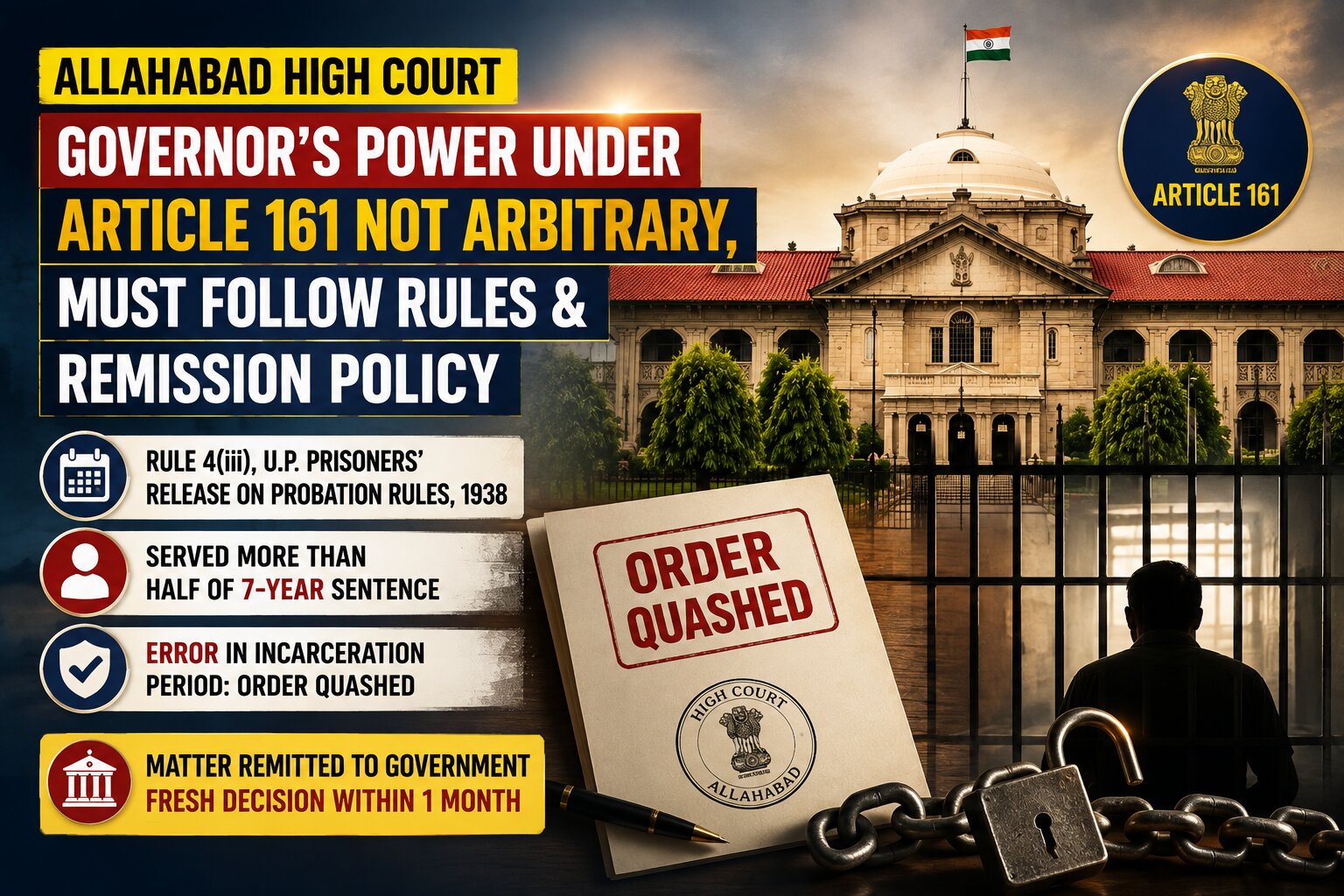
Judgement Details
Court
Allahabad High Court
Date of Decision
15 August 2026
Judges
Justice J.J. Munir and Justice Tarun Saxena
Citation
Acts / Provisions
Facts of the Case
-
The petitioner, Ram Pratap Singh, had been convicted in a case involving attempt to murder.
-
The conviction was recorded under Sections 307/34 IPC by the Additional Sessions Judge, Fatehpur, in 2002.
-
The petitioner was sentenced to seven years' rigorous imprisonment.
-
He was also directed to pay a fine of ₹2,000.
-
The petitioner challenged his conviction before the High Court.
-
His appeal was dismissed by the High Court in 2019.
-
Thereafter, the petitioner approached the Supreme Court by filing a Special Leave Petition, which was also dismissed.
-
In September 2022, a proposal for the petitioner's premature release was sent to the concerned jail authorities and the District Magistrate, Fatehpur.
-
The proposal remained pending for a considerable period.
-
In February 2025, the petitioner submitted an application requesting a decision on his premature-release proposal.
-
The petitioner specifically pointed out that he had already undergone more than half of his seven-year sentence.
-
According to the jail report, the petitioner had undergone 4 years, 6 months and 6 days without remission.
-
With remission, the period undergone was recorded as 5 years and 4 months.
-
The jail authorities also recorded the petitioner's conduct as satisfactory.
-
Despite the jail report, an order dated 26 June 2025 was communicated refusing the petitioner's premature release.
-
The rejection order stated that the petitioner had undergone only 2 years and 6 days without remission and 2 years, 1 month and 27 days with remission.
-
The petitioner challenged the rejection before the Allahabad High Court.
-
He contended that the authorities had incorrectly calculated his period of incarceration.
-
He argued that the rejection order had ignored the actual period of imprisonment recorded in the jail report.
-
He further contended that the order did not disclose any adverse material against him.
-
The petitioner also relied upon the fact that his conduct in prison had been recorded as satisfactory.
-
The petitioner argued that the applicable Uttar Pradesh rules made him eligible for consideration for premature release because he had already undergone more than the prescribed portion of his sentence.
Issues
-
Whether the Governor's power under Article 161 of the Constitution to grant premature release can be exercised arbitrarily or contrary to the applicable remission rules and policy?
-
Whether the rejection of the petitioner's premature-release claim was vitiated by an error apparent on the face of the record concerning the period of incarceration actually undergone by him?
-
Whether the petitioner had become eligible for consideration of premature release under Rule 4(iii) of the Uttar Pradesh Prisoners' Release on Probation Rules, 1938, after serving the prescribed portion of his sentence without remission?
-
Whether the authorities were justified in refusing premature release by relying upon an incorrect calculation of the period of imprisonment undergone by the petitioner?
-
Whether an order refusing premature release can be sustained when the adverse recommendations relied upon by the authorities are not disclosed and their reasons are not apparent from the record?
-
Whether the impugned order refusing premature release was vitiated by non-application of mind and manifest illegality?
-
Whether the rejection order dated 26 June 2025 was liable to be quashed and the matter remitted to the Government for fresh consideration?
Judgement
-
The Allahabad High Court allowed the writ petition filed by the petitioner.
-
The Court examined the legality of the order refusing the petitioner's premature release.
-
The Court found that the rejection order contained a serious error concerning the period of incarceration actually undergone by the petitioner.
-
The jail report specifically recorded that the petitioner had undergone 4 years, 6 months and 6 days without remission.
-
The report further recorded that, after taking remission into account, the period undergone was 5 years and 4 months.
-
Despite this material, the rejection order proceeded on the basis that the petitioner had served only 2 years and 6 days without remission.
-
The Court found that there was no basis in the record for this finding.
-
The Bench characterised the incorrect calculation as an “error apparent” and a case of non-application of mind to the record.
-
The Court further described the misreading of the period of incarceration as a “manifest illegality.”
-
The Court examined Rule 4(iii) of the Uttar Pradesh Prisoners' Release on Probation Rules, 1938.
-
The applicable rule provided that a convict falling within the relevant category becomes eligible for consideration for premature release after undergoing one-third of the sentence without remission.
-
The petitioner had undergone substantially more than one-third of his seven-year sentence without remission.
-
The Court therefore found that the petitioner had crossed the relevant eligibility threshold.
-
The Court also considered the constitutional nature of the Governor's power under Article 161.
-
The Court observed that although Article 161 confers a constitutional power, such power cannot be exercised arbitrarily.
-
The exercise of the power remains subject to the applicable Rules and remission policy.
-
The Court distinguished the constitutional power under Article 161 from the statutory power of the State Government under Section 432 CrPC.
-
Nevertheless, the Court held that even the constitutional power cannot be exercised on the basis of an obvious factual error concerning an important matter such as the period of imprisonment actually undergone.
-
The Court also considered the reliance placed by the authorities upon recommendations made by the District Magistrate and Superintendent of Police.
-
The Court noted that the impugned order and the State's response did not disclose the contents or reasoning of those adverse recommendations.
-
The Court observed that if those recommendations were merely “without reasons and ipse dixit of the officers”, fresh comments would have to be obtained from the concerned officers.
-
In view of the errors and deficiencies in the decision-making process, the Court held that the rejection order could not be sustained.
-
The High Court consequently quashed the order dated 26 June 2025 refusing premature release.
-
The matter was remitted to the Government for fresh consideration.
-
The Government was directed to take a fresh decision on the petitioner's request for premature release within one month from receipt of the High Court's order.
Held
-
The exercise of the power is regulated by the applicable rules and remission policy.
-
An order concerning premature release cannot be sustained when it is based upon an error apparent on the face of the record.
-
The authorities had incorrectly calculated the petitioner's period of incarceration despite the jail report recording that he had undergone 4 years, 6 months and 6 days without remission.
-
The petitioner had therefore served substantially more than the period required for eligibility under the applicable premature-release rules.
-
The rejection order demonstrated non-application of mind to the official record.
-
The unexplained reliance upon adverse recommendations, without disclosing their contents or reasons, further weakened the legality of the decision.
-
The rejection order dated 26 June 2025 was therefore quashed.
-
The matter was remitted to the Government for fresh consideration of the petitioner's premature-release request.
-
The Government was directed to take a fresh decision within one month.
Analysis
-
The judgment is significant for clarifying that the constitutional nature of the Governor's power under Article 161 does not place its exercise beyond judicial review.
-
Although Article 161 confers a constitutional executive power, the decision-making process must remain consistent with applicable statutory rules, remission policies and basic principles of fairness and non-arbitrariness.
-
The Court drew an important distinction between the existence of constitutional power and the manner in which that power is exercised.
-
The Governor possesses the constitutional authority to grant remission or premature release, but the decision cannot be founded upon an obvious factual mistake or an irrational assessment of the record.
-
The incorrect calculation of the petitioner's incarceration was central to the Court's decision.
-
The official jail report clearly recorded that the petitioner had undergone 4 years, 6 months and 6 days without remission, whereas the rejection order treated his custody as only 2 years and 6 days without remission.
-
Such a substantial discrepancy was not a minor clerical error because the period of incarceration directly affected the petitioner's eligibility for premature release.
-
The Court therefore correctly treated the discrepancy as an error apparent on the face of the record rather than a matter of mere administrative calculation.
-
The judgment reinforces the principle that authorities exercising executive discretion must properly consider relevant material available on the official record.
-
Failure to consider or correctly understand a material document can amount to non-application of mind.
-
The Court's reliance on Rule 4(iii) of the Uttar Pradesh Prisoners' Release on Probation Rules, 1938 demonstrates that premature release cannot be considered entirely in the abstract.
-
The authorities must examine the convict's eligibility according to the applicable remission rules and policy framework.
-
The fact that the petitioner had undergone more than one-third of the sentence without remission was therefore legally relevant to the decision-making process.
-
The Court did not hold that crossing the eligibility threshold creates an automatic or unconditional right to release.
-
Eligibility for consideration and entitlement to actual release are distinct concepts.
-
The Government must still examine the relevant factors and exercise its discretion lawfully.
-
The judgment therefore protects both sides of the legal framework: it preserves executive discretion while requiring that discretion to be exercised lawfully, rationally and on the basis of correct facts.
-
The Court's discussion of the adverse recommendations of the District Magistrate and Superintendent of Police is also important.
-
An administrative authority cannot simply rely upon unexplained adverse recommendations while making a decision that has significant consequences for a prisoner's liberty.
-
Where such recommendations are relied upon, their substance and reasons must be available for meaningful judicial scrutiny.
-
The Court's observation regarding recommendations that are merely “ipse dixit” emphasises that official conclusions should be supported by reasons and relevant material.
-
The judgment therefore reinforces the broader administrative-law principle that discretion must not become arbitrary power.
-
The decision also illustrates the role of judicial review in examining the legality of executive decision-making without substituting the Court's own decision for that of the competent authority.
-
The High Court did not itself order the petitioner's immediate release.
-
Instead, it quashed the defective decision and remitted the matter to the Government for a fresh and lawful determination.
-
This approach respects the separation between judicial review and executive decision-making.
-
The Court's remedy was therefore procedural and corrective rather than an assumption of the Governor's or Government's substantive power.
-
The judgment is particularly relevant to prisoners seeking premature release because it confirms that their applications must be considered on the basis of accurate custody records and applicable remission policies.
-
The decision also demonstrates that an administrative decision may be invalidated where an authority relies upon a materially incorrect factual premise.
-
Overall, the judgment strengthens the principle that constitutional executive powers concerning remission and premature release are wide but not arbitrary.
-
The central lesson is that a decision affecting a prisoner's liberty must be based on the correct factual record, relevant rules, reasoned consideration and a lawful exercise of discretion.