
Ram Prasad v. State of Rajasthan & Ors. and Connected Petitions, 2026
Road widening and Master Plan development may proceed in public interest, but authorities cannot demolish or deprive citizens of property without due process, including notice and a fair hearing.
Judgement Details
Court
Rajasthan High Court
Date of Decision
21 August 2026
Judges
Justice Anoop Kumar Dhand
Citation
Acts / Provisions
Facts of the Case
-
Several petitioners claimed ownership or lawful possession of residential properties in Sri Ganganagar.
-
The authorities proposed demolition and removal of properties for road construction and widening under the Master Plan.
-
The petitioners alleged that the proposed action was being taken without proper notice, hearing or compensation.
-
The State contended that the properties were required for implementation of the Master Plan and that the petitioners were encroachers without valid title.
-
The High Court examined the competing claims of planned development and protection of property rights.
-
The Court emphasized that development under a Master Plan cannot be frustrated by individual encroachments, but government authorities must nevertheless follow due process of law.
Issues
-
Whether properties can be demolished for road construction or widening under a Master Plan without providing affected persons notice and an opportunity of hearing?
-
Whether the State can deprive a person of property without following the applicable procedure established by law?
-
Whether persons establishing valid title to property required for public road development are entitled to consideration of compensation?
-
Whether a committee should be constituted to examine the title claims and grievances of persons affected by the proposed demolition?
Judgement
-
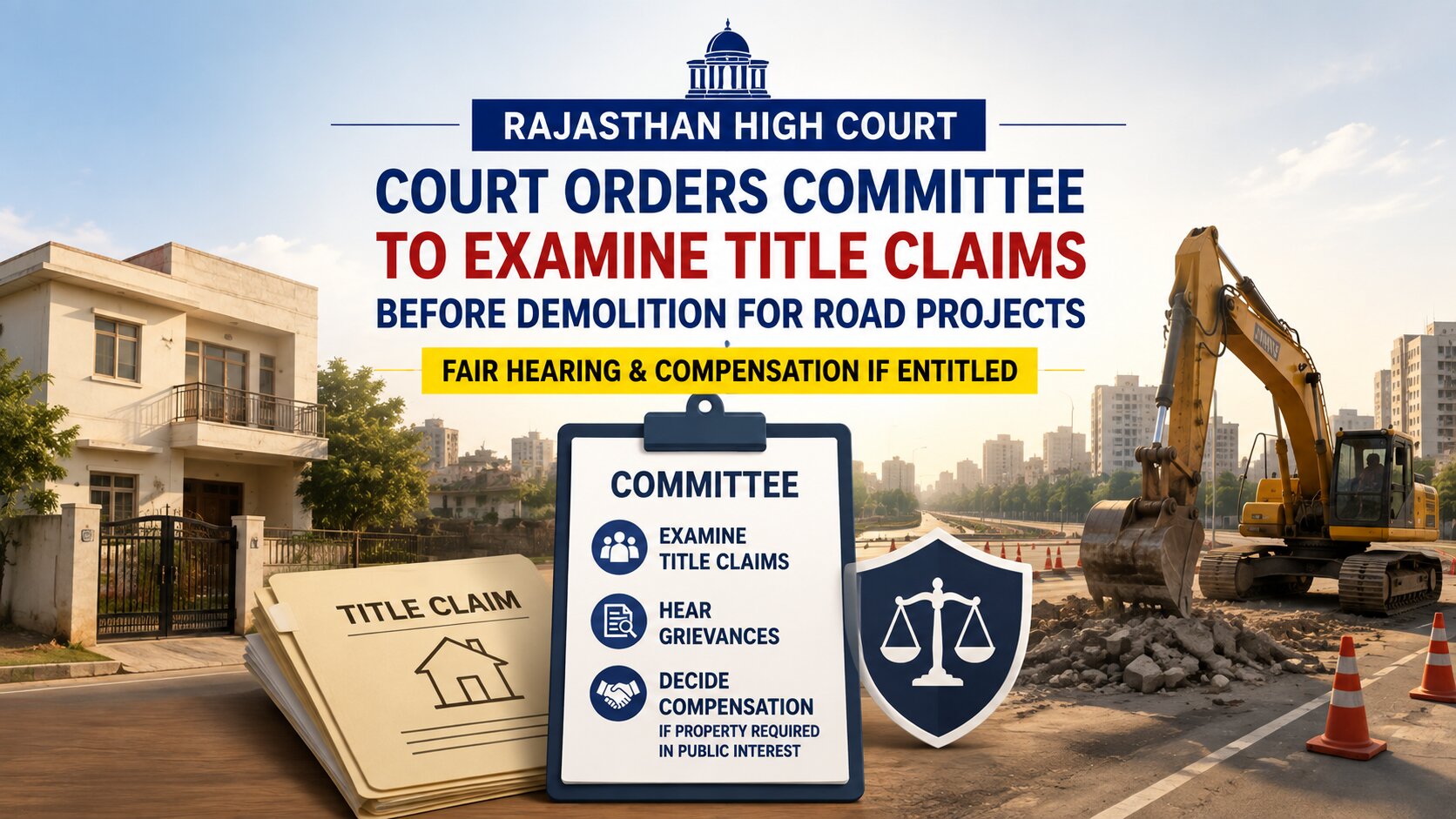
The High Court directed the authorities to constitute a Committee of higher officials within 15 days.
-
The Committee must examine the claims and grievances of the affected petitioners.
-
Every affected person must receive a fair opportunity of hearing.
-
The Court clarified that implementation of the Master Plan and necessary road development should not be unnecessarily obstructed.
-
At the same time, authorities cannot simply demolish properties without following the procedure prescribed by law.
-
Where a person's valid title is established, but the property is nevertheless required for road construction or widening in public interest, the question of compensation must be considered.
-
The Court therefore sought to balance planned urban development with protection of individual property rights.
Held
-
Master Plan implementation does not override due process of law.
-
Authorities must provide appropriate notice and opportunity of hearing before taking coercive action against affected property holders.
-
A valid title claim must be examined before demolition.
-
Where legally owned property is required for a public project, the affected owner must be considered for compensation.
-
The State cannot deprive citizens of property merely by relying upon administrative planning without following lawful procedure.
Analysis
-
Due process: The judgment reinforces that State action affecting property rights must comply with procedural fairness.
-
Article 21: The Court linked protection against arbitrary deprivation of property with constitutional guarantees of dignity and lawful procedure.
-
Master Plan is not absolute: Although a Master Plan is an important policy instrument for planned urban development, its implementation cannot be used as a shortcut to bypass legal safeguards.
-
Natural justice: Notice and meaningful opportunity to present title documents are essential before demolition or eviction.
-
Public interest versus private rights: The Court did not prohibit road widening. Instead, it required authorities to reconcile public development with lawful individual interests.
-
Compensation: Where validly owned property is required for a public purpose, the affected owner's entitlement must be considered rather than simply ignoring the ownership claim.
-
Committee mechanism: The Committee provides an administrative mechanism to separately examine each affected person's documents and grievances rather than treating all properties uniformly as encroachments.