
Ram Kailash Gupta v. State of Madhya Pradesh, 2026
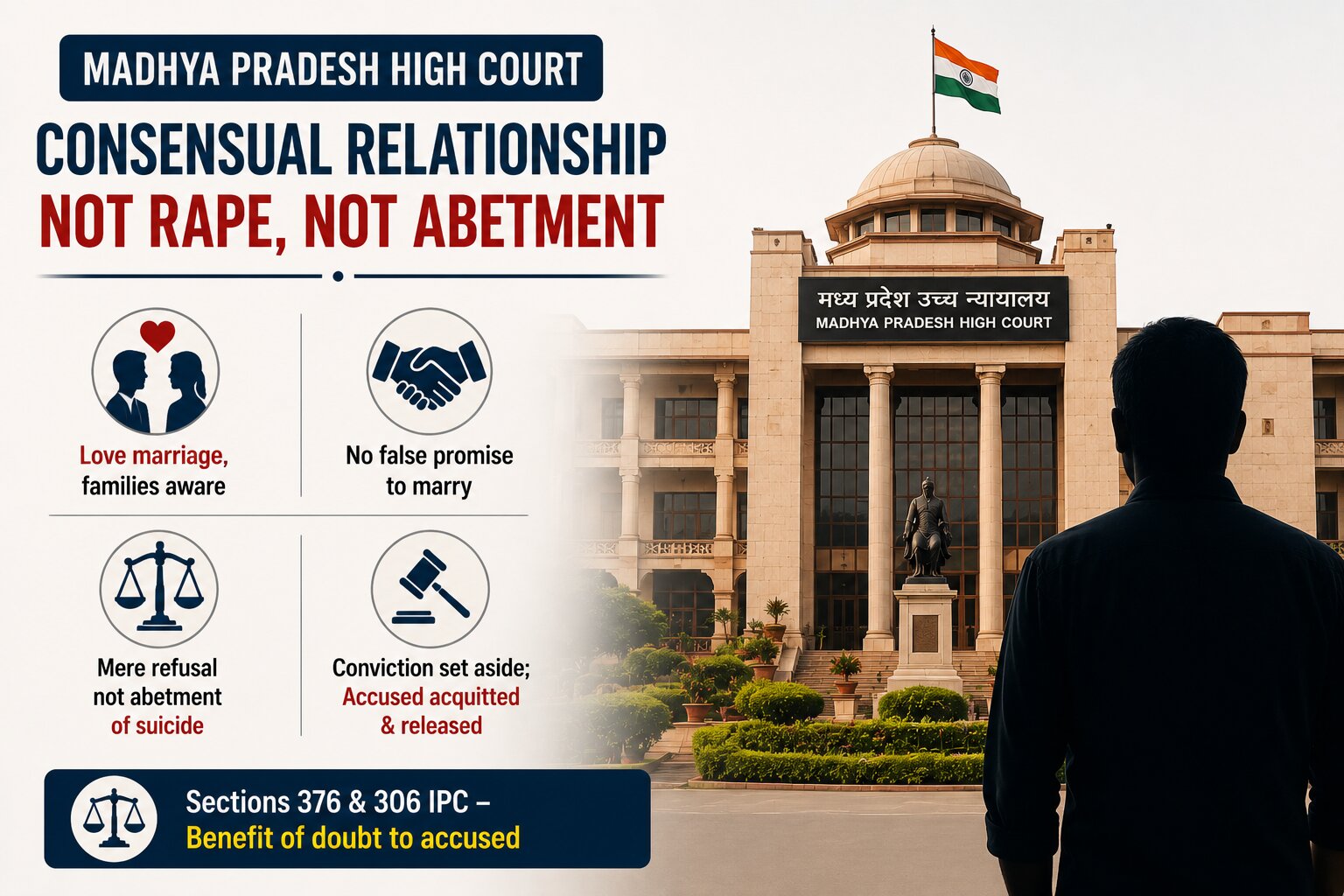
A consensual relationship arising out of a genuine love affair does not amount to rape merely because the marriage ultimately does not take place.
Judgement Details
Court
Madhya Pradesh High Court
Date of Decision
18 July 2026
Judges
Justice Rajendra Kumar Vani
Citation
Acts / Provisions
Facts of the Case
-
The deceased and the accused were in a love relationship, which was known to the deceased's parents and brother.
-
The families were aware of the relationship and did not object to it.
-
The prosecution alleged that the accused established physical relations with the deceased on a false promise of marriage.
-
The deceased subsequently became pregnant, and a DNA report confirmed that the accused was the father of the fetus.
-
According to the prosecution, the accused later refused to marry the deceased and allegedly demanded a house as a condition for marriage.
-
It was alleged that due to the accused's refusal, the deceased committed suicide by hanging on 12 February 2020.
-
The Trial Court convicted the accused under Sections 376 and 306 IPC.
-
The accused challenged the conviction before the Madhya Pradesh High Court, contending that the relationship was consensual and that there was no false promise to marry from the inception.
Issues
-
Whether the physical relationship between the accused and the deceased constituted rape under Section 376 IPC on the ground of a false promise to marry?
-
Whether the prosecution proved that the accused never intended to marry the deceased from the very beginning and induced her consent solely by deception?
-
Whether the accused's subsequent refusal to marry the deceased amounted to abetment of suicide under Section 306 IPC?
-
Whether the prosecution established beyond reasonable doubt that the accused instigated or intentionally aided the deceased to commit suicide?
-
Whether the conviction recorded by the Trial Court was legally sustainable?
Judgement
-
The Madhya Pradesh High Court allowed the criminal appeal.
-
The Court held that the prosecution failed to prove that the accused had made a false promise to marry from the very inception of the relationship.
-
It observed that the evidence established a consensual love relationship between the parties.
-
The Court noted that the deceased's parents and brother were fully aware of the relationship and had never objected to it.
-
The Court found no evidence showing that the accused entered the relationship solely to satisfy his sexual desires or with fraudulent intentions.
-
It observed that a mere failure or refusal to marry does not automatically convert a consensual relationship into rape.
-
The Court held that where a promise to marry was genuine at the beginning but could not ultimately be fulfilled, the offence of rape under Section 376 IPC is not attracted.
-
The Court further found that the prosecution failed to establish that the accused had demanded a house as a precondition for marriage.
-
Regarding Section 306 IPC, the Court held that even if the accused subsequently refused to marry, such refusal alone does not amount to instigation or abetment of suicide.
-
The Court observed that there was no evidence of intentional provocation, incitement or active participation by the accused in the commission of suicide.
-
Applying the principle that where two reasonable views are possible, the one favourable to the accused must prevail, the Court extended the benefit of doubt.
-
Consequently, the Court set aside the conviction under Sections 376 and 306 IPC and directed the immediate release of the accused.
Held
-
A conviction for rape on the ground of false promise to marry requires proof that the promise was false from the inception and made solely to obtain consent.
-
Mere refusal to marry does not constitute abetment of suicide unless accompanied by evidence of instigation or intentional aid.
-
The prosecution failed to prove the offences under Sections 376 and 306 IPC beyond reasonable doubt.
-
The accused was acquitted, and his conviction was set aside.
Analysis
-
The judgment reiterates the settled distinction between a breach of promise to marry and a false promise to marry made with fraudulent intent from the beginning.
-
The Court emphasized that consent obtained during a genuine romantic relationship cannot automatically be treated as consent obtained by deception.
-
The ruling reinforces that DNA evidence proving paternity does not, by itself, establish the offence of rape.
-
The Court correctly applied the principle that criminal liability under Section 376 IPC requires proof of dishonest intention at the inception of the promise.
-
In relation to Section 306 IPC, the Court reaffirmed that criminal liability for abetment requires clear evidence of instigation, intentional aid, or active participation in the suicide.
-
The judgment protects against criminalising failed relationships where the evidence points to a consensual affair rather than deception.
-
By granting the benefit of doubt, the Court reaffirmed the fundamental principle that guilt must be established beyond reasonable doubt.
-
The ruling strengthens the jurisprudence governing false promise to marry, consensual relationships, and abetment of suicide under the IPC.