
Rajvir & Another v. State of U.P. & 3 Others, 2026
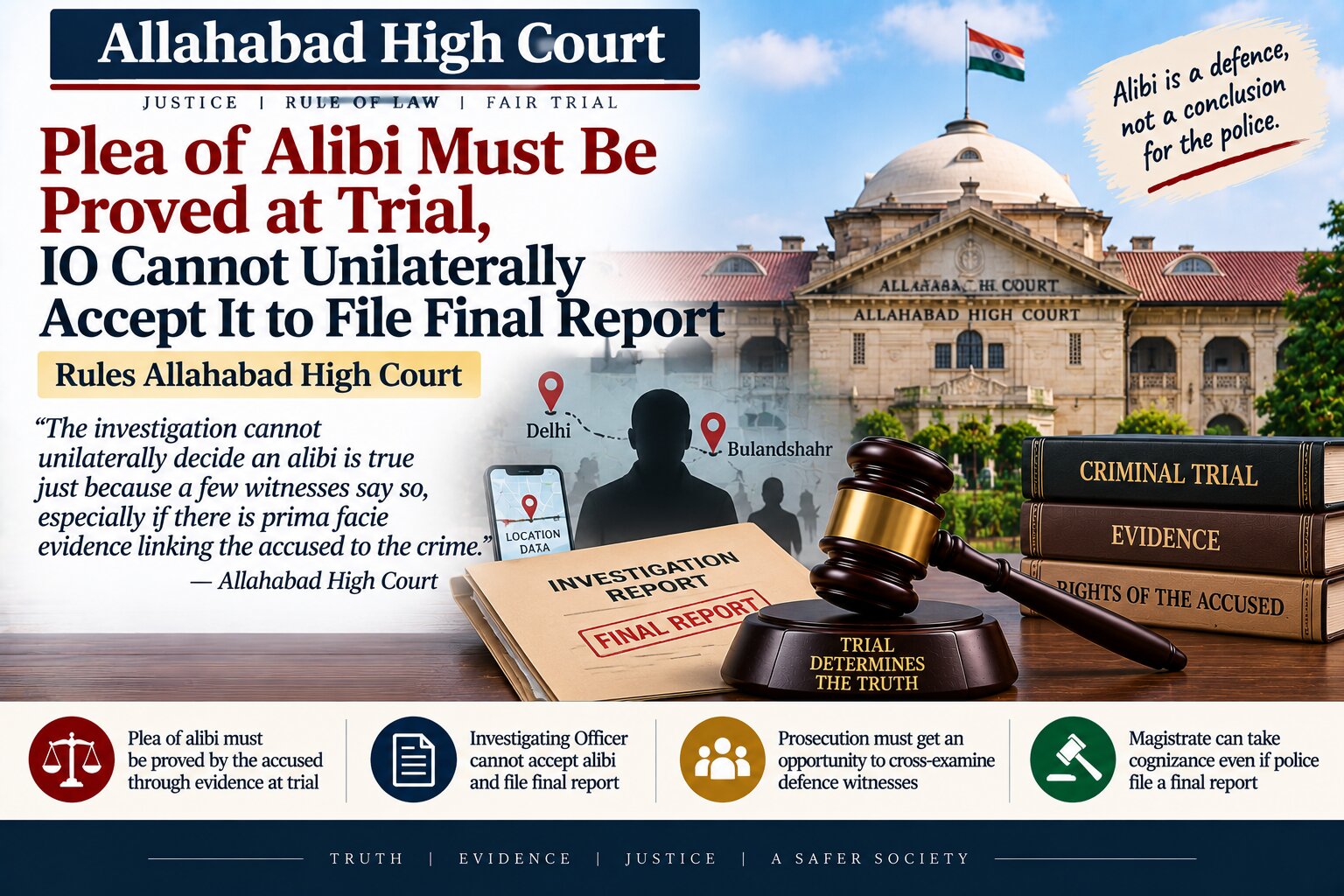
An alibi is a defence and must ordinarily be established by the accused through evidence at trial.
Judgement Details
Court
Allahabad High Court
Date of Decision
19 August 2026
Judges
Justice Vivek Kumar Singh
Citation
Acts / Provisions
Facts of the Case
-
An FIR was registered concerning the alleged kidnapping of a 16-year-old girl.
-
The victim's mother supported the prosecution case in her statement.
-
The victim, in her statements under Sections 161 and 164 CrPC, allegedly stated that she had been forcibly kidnapped and sexually assaulted by the applicants.
-
During investigation, the Investigating Officer collected Call Detail Records (CDRs), mobile location data and other material.
-
According to the IO, the location records indicated that the applicants were at different places and were not present at the alleged place of occurrence.
-
The IO also recorded statements of certain independent witnesses who supported the applicants' plea of alibi.
-
Relying upon this material, the IO submitted a final report instead of a chargesheet.
-
The victim's mother filed a protest petition challenging the final report.
-
The Special Judge (POCSO), Aligarh rejected the final report and summoned the applicants to face trial.
-
The applicants approached the Allahabad High Court under Section 528 BNSS, seeking quashing of the summoning order.
-
The High Court dismissed their application.
Issues
-
Whether an Investigating Officer can conclusively accept a plea of alibi during investigation and submit a final report on that basis?
-
Whether a plea of alibi must be established by the accused through evidence during trial?
-
Whether a Magistrate can take cognizance despite a police final report stating that no offence is made out against the accused?
-
Whether the High Court can examine the truth or reliability of an alibi defence while exercising jurisdiction under Section 528 BNSS?
-
Whether the Special Judge committed any jurisdictional error or illegality in rejecting the final report and summoning the accused?
Judgement
-
The Allahabad High Court dismissed the application filed by the accused under Section 528 BNSS.
-
The Court held that the plea of alibi is a defence which has to be proved during trial by leading appropriate evidence.
-
The Investigating Officer cannot unilaterally treat an alibi as conclusively established merely because some witnesses support it.
-
The IO committed a serious illegality by relying upon the alleged alibi and completely disregarding the victim's statements recorded under Sections 161 and 164 CrPC.
-
The Court held that a Magistrate is not bound by the conclusion reached by the Investigating Officer in a police report.
-
Even where the police submit a final report, the Magistrate can independently examine the material collected during investigation and take cognizance if a prima facie case is disclosed.
-
The Court refused to assess the credibility of the CDRs, mobile-location evidence or defence witnesses at the pre-trial stage.
-
The accused would have an adequate opportunity to establish their alibi before the Trial Court.
-
The Court clarified that its observations were tentative and should not influence the Trial Court while deciding the case on evidence.
-
The truth of the prosecution allegations must ultimately be determined at trial and beyond reasonable doubt.
Held
-
An Investigating Officer cannot conclusively determine the truth of an alibi merely on the basis of statements of supporting witnesses or investigation material.
-
The prosecution must be given an opportunity to cross-examine defence witnesses who seek to establish the alibi.
-
A Magistrate can take cognizance under Section 190(1)(b) CrPC even when the police have submitted a final report stating that no case is made out.
-
The Magistrate is entitled to independently apply his mind to the material collected during investigation.
-
The High Court, while exercising inherent jurisdiction under Section 528 BNSS, should not conduct a mini-trial or determine disputed questions of fact.
-
The Special Judge's decision to reject the final report and summon the accused disclosed no jurisdictional error or illegality.
-
The application for quashing was therefore dismissed.
Analysis
- The judgment reinforces the fundamental distinction between the investigation stage and trial stage of a criminal proceeding.
-
An Investigating Officer's role is to investigate the allegations and collect evidence; the IO cannot effectively conduct a trial and conclusively determine whether a defence such as alibi is true.
-
The plea of alibi is essentially a claim that the accused was somewhere else when the offence occurred. Its ultimate proof depends upon evidence that can be tested during trial.
-
This requirement is particularly important because defence witnesses must be subject to cross-examination by the prosecution.
-
The Court therefore rejected the idea that statements collected by the IO under Section 161 CrPC can themselves conclusively establish an accused's alibi before trial.
-
The decision also emphasizes the independent judicial role of the Magistrate. A police final report is an investigative opinion and does not bind the Magistrate.
-
Even if the police conclude that an accused should not be prosecuted, the Magistrate can examine the investigation material independently and take cognizance where the material discloses a prima facie offence.
-
The ruling prevents the police from effectively determining the outcome of criminal proceedings merely by accepting a defence version during investigation.
-
The Court's approach is also consistent with the limited scope of Section 528 BNSS. Inherent jurisdiction cannot ordinarily be used to decide disputed factual questions that require appreciation of evidence.
-
The CDRs and mobile-location records may ultimately become important evidence, but their accuracy, interpretation, reliability and connection with the alleged occurrence must be tested in the proper proceedings.
-
Similarly, the prosecution must have an opportunity to challenge the witnesses relied upon by the accused to establish their presence elsewhere.
-
The judgment does not mean that an alibi can never be considered before trial. Rather, it emphasizes that where the defence depends upon disputed questions of fact, the High Court should ordinarily allow the trial process to determine them.
-
The ruling also protects the victim's right to have allegations tested through a proper judicial process instead of allowing the prosecution to be terminated solely on the IO's assessment of a defence.
-
At the same time, the High Court carefully avoided declaring the accused guilty. Its observations were expressly tentative, leaving the Trial Court free to independently assess all evidence.
-
The broader principle is that investigation cannot replace adjudication. A defence raised by an accused may be investigated, but its final truth must ordinarily be determined by the Trial Court after both sides have had an opportunity to lead and challenge evidence.