
Rajesh Kumar Chaurasia and 2 Others v. Suresh Kapoor and 3 Others, 2026
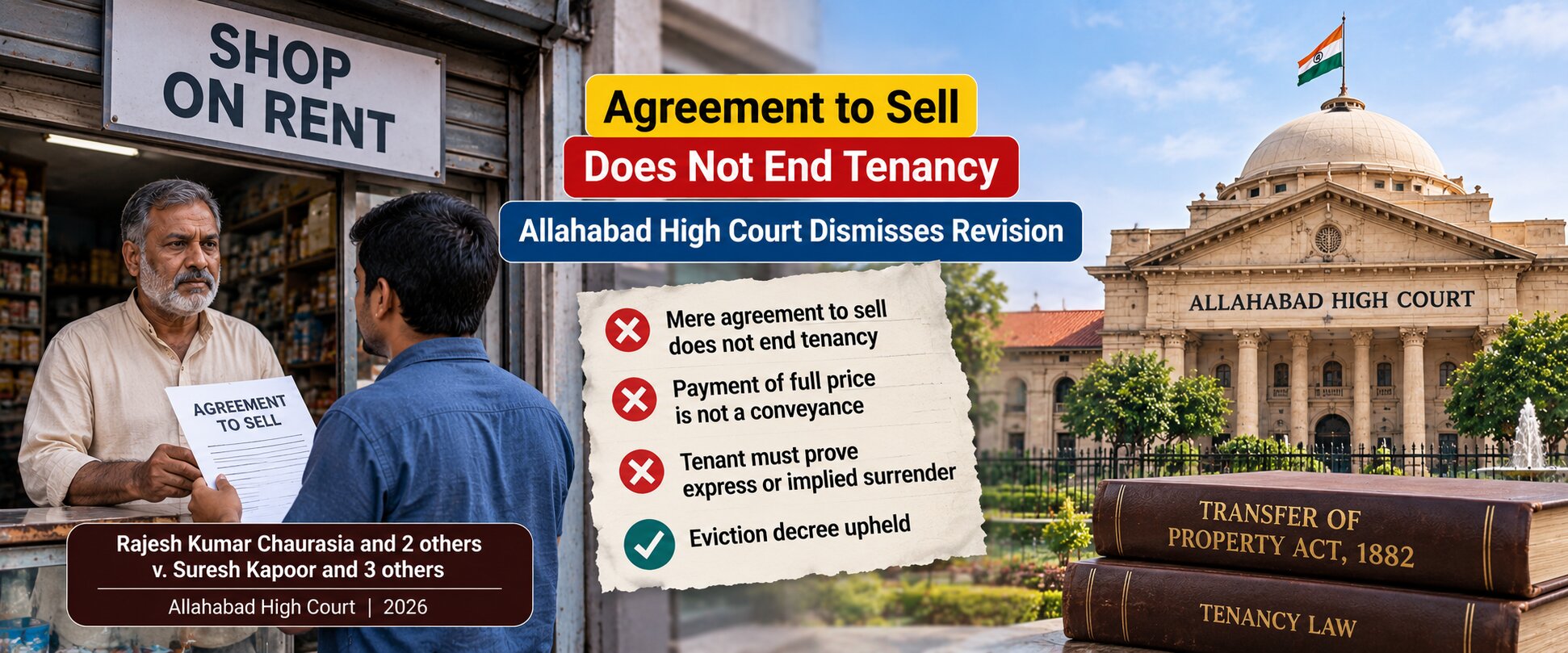
An agreement to sell executed between a landlord and an existing tenant does not automatically terminate the tenancy.
Judgement Details
Court
Allahabad High Court
Date of Decision
21 September 2026
Judges
Justice Dr. Yogendra Kumar Srivastava
Citation
Acts / Provisions
Facts of the Case
-
The dispute concerned a shop situated in Kanpur Nagar, in which the defendants were admittedly tenants.
-
The landlord instituted a suit before the Small Causes Court, Kanpur Nagar in 2019, seeking eviction of the defendants.
-
The landlord alleged that the defendants had defaulted in payment of rent for the period from 1 January 2003 to 31 August 2019.
-
The monthly rent was stated to be ₹3,000.
-
It was pleaded that the tenancy was outside the protective operation of the U.P. Urban Buildings (Regulation of Letting, Rent and Eviction) Act, 1972.
-
The landlord issued a notice dated 1 September 2019 terminating the tenancy and demanding the outstanding rent.
-
During the pendency of the proceedings, the original plaintiff died and was substituted by his legal heirs.
-
The defendants admitted that they had originally entered the property as tenants.
-
However, they contended that on 24 December 2002, an agreement to sell the property had been executed in their favour.
-
They further relied upon a separate possession letter, claiming that possession of the shop had been delivered to them pursuant to the agreement to sell.
-
The defendants asserted that the entire sale consideration of ₹1,10,000 had been paid.
-
On that basis, they argued that their possession after 24 December 2002 was no longer as tenants but was possession in part performance of the agreement to sell under Section 53-A of the Transfer of Property Act.
-
They consequently contended that the landlord-tenant relationship had come to an end and that the eviction proceedings were not maintainable.
-
The Small Causes Court rejected this defence and decreed the suit on 14 May 2026.
-
The defendants thereafter filed a revision before the Allahabad High Court under Section 25 of the Provincial Small Cause Courts Act, 1887.
-
Before the High Court, the defendants argued that the agreement to sell, possession letter and payment of the entire consideration had to be considered together.
-
The respondents argued that the registered agreement to sell itself recorded that possession had not been delivered and would instead be handed over at the time of execution of the sale deed.
-
The respondents further contended that the alleged possession letter was unregistered and disputed, and that none of its attesting witnesses had been examined.
-
The High Court therefore examined whether the agreement to sell had actually brought the tenancy to an end and altered the legal basis of the defendants' possession.
Issues
-
Whether the execution of an agreement to sell between a landlord and an existing tenant automatically terminates the tenancy and changes the legal character of the tenant's possession?
-
Whether the defendants could claim protection under Section 53-A of the Transfer of Property Act, 1882 merely on the basis of the agreement to sell, payment of the entire consideration and their continued physical possession of the property?
-
Whether the defendants had established that the existing tenancy was expressly or impliedly surrendered under Section 111(e) or Section 111(f) of the Transfer of Property Act, 1882?
-
Whether the alleged possession letter was sufficient to establish that the defendants' possession after execution of the agreement to sell was pursuant to the agreement rather than the pre-existing tenancy?
-
Whether the payment of the entire sale consideration of ₹1,10,000 converted the agreement to sell into a conveyance or otherwise terminated the existing tenancy?
-
Whether the notice dated 01.09.2019 terminating the tenancy was invalid merely because some of the rent demanded in the notice was allegedly barred by limitation?
-
Whether the judgment and decree of the Small Causes Court warranted interference in revision under Section 25 of the Provincial Small Cause Courts Act, 1887?
Judgement
-
The Allahabad High Court dismissed the revision filed by the defendants.
-
The Court affirmed the judgment and decree passed by the Small Causes Court.
-
The Court held that an agreement to sell does not, merely by its execution, terminate an existing tenancy.
-
Where the purchaser was already in possession as a tenant, his continued physical possession cannot automatically be treated as possession under the agreement to sell.
-
The Court held that the defendants were required to establish a change in the juridical basis of their possession.
-
Such a change could be established only through cogent material showing that the tenancy had been expressly or impliedly surrendered or otherwise legally determined.
-
The Court found that the registered agreement to sell itself stated that possession would be delivered at the time of execution of the sale deed.
-
This recital was inconsistent with the defendants' claim that possession had already been delivered to them on 24 December 2002 under the agreement.
-
The alleged possession letter was not satisfactorily proved because its attesting witnesses were not examined.
-
The Court held that the mere continuation of physical possession could not establish possession in part performance when the defendants were already occupying the property as tenants.
-
The defendants' payment of the entire sale consideration also did not transform the agreement into a conveyance.
-
The Court observed that an agreement to sell, even after payment of the entire consideration, does not itself transfer title in immovable property.
-
The Court also considered the defendants' subsequent conduct, including their rent deposits from 2016 onwards and proceedings seeking specific performance.
-
This conduct was found inconsistent with the assertion that the tenancy had already ceased in 2002.
-
The Court further held that the notice dated 1 September 2019 was not rendered invalid merely because certain arrears might have been beyond the limitation period.
-
Limitation could affect the amount legally recoverable but did not extinguish the underlying debt or invalidate the notice terminating the tenancy.
-
The Court concluded that the tenancy continued despite the agreement to sell and was validly terminated through the notice.
-
The revision was accordingly dismissed.
Held
-
A tenant seeking to establish that his possession subsequently became possession under an agreement to sell must prove that the legal basis of possession changed.
-
Such change requires evidence of an express or implied surrender of tenancy or another legally recognised mode of determination of the tenancy.
-
Mere continuation of physical possession is insufficient, because the tenant was already physically occupying the property before the agreement.
-
Payment of the entire sale consideration does not by itself convert an agreement to sell into a sale or conveyance.
-
The defendants failed to prove that their possession after 24 December 2002 flowed from the agreement to sell rather than their existing tenancy.
-
The disputed possession letter could not establish delivery of possession in the absence of proper proof, including examination of its attesting witnesses.
-
The registered agreement's recital that possession would be delivered upon execution of the sale deed contradicted the defendants' assertion of earlier delivery.
-
The tenancy therefore continued after the agreement to sell.
-
The notice dated 1 September 2019 validly terminated the tenancy.
-
The revision against the Small Causes Court's decree was therefore dismissed.
Analysis
-
Existing tenancy versus subsequent agreement to sell: The key legal distinction is between the physical fact of possession and the legal basis of possession. A person already occupying property as a tenant does not acquire a new legal character merely because the landlord subsequently agrees to sell the property to him.
-
Juridical basis of possession: The Court's central reasoning was that the defendants needed to establish that their possession had changed from tenancy-based possession to possession referable to the agreement to sell. Without proof of such a change, the law ordinarily attributes continued possession to the original relationship.
-
Section 53-A TPA: Protection under Section 53-A depends upon the statutory requirements of part performance being satisfied. The Court did not treat the agreement to sell itself as sufficient to alter the defendants' existing status as tenants.
-
Surrender of tenancy: The Court relied upon the principles governing express and implied surrender under Section 111(e) and Section 111(f). A tenant cannot simply assert that an agreement to purchase has ended the tenancy; the circumstances must demonstrate that the parties intended the original tenancy to cease.
-
Importance of documentary evidence: The registered agreement was particularly significant because it stated that possession would be delivered when the sale deed was executed. That recital directly conflicted with the defendants' assertion that possession had already been delivered under the agreement.
-
Possession letter: The Court also found the alleged possession letter insufficiently proved. The failure to examine its attesting witnesses weakened the defendants' claim that possession had been formally transferred pursuant to the agreement.
-
Payment of consideration: The judgment reinforces the distinction between an agreement to sell and a completed transfer of ownership. Even payment of the entire consideration does not, by itself, make the agreement a conveyance.
-
Subsequent conduct: The defendants' later conduct, particularly rent deposits and their specific-performance proceedings, was relevant because it did not sit comfortably with the assertion that the tenancy had completely ceased in 2002.
-
Limitation and termination notice: The Court distinguished between the recoverability of arrears and the validity of a notice terminating tenancy. Even if some arrears were time-barred, that did not necessarily invalidate the landlord's notice as a whole.
-
Relevance of Supreme Court precedent: Relying on Nazim Shaikh Hasan v. Nasir Mushtaq Shaikh and Others, the Court reaffirmed that a landlord-tenant relationship does not automatically disappear merely because the tenant subsequently enters into an agreement to purchase the property.
-
Practical significance: The judgment is important for disputes where a tenant claims ownership-related rights based on an agreement to sell with the landlord. It makes clear that the tenant must establish not merely the agreement and payment but also the legal transition from tenancy to possession under the contract of sale.