
RAJAT KUMAR AND OTHERS v. S D ADARSH JAIN KANYA MAHA VIDYALAYA SADHAURA AND OTHERS, 2026
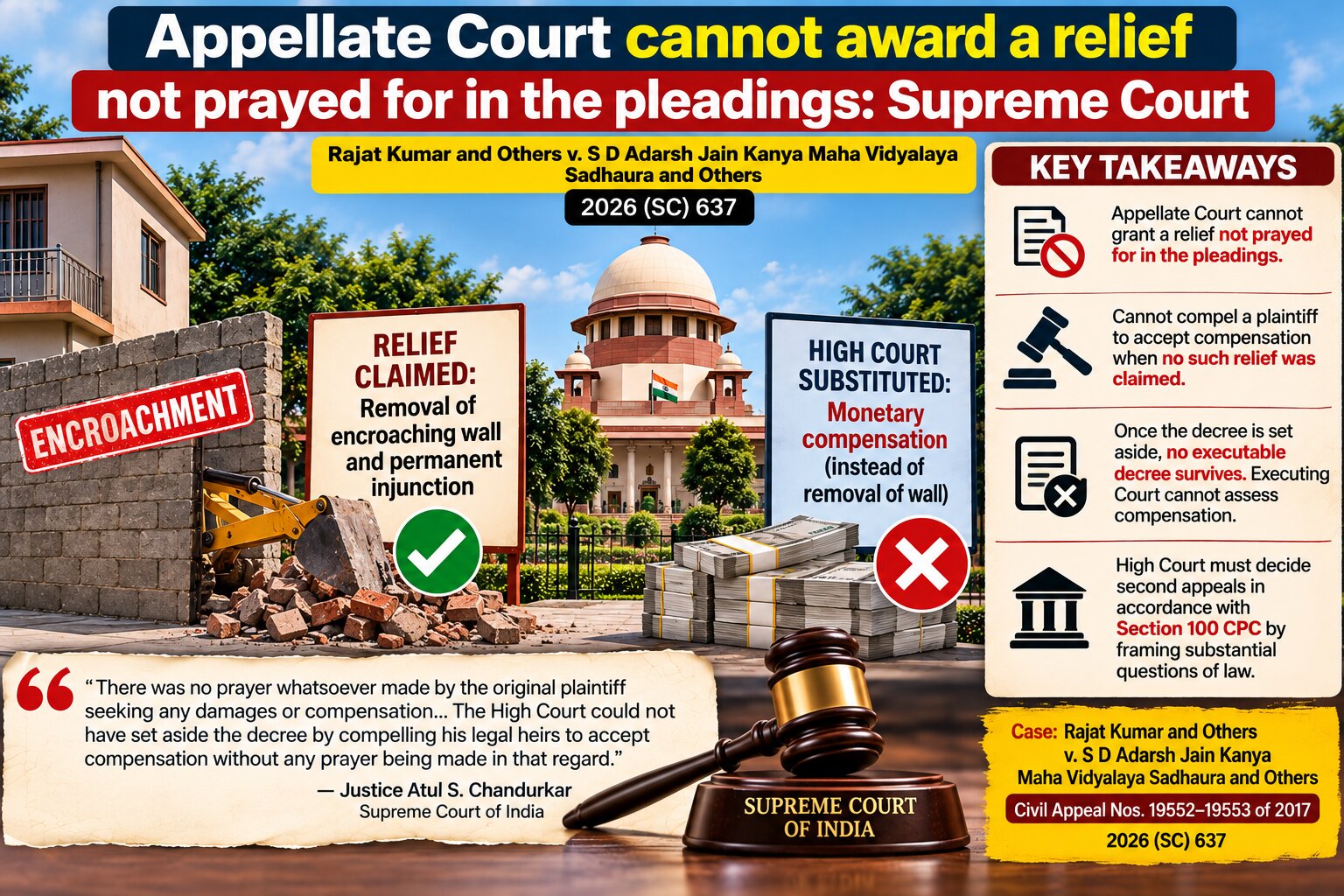
The High Court must exercise second appellate jurisdiction only in accordance with the statutory requirement concerning substantial questions of law.
Judgement Details
Court
Supreme Court of India
Date of Decision
3 September 2026
Judges
Justice S.V.N. Bhatti and Justice Atul S. Chandurkar
Citation
Acts / Provisions
Facts of the Case
-
The original plaintiff, Om Parkash, instituted civil proceedings against the respondents concerning alleged illegal construction and encroachment affecting his property.
-
In the first suit, the plaintiff alleged that the defendants had constructed a wall on common open space beyond his house.
-
According to the plaintiff, the construction interfered with his enjoyment of air and light through ventilators and also obstructed the passage of water through a common path.
-
The plaintiff therefore sought a mandatory injunction directing the defendants to remove the alleged encroachment.
-
He also sought a permanent injunction restraining the defendants from making any further construction.
-
The Trial Court decreed the suit on 6 February 2006 and directed removal of the offending wall and further restrained the defendants from making additional construction.
-
The defendants challenged the decree before the first Appellate Court.
-
The first Appellate Court dismissed the appeal on 5 September 2007 and affirmed the Trial Court's decree.
-
The defendants thereafter approached the Punjab and Haryana High Court in second appeal.
-
The High Court, in its judgment dated 25 November 2011, modified the decree and directed payment of ₹10,000 with 12% interest, representing half of the expenditure incurred on construction of the disputed walls.
-
The High Court further directed that upon payment, the disputed wall would be treated as a common wall.
-
The legal heirs of the original plaintiff challenged this modification before the Supreme Court.
-
In 2013, the Supreme Court set aside the High Court's earlier judgment because the High Court had failed to properly frame substantial questions of law as required under Section 100 CPC.
-
The matters were consequently remanded to the High Court.
-
On remand, the High Court again set aside the decrees in favour of the plaintiff.
-
Instead of ordering removal of the disputed construction, the High Court directed the Executing Court to assess the value of the construction and award monetary compensation to the plaintiffs.
-
The legal heirs of the original plaintiff again approached the Supreme Court.
-
The Supreme Court examined whether the High Court could substitute compensation for the relief actually claimed and decreed and whether an Executing Court could be directed to determine compensation after the decree itself had been set aside.
Issues
-
Whether a High Court exercising jurisdiction under Section 100 CPC can substitute a relief not sought in the pleadings for the relief granted by the Trial Court and affirmed by the first Appellate Court?
-
Whether an Appellate Court can compel a plaintiff or the plaintiff's legal heirs to accept monetary compensation when no damages or compensation were claimed in the pleadings and no consent was given for such relief?
-
Whether an Executing Court can be directed to assess the value of a disputed construction after the decree in favour of the plaintiff has been set aside?
-
Whether an Executing Court can undertake an exercise for determining compensation when no subsisting executable decree authorises such determination?
-
Whether the High Court was justified in deciding the second appeals without properly framing and adjudicating substantial questions of law as required under Section 100 CPC?
-
Whether the High Court was justified in setting aside the concurrent decrees of the Trial Court and first Appellate Court on considerations unrelated to a properly formulated substantial question of law?
Judgement
-
The Supreme Court allowed the appeals filed by the legal heirs of the original plaintiff.
-
The Court held that the High Court had erred in setting aside the decrees for mandatory injunction and compelling the plaintiffs to accept monetary compensation.
-
The Supreme Court found that the original plaintiff had made no prayer for damages or compensation.
-
The Court held that the absence of such a prayer prevented the High Court from replacing the decreed relief with a monetary remedy, particularly when the legal heirs had not consented to that course.
-
The Supreme Court further held that after the High Court set aside the Trial Court's decrees, there was no subsisting decree available for execution.
-
Consequently, the High Court could not direct the Executing Court to assess the value of the disputed wall for determining compensation.
-
The Court held that such an exercise had no legal foundation under Order XXI CPC.
-
The Supreme Court also found that the High Court had again failed to properly exercise its jurisdiction under Section 100 CPC.
-
The Court therefore set aside the impugned High Court judgment.
-
Instead of finally deciding the underlying encroachment dispute itself, the Supreme Court remanded both second appeals to the High Court for consideration in accordance with Section 100 CPC.
-
The High Court was requested to decide the second appeals on their own merits and to do so expeditiously because the second appeals had originally been instituted in 2008.
-
The appeals before the Supreme Court were allowed with no order as to costs.
Held
-
Relief cannot ordinarily travel beyond the pleadings: An Appellate Court cannot compel a plaintiff to accept a form of relief that was never sought in the pleadings, particularly where the plaintiff has not consented to such relief.
-
No compensation without a corresponding claim: Since the original plaintiff never claimed damages or compensation for the encroachment, the High Court could not substitute compensation for the mandatory injunction.
-
Consent matters: The legal heirs of the original plaintiff had not consented to the substitution of the injunctive relief with monetary compensation.
-
Execution depends upon a subsisting decree: An Executing Court can execute an existing decree; once the decree has been set aside, there is no decree upon which execution proceedings can operate.
-
Executing Court cannot create new relief: The Executing Court cannot be directed to undertake an independent valuation exercise for creating compensation where no executable decree authorises it.
-
Order XXI CPC does not support such valuation: The High Court's direction to the Executing Court to value the disputed wall after setting aside the decree had no support under Order XXI CPC.
-
Fresh consideration required: Since the High Court's earlier decision had not properly proceeded on substantial questions of law, the Supreme Court remanded the second appeals for fresh adjudication on merits in accordance with Section 100 CPC.
Analysis
- First, relief must ordinarily remain within the framework of the pleadings. A Court cannot compel a plaintiff to accept compensation when no such relief was claimed.
- Second, an Executing Court cannot act without a subsisting decree. Once the High Court set aside the decree directing removal of the encroachment, there was no decree left for execution and therefore no basis for directing the Executing Court to value the disputed wall and determine compensation.
- Third, Section 100 CPC strictly limits the jurisdiction of the High Court in second appeals. Interference with concurrent findings requires a properly formulated and adjudicated substantial question of law.
- The judgment therefore preserves the distinction between pleadings, appellate adjudication and execution, and prevents an appellate or executing Court from creating a new substantive remedy that was neither pleaded nor supported by a surviving decree.