
Rajashreeben W/o Bhupendrakumar Patel v. Bhupendrakumar Ambalal Patel, 2026
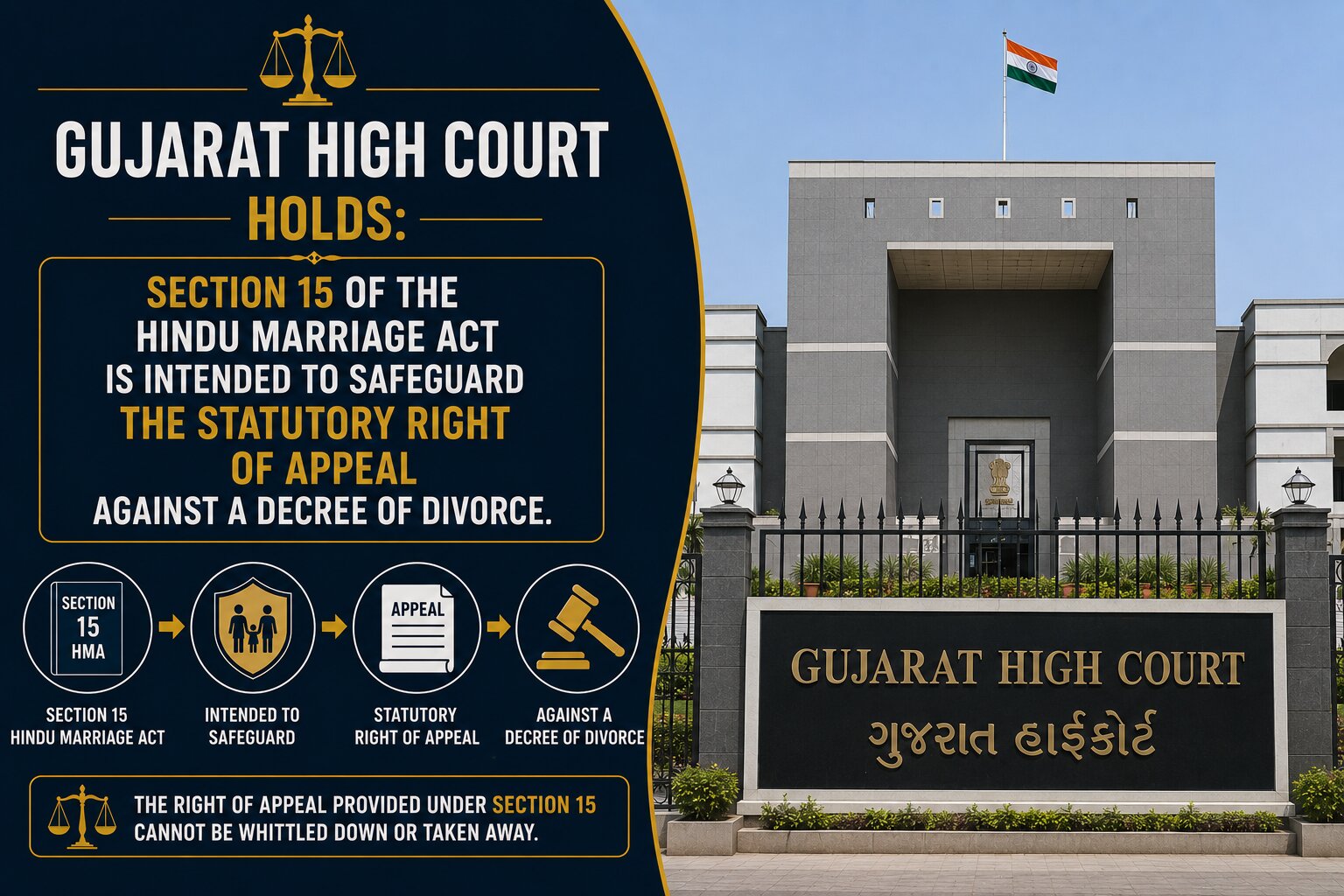
The judgment emphasizes the protective purpose of Section 15 of the Hindu Marriage Act, ensuring that the statutory right of appeal is not rendered illusory by a hasty second marriage.
Judgement Details
Court
Gujarat High Court
Date of Decision
13 July 2026
Judges
Justice Ilesh J. Vora and Justice R.T. Vachhani
Citation
Acts / Provisions
Facts of the Case
-
The husband instituted divorce proceedings under the Hindu Marriage Act, 1955 before the Family Court.
-
The Family Court granted a decree of divorce in favour of the husband on 15 May 2024.
-
Along with the decree of divorce, the Family Court awarded permanent alimony and medical expenses to the wife.
-
Aggrieved by the decree, the wife preferred a First Appeal before the Gujarat High Court challenging the judgment and also filed an application seeking stay of the divorce decree.
-
During the pendency of the appeal, the husband contracted a second marriage on 11 July 2024, which was subsequently registered on 15 July 2024.
-
The husband argued that his second marriage was valid because, on the date of the marriage, no appeal had yet been presented before the High Court.
-
The wife contended that the second marriage defeated the statutory protection available under Section 15 of the Hindu Marriage Act, as it effectively deprived her of her right to pursue the appeal against the divorce decree.
-
The High Court was called upon to determine whether the divorce decree should be stayed pending disposal of the wife's appeal.
Issues
-
Whether Section 15 of the Hindu Marriage Act, 1955 protects the right of a spouse to effectively pursue an appeal against a decree of divorce before the other spouse contracts a second marriage?
-
Whether the husband's act of contracting a second marriage immediately after the divorce decree, during the period available for filing an appeal, defeated the object of Section 15 of the Hindu Marriage Act?
-
Whether the wife established a prima facie case warranting grant of interim stay of the Family Court's decree of divorce pending disposal of the appeal?
-
Whether refusal to grant interim stay would cause irreparable injury to the wife by affecting her marital status and other legal rights?
Judgement
-
The Gujarat High Court held that Section 15 of the Hindu Marriage Act is intended to safeguard the statutory right of appeal against a decree of divorce.
-
The Court observed that the purpose of Section 15 is to prevent legal and factual complications arising from a second marriage contracted before appellate remedies are exhausted.
-
The Court held that a spouse seeking to remarry must exercise due diligence to ascertain whether an appeal has been filed against the decree of divorce.
-
The Court observed that by contracting a second marriage immediately after the decree of divorce, the husband effectively deprived the wife of her legitimate right to pursue her appeal on merits.
-
The Court found that the wife had established a prima facie case in her favour.
-
The Court further held that the balance of convenience strongly favoured the wife, as refusal to grant interim relief would result in irreparable injury by depriving her of her legal status as wife and adversely affecting her pending legal rights.
-
The Court clarified that its observations were only prima facie and confined to the facts of the present case without expressing any final opinion on the merits of the appeal.
-
Accordingly, the High Court stayed the execution, operation, and implementation of the Family Court's decree of divorce until final disposal of the appeal.
Held
-
Section 15 of the Hindu Marriage Act, 1955 protects the statutory right of a party to pursue an appeal against a decree of divorce.
-
Contracting a second marriage immediately after the decree of divorce, without ensuring that no appeal has been filed, may frustrate the object of Section 15.
-
The wife established a prima facie case, and the balance of convenience favoured grant of interim relief.
-
The Family Court's decree of divorce was stayed pending final disposal of the appeal.
Analysis
-
The Court adopted a purposive interpretation of Section 15 by focusing on preserving the effectiveness of appellate remedies rather than merely the chronology of filing and remarriage.
-
The decision highlights that matrimonial litigation does not attain practical finality until appellate rights have been meaningfully exercised or exhausted.
-
By granting interim stay, the Court sought to preserve the status quo and prevent irreversible consequences affecting the wife's legal status and related matrimonial rights.
-
The ruling underscores that courts must consider the likelihood of irreparable injury in matrimonial disputes where a change in marital status could prejudice pending proceedings.
-
The Court carefully limited its observations to the peculiar facts of the case, expressly stating that the order should not be treated as a precedent, thereby avoiding an authoritative pronouncement on the broader interpretation of Section 15.
-
Overall, the judgment reinforces the importance of protecting appellate rights in matrimonial disputes while balancing competing equities through interim relief.