
Raja Ram Dangi v. State of Madhya Pradesh, 2026
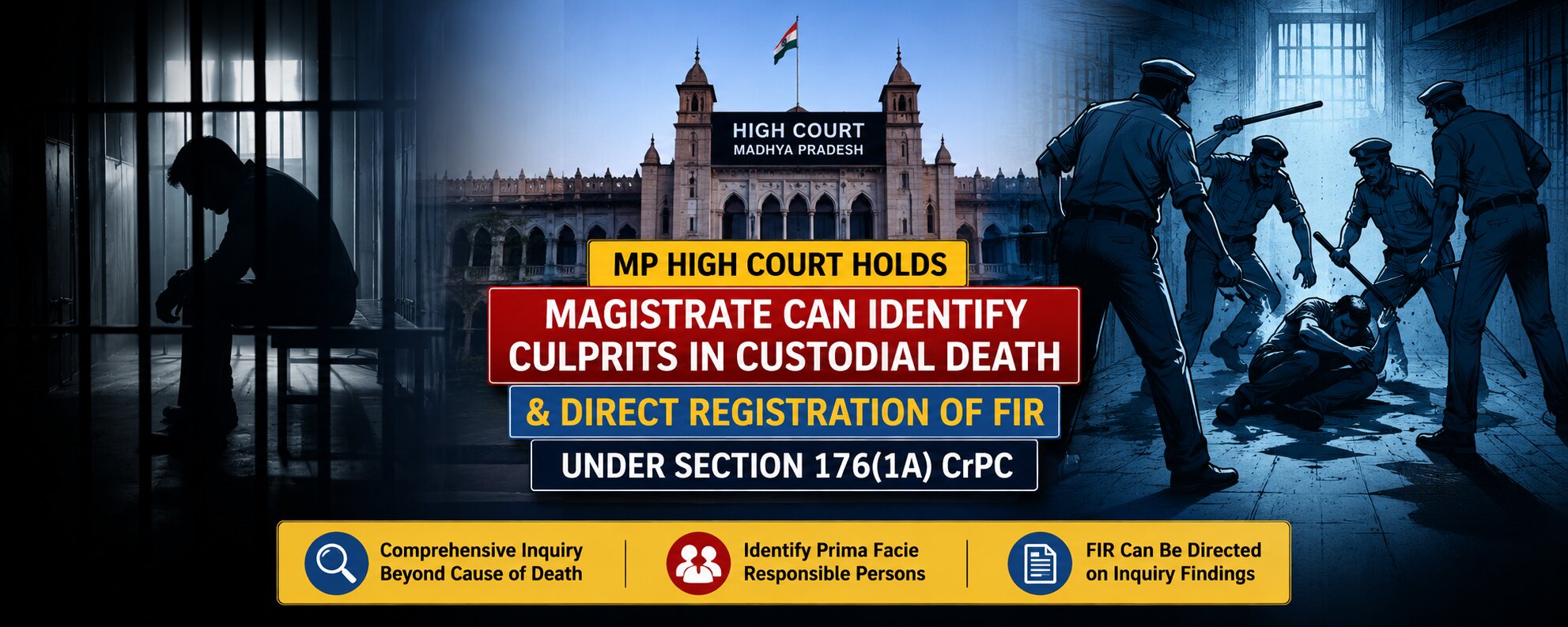
The Magistrate's jurisdiction under Section 176(1A) CrPC is not confined merely to ascertaining the medical or physiological cause of a custodial death.
Judgement Details
Court
High Court of Madhya Pradesh
Date of Decision
10 August 2026
Judges
Justice Jai Kumar Pillai
Citation
Acts / Provisions
Facts of the Case
-
e case arose out of the alleged custodial death of a jail inmate named Bheru in the District Jail, Dhar.
-
Bheru allegedly died after being assaulted by members of a search team inside the jail.
-
The alleged assault followed the recovery of a packet of tobacco, which was allegedly supplied by Bheru to another inmate.
-
Another inmate, referred to as “A”, was also allegedly injured during the incident and survived.
-
A judicial inquiry under Section 176(1A) CrPC was ordered into Bheru's custodial death.
-
A medical board conducted the post-mortem examination of the deceased.
-
The medical board described the manner of death as “open and unknown” and stated that a final opinion could be given only after receiving and examining the viscera report.
-
During the judicial inquiry, the Magistrate personally visited the jail premises.
-
The Magistrate recorded statements of convicts and undertrial prisoners who allegedly stated that the Jailor and other jail personnel had assaulted Bheru and inmate “A” with sticks and belts.
-
On the basis of the evidence collected during the inquiry, the Magistrate concluded that the incident involved custodial violence and implicated the Jail Superintendent, subordinate jail staff and empanelled doctors for their alleged respective roles.
-
The Magistrate also made findings concerning deliberate negligence and destruction of vital evidence.
-
One of the petitioners, the Jail Superintendent, argued that he was not part of the search team and was not physically present at the spot, claiming that he merely held the official position of Superintendent of the District Jail.
-
The petitioners argued that the Magistrate's jurisdiction under Section 176(1A) CrPC was limited to determining the cause and nature of death.
-
They contended that the Magistrate had exceeded his jurisdiction by identifying alleged perpetrators and directing registration of an FIR, which according to them amounted to conducting a parallel criminal trial.
-
The petitioners also relied upon the Superintendent's 32 years of clean service record.
-
The empanelled doctors argued that they had discharged their statutory duties bona fide and that the physiological cause of death could not yet be scientifically determined because the viscera report was awaited.
-
The State and the deceased's father, however, alleged that Bheru had suffered a brutal and fatal assault by jail personnel while inside the secure premises of the jail.
-
It was further alleged that the Jail Superintendent was present at the crime scene and deliberately ignored the deceased's cries.
-
The respondents alleged that the autopsy report was deliberately vague and that the injuries on Bheru's body were similar to those suffered by inmate “A”.
-
It was also alleged that the doctors intentionally omitted important details from the medical documentation to protect the persons responsible for the assault.
-
The petitioners consequently challenged the judicial inquiry report and the consequential registration of the FIR before the High Court.
Issues
-
Whether a Magistrate conducting an inquiry under Section 176(1A) CrPC into a custodial death is confined merely to determining the physiological or medical cause and nature of death?
-
Whether a Magistrate conducting an inquiry under Section 176(1A) CrPC is empowered to conduct a comprehensive inquiry into the circumstances surrounding a custodial death?
-
Whether the Magistrate exceeded his jurisdiction by identifying and naming persons who were prima facie responsible for the custodial death?
-
Whether the Magistrate was legally empowered, on the basis of his inquiry findings, to direct registration of an FIR against the persons allegedly responsible for the custodial death?
-
Whether the Magistrate's identification of the alleged perpetrators amounted to conducting a parallel criminal trial beyond the scope of Section 176(1A) CrPC?
-
Whether the material collected during the judicial inquiry, including the statements of inmates and the circumstances surrounding the injuries, justified the findings recorded by the Magistrate?
-
Whether Section 106 of the Indian Evidence Act could be applied to place the burden upon the jail administration to explain circumstances concerning injuries suffered by a person who died in its custody?
-
Whether the Magistrate acted within his jurisdiction by refraining from directly initiating administrative or departmental misconduct proceedings against the empanelled doctors?
Judgement
-
The Madhya Pradesh High Court dismissed the writ petitions filed by the Superintendent of the District Jail, Dhar, and the empanelled doctors.
-
The Court held that the power of a Magistrate under Section 176(1A) CrPC is not narrowly restricted to determining the physiological or medical cause of death.
-
The Court held that the Magistrate can conduct a comprehensive and holistic inquiry into the circumstances surrounding a custodial death.
-
According to the Court, such an inquiry may include examination of the complete sequence of events and the specific circumstances in which the custodial incident occurred.
-
The Court held that the Magistrate was empowered to identify and name persons whose acts or omissions prima facie contributed to the fatality.
-
The Court rejected the petitioners' argument that identifying alleged perpetrators amounted to conducting a parallel criminal trial.
-
The Court found that the Magistrate had rigorously and objectively examined the ocular and documentary evidence before reaching his conclusions.
-
The Court upheld the consequential registration of the FIR based upon the findings recorded during the judicial inquiry.
-
The Court also concurred with the Magistrate's application of Section 106 of the Indian Evidence Act, particularly in view of the fact that the deceased was in the custody of the jail administration.
-
The Court observed that the Magistrate had remained conscious of the limits of his jurisdiction.
-
In particular, the Magistrate had not directly initiated administrative or departmental misconduct proceedings against the doctors because he did not possess the mandate to do so.
-
Instead, that aspect was appropriately left to the Principal District and Sessions Judge, acting as the Special Judge of the District Human Rights Court.
-
The Court therefore upheld the judicial inquiry report and the consequential FIR.
Held
- The Magistrate may undertake a comprehensive and holistic inquiry into the circumstances surrounding the death.
-
The Magistrate may identify persons who are prima facie responsible for the custodial death.
-
The Magistrate may direct registration of an FIR on the basis of findings arising from the inquiry.
-
Identifying alleged perpetrators during such an inquiry does not, by itself, amount to conducting a criminal trial.
-
The Magistrate's findings must still be understood within the limits of the inquiry and the subsequent criminal process.
-
The application of Section 106 of the Indian Evidence Act was considered appropriate in relation to circumstances particularly within the knowledge of the jail administration.
-
The Magistrate correctly refrained from directly initiating departmental proceedings against the doctors, leaving that matter to the competent authority.
-
The writ petitions were consequently dismissed, and the judicial inquiry report and consequential FIR were upheld.
Analysis
-
Broad interpretation of Section 176(1A) CrPC: The central importance of the judgment lies in its interpretation of Section 176(1A) as authorizing more than a narrow medical inquiry into the cause of death. The Court treated the provision as permitting an examination of the circumstances in which a custodial death occurred.
-
Comprehensive and holistic inquiry: The judgment recognizes that a custodial death cannot always be meaningfully investigated by examining only the final physiological cause of death. The circumstances leading to the death, conduct of custodial personnel, witness accounts and surrounding evidence may be necessary to understand what actually happened.
-
Identification of prima facie perpetrators: The Court made an important distinction between identifying persons who appear prima facie responsible and finally determining their criminal guilt. The Magistrate's identification of alleged perpetrators does not substitute for the criminal trial.
-
Power to facilitate criminal proceedings: By upholding the direction for registration of an FIR, the Court recognized that a Section 176(1A) inquiry can have consequences beyond merely recording a finding concerning the death. Where the inquiry discloses material indicating criminal conduct, registration of an FIR can follow.
-
Custodial accountability: The judgment places significant emphasis on the special circumstances of custodial deaths. A person who dies inside a jail is under the control and protection of the State. Consequently, the circumstances surrounding injuries suffered in custody require particularly careful scrutiny.
-
Application of Section 106 of the Evidence Act: The Court's reliance on Section 106 reflects the principle that where certain facts are especially within the knowledge of a particular party, that circumstance can assume importance in determining whether an adequate explanation has been provided.
-
Importance of independent judicial inquiry: The judgment reinforces the importance of judicial scrutiny where a death occurs within a custodial institution. The Magistrate was permitted to examine evidence independently rather than being limited exclusively to the conclusions of the medical board.
-
Medical evidence and pending viscera report: The petitioners argued that the doctors were justified in withholding a final medical opinion until the viscera report was available. However, the Court considered the broader material gathered during the judicial inquiry, including allegations concerning injuries and the conduct of jail personnel.
-
Jurisdictional restraint: At the same time, the Court recognized that the Magistrate did have limits. The Magistrate did not directly initiate departmental proceedings against the doctors and instead left the administrative question to the competent authority.
-
Impact on custodial-death inquiries: The judgment strengthens the role of a Magistrate conducting an inquiry into a custodial death. Such an inquiry can examine not merely how a person died medically, but also the surrounding circumstances and persons who may be prima facie responsible.
-
Impact on criminal proceedings: The judgment indicates that the inquiry report may provide a basis for registration of an FIR. However, the identification of persons in the inquiry should not be confused with a final adjudication of criminal liability.
-
Overall legal significance: The judgment therefore adopts a functional approach to Section 176(1A) CrPC, emphasizing effective investigation, custodial accountability and judicial scrutiny, while maintaining the distinction between an inquiry, criminal investigation and final criminal adjudication.