
Rahul v. State of Uttar Pradesh & Another, 2026
A plea of alibi is not subject to an absolute rule that it can never be considered before trial.
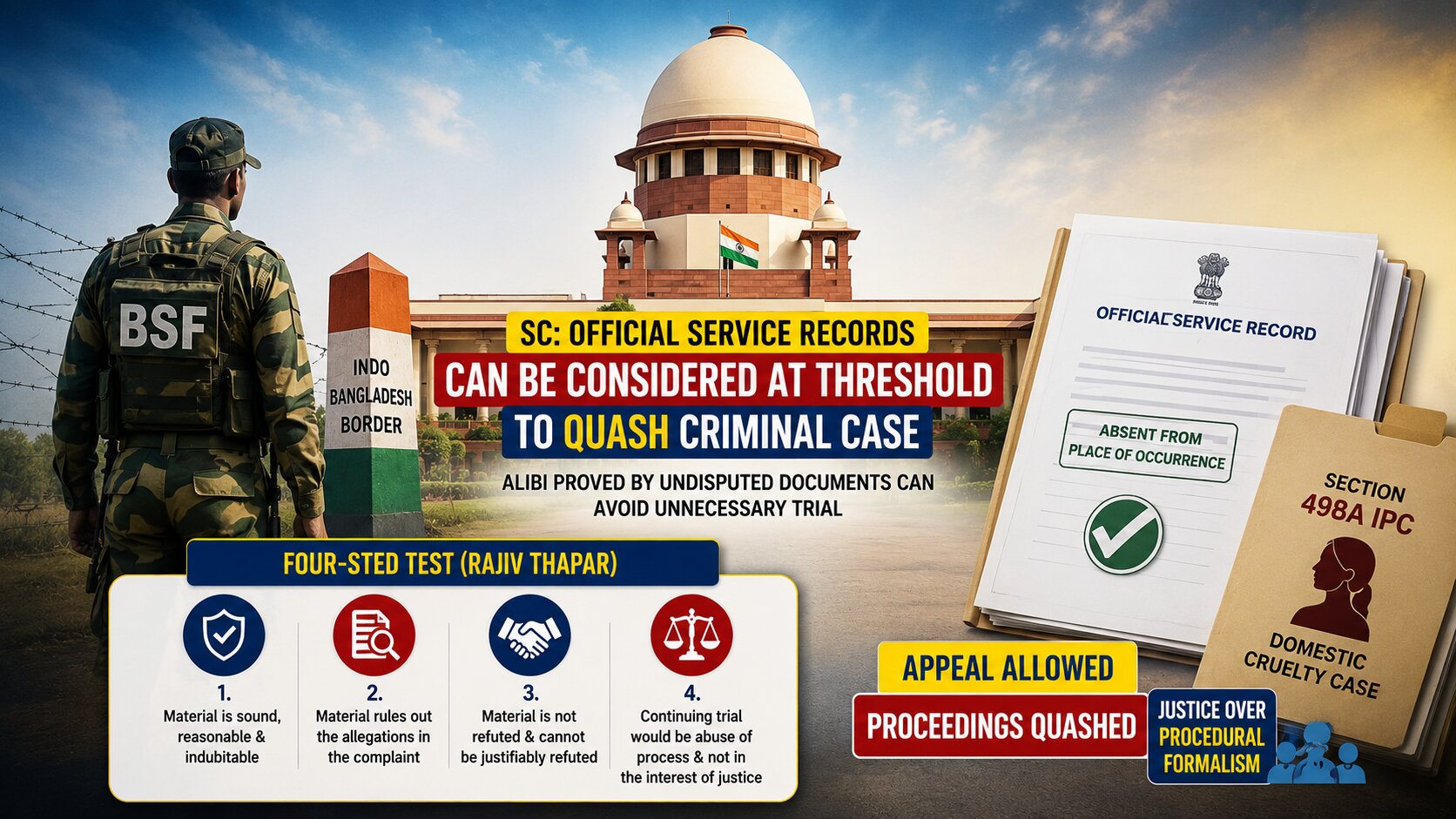
Judgement Details
Court
Supreme Court of India
Date of Decision
13 August 2026
Judges
Justice Sanjay Karol and Justice Augustine George Masih
Citation
Acts / Provisions
Facts of the Case
-
The appellant, Rahul, was a personnel of the Border Security Force (BSF).
-
Criminal proceedings were initiated against him in connection with allegations of domestic cruelty under Section 498A IPC.
-
The alleged incident had occurred in Uttar Pradesh.
-
At the relevant time, the appellant claimed that he was posted on duty in a border area and was not physically present in Uttar Pradesh when the alleged occurrence took place.
-
The appellant relied upon official service records and service certificates to establish his absence from the place of occurrence.
-
The official records were maintained in the ordinary course of duty by the Armed Forces/BSF authorities.
-
According to the material before the Supreme Court, the service records had been produced from an early stage of the investigation.
-
The prosecution had not established that these official records were forged, fabricated or otherwise unreliable.
-
The investigating officer had also acknowledged material indicating that the appellant was on duty at the relevant time.
-
The appellant therefore sought to rely upon the documentary material as establishing an alibi.
-
The appellant approached the High Court seeking quashing of the criminal proceedings.
-
The Allahabad High Court declined to consider the service documents at the threshold.
-
The High Court relied upon the principle that a plea of alibi ordinarily involves a question of fact that should be established during trial.
-
The High Court relied upon Rajendra Singh v. State of Uttar Pradesh (2007) in refusing to adjudicate upon the appellant's alibi at the pre-trial stage.
-
The appellant challenged the High Court's decision before the Supreme Court.
-
The Supreme Court examined whether the general rule concerning proof of alibi at trial prevented a High Court from considering reliable, undisputed and unimpeachable official records at the threshold stage.
-
The Supreme Court distinguished the factual circumstances in Rajendra Singh, observing that the material relied upon there was materially different from the official service records involved in the present case.
-
The Court found that the service records in the present case possessed a substantially higher degree of reliability because they were official records maintained in the ordinary course of duty and had not been seriously disputed by the prosecution.
Issues
-
Whether the High Court was justified in declining to examine at the threshold the effect of official service records establishing the appellant's absence from the place of occurrence?
-
Whether a plea of alibi must invariably be established only during trial and cannot, under any circumstances, be considered by the High Court while exercising its inherent jurisdiction to quash criminal proceedings?
-
Whether reliable, undisputed and unimpeachable official documents establishing the accused's absence from the place of occurrence can be considered at the threshold stage while determining whether continuation of criminal proceedings would amount to an abuse of process?
-
Whether the High Court was correct in relying upon Rajendra Singh v. State of Uttar Pradesh to refuse consideration of the appellant's official service records despite the materially different factual circumstances of that case?
-
Whether the four-step test laid down in Rajiv Thapar v. Madan Lal Kapoor permits the High Court to consider sterling and incontrovertible defence material where such material conclusively undermines the factual basis of the criminal allegations?
-
Whether continuation of the criminal proceedings against an accused whose absence from the place of occurrence is established by unimpeachable official records would amount to an abuse of the process of the court and defeat the ends of justice?
Judgement
-
The Supreme Court allowed the appeal filed by the appellant.
-
The Court set aside the order of the Allahabad High Court.
-
The Supreme Court held that the High Court had erred in treating the plea of alibi as a matter that could never be considered at the threshold stage.
-
The Court clarified that the proposition that an accused ordinarily has to establish an alibi during trial is not an inflexible or absolute rule.
-
The Court held that reliable documentary material can, in an appropriate case, be considered by the High Court while exercising its inherent jurisdiction.
-
The Court particularly emphasised the distinction between ordinary defence evidence requiring factual adjudication and official material of sterling and unimpeachable quality.
-
The service records relied upon by the appellant were official records maintained in the ordinary course of duty.
-
The records had been placed before the investigating authorities at an early stage and their authenticity had not been seriously challenged.
-
The records indicated that the appellant was performing official duty away from the place of occurrence at the relevant time.
-
The Supreme Court therefore considered the documents to possess the character of unimpeachable material.
-
The Court distinguished Rajendra Singh v. State of Uttar Pradesh, holding that the factual circumstances in that case did not justify applying its principle mechanically to the present case.
-
The Court relied upon the principles in Rajiv Thapar v. Madan Lal Kapoor, particularly the four-step test for determining when defence material can justify quashing criminal proceedings at the threshold.
-
The Court concluded that compelling an accused to undergo a full criminal trial despite reliable official records conclusively establishing his absence could amount to an unnecessary abuse of the judicial process.
-
The pending criminal proceedings against the appellant were consequently quashed.
Held
-
The High Court may consider defence material at the threshold where that material is sterling, unimpeachable, reliable and incapable of being reasonably disputed.
-
Official service records maintained in the ordinary course of duty can, in an appropriate case, constitute such unimpeachable material.
-
The ordinary rule that an accused should prove an alibi during trial does not prevent consideration of documentary evidence where the material conclusively establishes the accused's absence.
-
The source, nature, authenticity and reliability of the documentary material must be examined before deciding whether it can be considered at the threshold.
-
The mere fact that the material is produced by the accused does not automatically make it inadmissible or irrelevant for the limited purpose of exercising inherent jurisdiction.
-
Rajendra Singh does not establish an absolute prohibition against considering documentary evidence relating to alibi at the threshold.
-
The principles in Rajiv Thapar permit consideration of defence material where it is of sterling quality, effectively demolishes the prosecution's factual assertions, remains unrebutted or cannot reasonably be rebutted, and continuation of the prosecution would constitute an abuse of process.
-
Where all four requirements are satisfied, the High Court may exercise its inherent powers to quash the criminal proceedings.
-
In the present case, continuation of the proceedings despite the unimpeachable official service records would not advance the ends of justice.
-
The criminal proceedings against the appellant were therefore quashed.
Analysis
-
Court's reasoning: The Supreme Court adopted a pragmatic approach to the exercise of inherent jurisdiction. It recognised that although criminal trials are normally the appropriate forum for testing disputed facts, this principle cannot be converted into an absolute procedural barrier where indisputable official material completely undermines the factual foundation of the prosecution.
-
Alibi and burden of proof: Ordinarily, an accused who raises a plea of alibi carries the evidentiary burden of establishing that he was somewhere else when the offence occurred. However, the judgment distinguishes between the ordinary evidentiary burden at trial and the High Court's separate jurisdiction to prevent abuse of criminal process.
-
Importance of documentary evidence: The crucial factor was not simply that the appellant produced documents. The decisive consideration was the quality and reliability of the documents. They were official service records, maintained in the ordinary course of duty, produced at an early stage and not shown to be fabricated.
-
Threshold scrutiny: The judgment does not permit accused persons to routinely introduce disputed defence evidence at the quashing stage. The threshold remains high. Courts must be satisfied that the material is so reliable and incontrovertible that insisting upon a full trial would serve little legitimate purpose.
-
Distinction from Rajendra Singh: The Supreme Court carefully distinguished the earlier case rather than rejecting its general principle. In Rajendra Singh, the alibi material involved a sworn private affidavit whose credibility could be tested through trial and cross-examination. The present case involved official records with a fundamentally different evidentiary character.
-
Rajiv Thapar four-step test: The judgment gives practical significance to the four-step test laid down in Rajiv Thapar. The defence material should be sound and indubitable; it should effectively rule out the prosecution's allegations; it should remain unrebutted or incapable of reasonable rebuttal; and continuation of the prosecution should amount to an abuse of process.
-
First step — quality of material: The material must be of sterling and impeccable quality. A disputed private document or a self-serving statement would ordinarily not satisfy this requirement.
-
Second step — destruction of prosecution case: The material must be sufficiently powerful to rule out the factual assertions underlying the criminal charge. It is not enough merely to create a possible alternative version.
-
Third step — absence of effective rebuttal: The prosecution must not have a credible basis to dispute the material. Where authenticity or accuracy can reasonably be challenged, the matter may ordinarily have to proceed to trial.
-
Fourth step — abuse of process: Even where defence material is strong, the ultimate question is whether continuation of the prosecution would constitute an abuse of process or would fail to serve the ends of justice.
-
Substantial justice over procedural formalism: One of the most significant aspects of the judgment is the Court's refusal to allow procedural rules to produce an obviously unjust result. The Court reasoned that forcing an accused who was demonstrably absent from the scene to undergo a full criminal trial could elevate procedural formalism over substantive justice.
-
Judicial restraint remains important: The judgment should not be understood as granting High Courts a general power to conduct a mini-trial. The Court's reasoning is confined to cases involving exceptionally reliable and unimpeachable material.
-
Protection against vexatious prosecution: The decision strengthens the protective function of Section 482 CrPC. In appropriate cases, the inherent jurisdiction of the High Court can prevent an accused from being subjected to a prolonged criminal process where the foundational allegation is conclusively contradicted by undisputed official records.
-
Balance between prosecution and accused: The judgment maintains a balance. Genuine factual disputes should normally be resolved through trial, but courts are not required to ignore documentary material whose authenticity and reliability are beyond reasonable dispute.
-
Impact on existing law: The judgment clarifies the scope of the principles in Rajendra Singh and reinforces the four-step framework in Rajiv Thapar. It therefore represents an important clarification of when defence material may be considered while exercising the High Court's inherent jurisdiction.
-
Practical significance: Accused persons seeking quashing on the basis of alibi cannot rely merely on their own assertions. They would need material of exceptional quality—such as undisputed official records—that conclusively establishes the relevant fact and satisfies the Rajiv Thapar requirements.
-
Significance for Section 498A proceedings: The case is particularly relevant to matrimonial criminal proceedings because allegations under Section 498A may concern events occurring at a particular place and time. Where official records conclusively establish that an accused was elsewhere, the judgment provides a basis for seeking threshold consideration of such evidence in an appropriate case.
- Four-Step Rajiv Thapar Test
-
Step 1 — Sterling quality: Whether the defence material is sound, reasonable, indubitable and of impeccable quality.
-
Step 2 — Contradiction of allegations: Whether the material effectively rules out the factual assertions contained in the complaint or charges.
-
Step 3 — Rebuttal: Whether the prosecution or complainant has failed to refute the material, or whether the material is incapable of being reasonably refuted.
-
Step 4 — Abuse of process: Whether allowing the criminal proceedings to continue would amount to an abuse of the process of the court and would not serve the ends of justice.
-
If all four requirements are affirmatively satisfied, the High Court may exercise its inherent jurisdiction to quash the criminal proceedings.