
Rafikmiya Ahmedmiya Malek v. State of Gujarat & Sirajbhai Rasulbhai Vora v. State of Gujarat, 2026
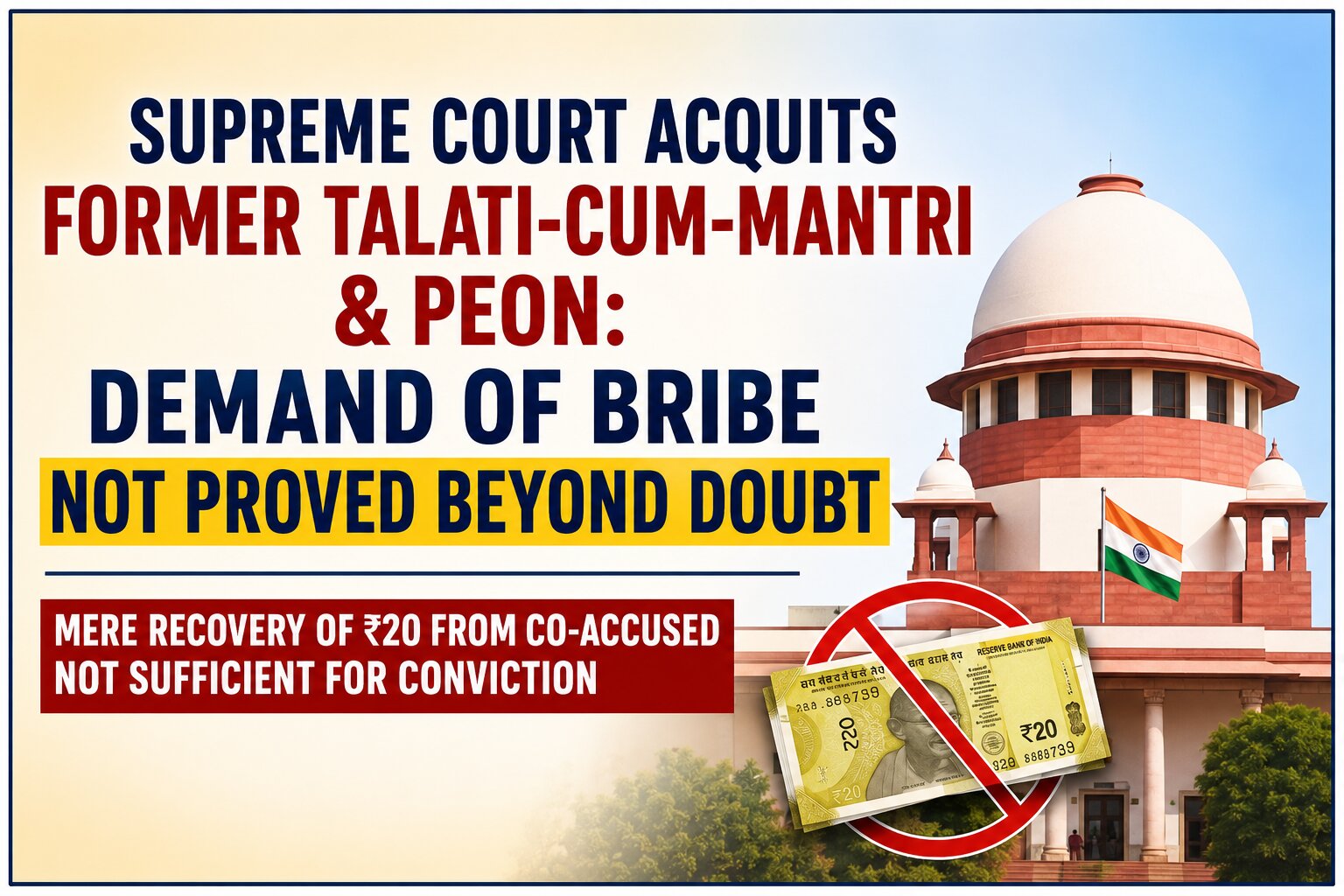
In a bribery case, recovery of tainted money cannot by itself sustain conviction when the prosecution fails to prove the initial demand for illegal gratification beyond reasonable doubt.
Judgement Details
Court
Supreme Court of India
Date of Decision
20 August 2026
Judges
Justice Ujjal Bhuyan and Justice Atul S. Chandurkar
Citation
Acts / Provisions
Facts of the Case
-
The complainant approached the Mamlatdar for obtaining an Income Certificate.
-
The application was examined and forwarded to the Talati-cum-Mantri of village Bechri, who was Accused No. 1.
-
The prosecution alleged that A1 demanded ₹120 as a bribe.
-
According to the prosecution, ₹100 was allegedly intended for A1 and ₹20 for the Peon, A2.
-
The complainant approached the Anti-Corruption Bureau.
-
A trap was arranged.
-
The complainant was instructed to hand over the entire ₹120 if the demand was made.
-
The prosecution alleged that the complainant ultimately handed over a ₹20 currency note to A2.
-
A2 was found in possession of the currency note.
-
A1 was not found in possession of any tainted currency.
-
The Trial Court convicted both accused under the Prevention of Corruption Act.
-
They were sentenced to six months' rigorous imprisonment and fined ₹2,000 each.
-
The Gujarat High Court upheld their convictions.
-
The Supreme Court examined whether the prosecution had proved the initial demand for bribe beyond reasonable doubt.
-
The Court also examined whether mere recovery of ₹20 from A2 could sustain the conviction.
Issues
-
Whether the prosecution proved the initial demand for bribe by the accused beyond reasonable doubt?
-
Whether mere recovery of a tainted currency note from the possession of the co-accused is sufficient to establish the offence under the Prevention of Corruption Act?
-
Whether the statutory presumption under Section 20 of the Prevention of Corruption Act can arise when the prosecution has failed to establish the initial demand for illegal gratification?
-
Whether the contradictory versions given by the complainant regarding the alleged bribe demand create reasonable doubt about the prosecution case?
-
Whether the conduct of the complainant in handing over only ₹20 despite instructions to give the entire ₹120 creates doubt regarding the alleged demand and acceptance?
-
Whether possession of ₹20 by A2, when no demand was proved against him, is sufficient to sustain the conviction of both accused?
-
Whether the sanction granted for prosecution of A1 by the Deputy District Development Officer was legally valid?
-
Whether the prosecution established the guilt of both accused beyond reasonable doubt in the absence of proof of demand, acceptance and conspiracy?
Judgement
-
The Supreme Court allowed the appeals.
-
It set aside the judgments of the Trial Court and the Gujarat High Court.
-
Both appellants were acquitted of the charges under the Prevention of Corruption Act.
-
The Court held that the prosecution failed to establish the initial demand for bribe beyond reasonable doubt.
-
The complainant had given contradictory versions concerning the amount allegedly demanded.
-
The Court found the complainant's conduct during the trap suspicious.
-
Despite being instructed to hand over the entire ₹120 upon demand, he handed over only ₹20 to A2.
-
A2 himself was not shown to have made any demand.
-
The ₹20 was allegedly handed over only after the Income Certificate had already been delivered by A1.
-
The Court held that these circumstances created substantial doubt about the prosecution's version.
-
The Court rejected the argument that recovery of the currency note alone was sufficient to establish guilt.
-
It held that the Section 20 presumption could arise only after the foundational fact of demand had been proved.
-
Since demand was not established, the presumption could not be used to rescue the prosecution case.
-
The Court also found that the sanction granted for prosecution of A1 by the Deputy District Development Officer was invalid.
-
However, the Court clarified that it was not acquitting A1 solely because of the defective sanction.
-
The principal reason for acquittal was the prosecution's failure to prove the substantive charges beyond reasonable doubt.
-
The Court also found A2's explanation that the ₹20 was given as an Eid-related payment to be a probable defence in the circumstances.
-
Both accused were therefore acquitted.
Held
- The prosecution must prove the initial demand beyond reasonable doubt.
-
Mere recovery of tainted money is not sufficient when the prosecution fails to establish the demand.
-
The presumption under Section 20 PCA cannot arise automatically merely because the accused is a public servant and currency is recovered.
-
The presumption operates only after the prosecution establishes the necessary foundational facts.
-
Contradictions in the complainant's testimony concerning the alleged demand can create reasonable doubt.
-
Failure to follow the trap instructions can be a relevant circumstance affecting the credibility of the prosecution case.
-
Where demand is attributed to one accused but recovery is made from another, the prosecution must establish the connection between the two through reliable evidence.
-
The acquittal of the accused from the conspiracy charge was also relevant to the prosecution's theory concerning demand and acceptance.
-
The sanction granted by an authority lacking the requisite power to sanction prosecution is invalid.
-
Nevertheless, an invalid sanction was not the sole basis for A1's acquittal.
-
The prosecution's evidence independently failed to establish guilt beyond reasonable doubt.
Analysis
-
Demand is central: The judgment reinforces the Supreme Court's consistent approach that proof of demand is fundamental in corruption cases involving illegal gratification.
-
Recovery alone is insufficient: The mere fact that a currency note is recovered from an accused does not automatically establish that the money was accepted as a bribe.
-
Section 20 presumption has limits: The prosecution cannot invoke the statutory presumption at the beginning of the case. It must first establish the foundational facts, particularly the demand.
-
Importance of complainant's testimony: The complainant's contradictory statements regarding whether ₹200 or ₹120 was demanded significantly weakened the prosecution case.
-
Trap procedure: The Court attached importance to the fact that the complainant had been specifically instructed to hand over the entire ₹120 but ultimately handed over only ₹20.
-
No demand by A2: The complainant admitted that A2 did not make any demand. Recovery of ₹20 from A2 therefore could not, by itself, prove that he had accepted illegal gratification.
-
Timing of payment: The fact that the ₹20 was allegedly handed over after the Income Certificate had already been delivered further weakened the theory that the payment was demanded in exchange for the certificate.
-
Conspiracy theory weakened: Since the demand was attributed to A1 while acceptance was attributed to A2, and both were acquitted of conspiracy, the prosecution had to provide stronger independent evidence connecting the two acts.
-
Benefit of reasonable doubt: Criminal conviction requires proof beyond reasonable doubt. Where the prosecution evidence permits a reasonable alternative explanation, the accused must receive the benefit of doubt.
-
Probable defence: The Court considered A2's explanation concerning the ₹20 Eid payment to be probable in the circumstances, further strengthening the existence of reasonable doubt.
-
Invalid sanction: The Court also identified a defect in the sanction for prosecuting A1 because the prosecution failed to establish that the Deputy District Development Officer was competent to grant sanction.
-
Broader significance: The judgment serves as an important reminder that anti-corruption prosecutions cannot succeed merely on the basis of recovery. The prosecution must establish the essential elements of demand and acceptance through reliable evidence.