
Raeesa Parveen v. Union of India and Others, 2026
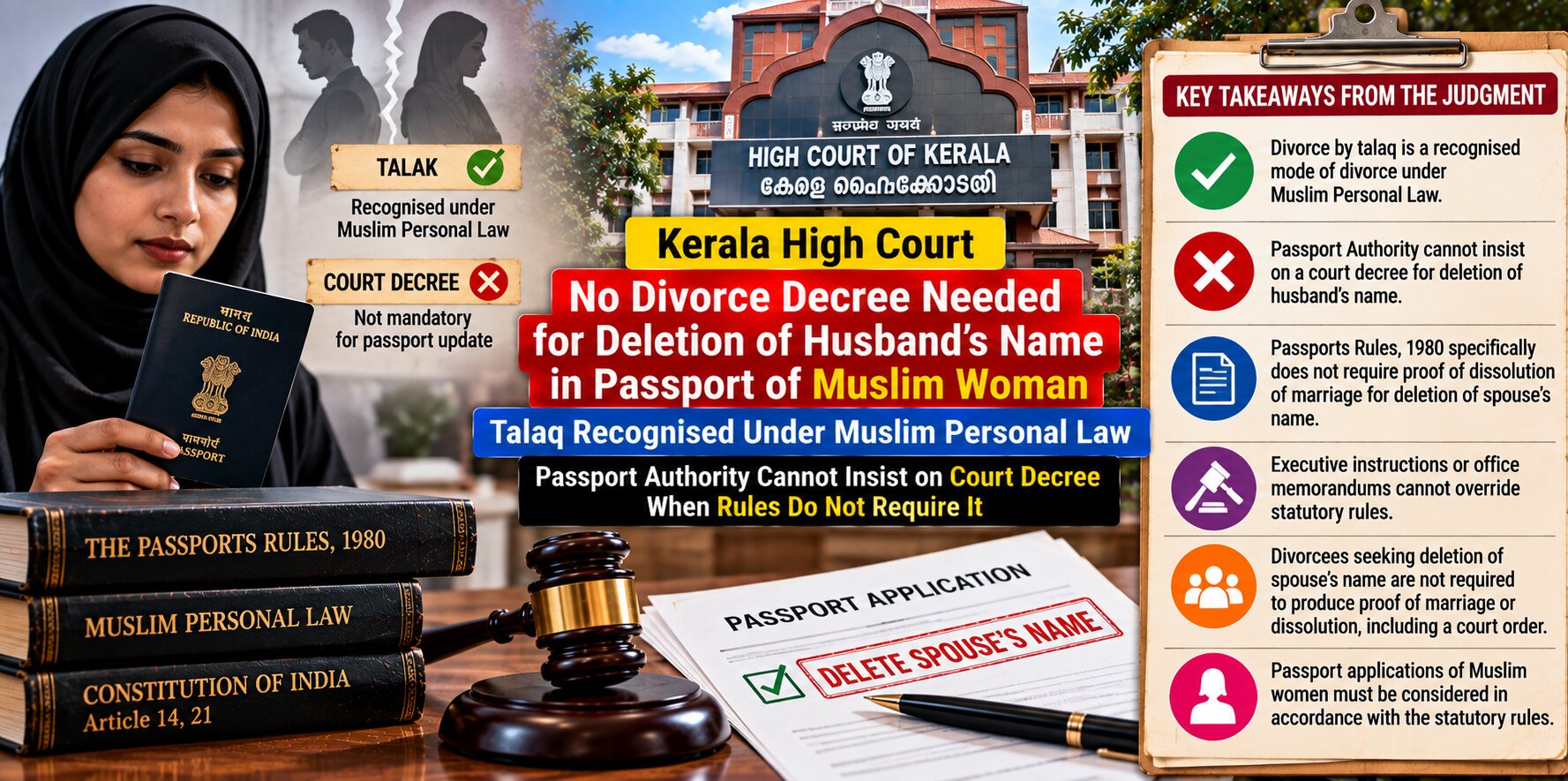
Talaq recognised under Muslim Personal Law can constitute a recognised mode of dissolution of marriage for the relevant passport purpose.
Judgement Details
Court
Kerala High Court
Date of Decision
24 September 2026
Judges
Justice Murali Purushothaman
Citation
Acts / Provisions
Facts of the Case
-
The petitioner, Raeesa Parveen, was the holder of a valid Indian passport which was stated to be valid until 5 April 2032.
-
She married in 2021, following which her husband's name was entered in the spouse column of her passport.
-
The marriage subsequently became estranged and the parties agreed to dissolve the marriage by mutual consent.
-
An agreement was executed between the parties under which talaq was to be pronounced in three stages.
-
The first, second and third pronouncements of talaq were made on 9 October 2025, 9 November 2025 and 9 December 2025, respectively.
-
After dissolution of the marriage, the petitioner applied for re-issuance of her passport with deletion of her former husband's name.
-
The Passport Authority did not entertain the application because the petitioner had not produced a divorce order or decree issued by a competent court.
-
The petitioner challenged this requirement before the Kerala High Court, contending that the Passport Authority could not insist upon a court decree when the applicable Passport Rules did not prescribe such a requirement.
-
The Union Government relied upon an Office Memorandum dated 6 September 2024 issued by the Ministry of External Affairs, which contemplated production of a divorce order or decree for deletion of a spouse's name.
-
The High Court therefore examined the relationship between the statutory Passport Rules and the executive instructions contained in the Office Memorandum.
-
The Court also examined whether talaq recognised under Muslim Personal Law could be accepted for the limited purpose of updating the petitioner's passport.
-
The Court considered its earlier decisions, including Fathima Abdul Kareem v. State of Kerala, Kanjirathingal Abdul Khader Nissar v. Passport Officer, and Ayshath Bunayath v. Union of India.
Issues
-
Whether the Passport Authority can insist upon production of a court decree of divorce for deletion of the husband's name from the passport of a Muslim divorcee when the applicable Passport Rules do not require such documentary proof?
-
Whether an executive Office Memorandum issued by the Ministry of External Affairs can impose a requirement that is not prescribed by the statutory Passport Rules?
-
Whether talaq recognised under Muslim Personal Law can be accepted as a mode of dissolution of marriage for the purpose of deleting the former husband's name from the petitioner's passport?
-
Whether authentication of dissolution of marriage by a competent court is the only permissible method of establishing divorce for the purpose of passport re-issuance?
Judgement
-
The Kerala High Court held that the Passport Authority could not insist upon a court decree of divorce for deletion of the former husband's name from the petitioner's passport in the circumstances of the case.
-
The Court examined Section IV(B) of the Passport Information Booklet under Schedule III to the Passports Rules, 1980, which specifically deals with change of name and addition or deletion of a spouse's name in connection with re-issue of a passport.
-
The provision expressly contemplates divorcees seeking deletion of a spouse's name and does not require production of a court order for judicial separation or a decree of divorce in the relevant category.
-
The Court held that the Schedule forms part of the statutory Rules and consequently has statutory force.
-
Since the statutory Rules did not mandate production of documentary proof of dissolution of marriage for the relevant passport alteration, an executive Office Memorandum could not introduce an additional mandatory requirement.
-
The Court reiterated the settled principle that executive instructions or office memorandums cannot override, amend or supersede statutory rules.
-
The Court further considered the nature of the petitioner's dissolution of marriage and held that divorce resulting from talaq pronounced by the husband is a mode of divorce recognised and accepted under Muslim Personal Law.
-
The Court referred to its earlier decision in Fathima Abdul Kareem v. State of Kerala, where it had recognised that authentication by a competent court is one method of proving divorce but is not necessarily the only method.
-
In Kanjirathingal Abdul Khader Nissar v. Passport Officer, the Court had similarly held that a formal decree of divorce was not necessary for deletion of the name of a Muslim divorced wife from her husband's passport.
-
The Court also relied on Ayshath Bunayath v. Union of India, concerning acceptance of a Mubaraat Nama as evidence of dissolution of marriage despite the absence of a conventional court decree.
-
Consequently, the Court directed the Regional Passport Officer to consider the petitioner's application for re-issuance of the passport and deletion of her former husband's name without insisting upon production of a divorce decree.
-
The writ petition was accordingly disposed of.
Held
-
A divorce decree cannot be insisted upon where the applicable Passport Rules do not prescribe it as a mandatory document for deletion of a spouse's name.
-
An executive Office Memorandum cannot override or add to a requirement contained in statutory rules.
-
Court authentication of divorce is not necessarily the exclusive method of establishing dissolution of a Muslim marriage.
-
Passport authorities must act in accordance with the statutory Passport Rules rather than imposing additional requirements through executive instructions.
-
The Regional Passport Officer was directed to reconsider and process the petitioner's application without insisting upon a decree of divorce from a competent court.
Analysis
-
The principal issue in the case concerned the hierarchy between statutory rules and executive instructions. The Court treated the Passport Rules as the governing legal framework and refused to permit an Office Memorandum to impose a condition that was absent from those Rules.
-
The judgment reinforces the established administrative-law principle that executive instructions cannot contradict or amend statutory rules. An administrative authority must operate within the requirements prescribed by the governing legislation and rules.
-
The Court's reasoning is particularly significant because the dispute was not about adjudicating the parties' matrimonial rights afresh. It concerned whether the Passport Authority could insist upon a particular form of documentary proof before making an administrative change to the passport.
-
The Court also distinguished between proof of divorce and a rigid requirement that such proof must necessarily take the form of a judicial decree.
-
By referring to its earlier decisions, the Court recognised that Muslim Personal Law contains modes of dissolution of marriage other than a decree obtained through matrimonial litigation, and that the legal recognition of such dissolution cannot simply be disregarded by passport authorities.
-
The judgment therefore adopts a rule-based administrative approach: where the Passport Rules themselves dispense with proof of dissolution for the specified passport alteration, the authority cannot independently create an additional documentary barrier.
-
The decision does not mean that every claim of divorce must automatically be accepted without scrutiny. The relevant authority can still examine the documents and facts presented in accordance with the governing legal framework; the specific point decided was that a court decree cannot be made a mandatory prerequisite contrary to the Rules.
-
The judgment is also important for administrative fairness because a person should not be subjected to a more burdensome procedure merely because an executive memorandum purports to prescribe it when the statutory scheme does not do so.
-
The decision provides continuity with earlier Kerala High Court jurisprudence on Muslim divorce and passport records, including the decisions concerning talaq and Mubaraat Nama.
-
From a practical perspective, the ruling means that a Muslim divorcee seeking deletion of a former spouse's name from a passport may rely upon the applicable statutory procedure without being compelled, merely by an executive instruction, to first obtain a separate judicial decree of divorce.
-
The broader legal principle emerging from the judgment is that administrative convenience or executive directions cannot prevail over the express scheme of statutory rules.