
R. Veronica & Anr. v. Rudrayani Devaki (D) through LRs. S. Satha Kumar & Ors., 2026
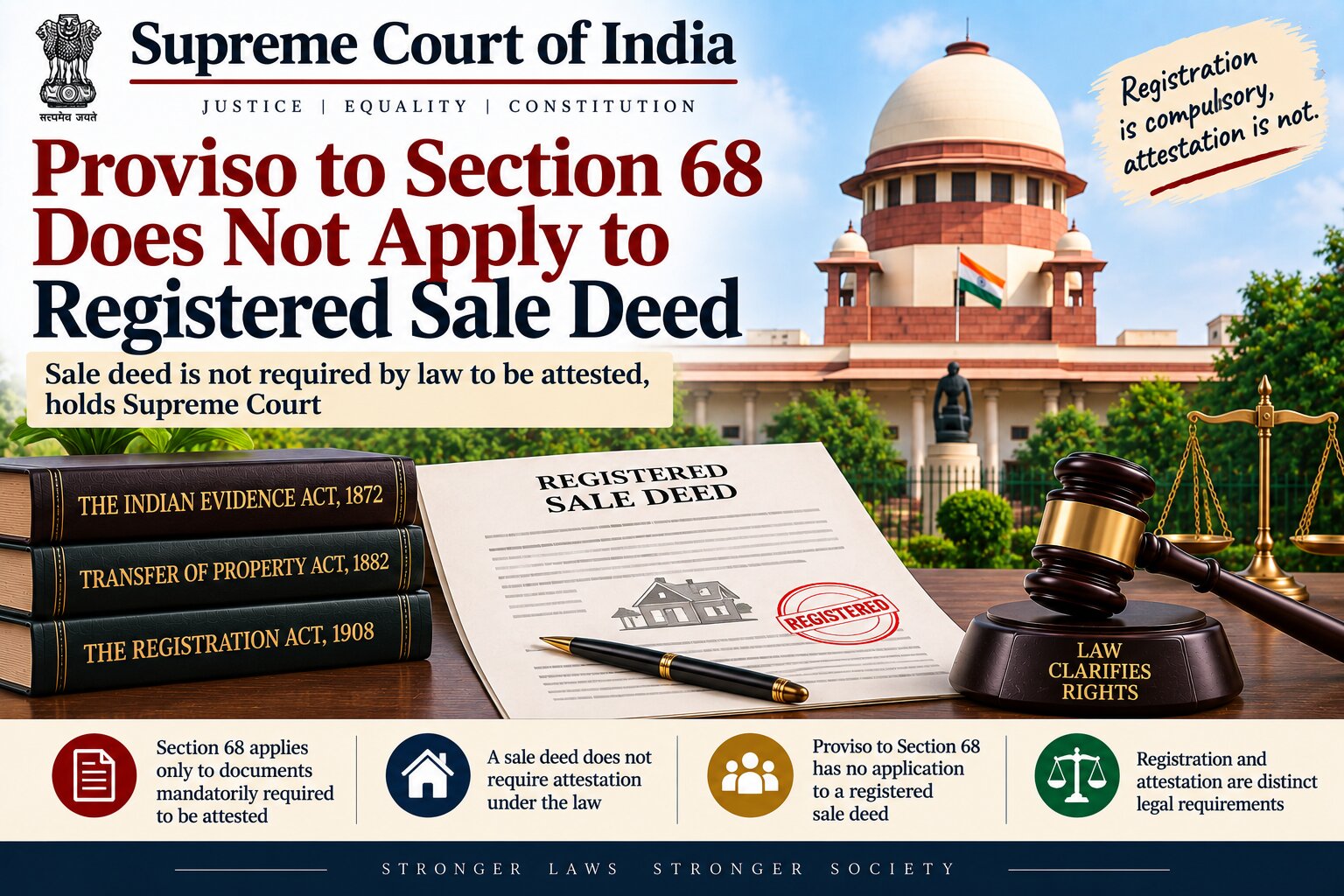
Section 68 of the Evidence Act does not apply to a registered sale deed.
Judgement Details
Court
Supreme Court of India
Date of Decision
20 August 2026
Judges
Justice J.B. Pardiwala and Justice Manoj Misra
Citation
Acts / Provisions
Facts of the Case
-
The dispute concerned ownership and possession of immovable property in Kerala.
-
The plaintiffs relied upon a registered sale deed to establish their title over the disputed property.
-
The defendants disputed the execution and validity of the earlier sale deed and contended that the document was not genuine.
-
The Trial Court accepted the plaintiffs' case and granted relief in their favour.
-
The First Appellate Court reversed the Trial Court's decision, including its findings regarding the execution of the sale deed.
-
The matter reached the Kerala High Court in a Second Appeal under Section 100 CPC.
-
The High Court considered the proviso to Section 68 of the Indian Evidence Act and held that the denial of execution required examination of an attesting witness.
-
The plaintiffs challenged the High Court's decision before the Supreme Court.
Issues
-
Whether a registered sale deed is required to be proved through examination of an attesting witness under Section 68 of the Evidence Act?
-
Whether the proviso to Section 68 applies to a sale deed which is not required by law to be attested?
-
Whether a specific denial of execution in a written statement can attract the proviso to Section 68 in respect of a registered sale deed?
-
Whether the High Court could decide a Second Appeal under Section 100 CPC without first formulating a substantial question of law?
-
Whether the High Court was correct in holding that denial of execution must be made through a separate suit or counterclaim?
Judgement
-
The Supreme Court set aside the judgment of the Kerala High Court and remitted the matter for fresh consideration.
-
The Court held that Section 68 of the Evidence Act does not apply to a registered sale deed because a sale deed is not required by law to be attested.
-
Section 68 applies to documents which are mandatorily required by law to be attested.
-
A sale deed is governed by Section 54 of the Transfer of Property Act, which requires registration in the relevant circumstances but does not require attestation by witnesses.
-
Consequently, the proviso to Section 68 cannot independently be applied to a registered sale deed.
-
The Court relied upon earlier decisions, including Hans Raji v. Yosodanand and Bayanabai Kaware v. Rajendra s/o Baburao Dhote.
-
The Supreme Court also held that the High Court committed a serious procedural error by deciding the Second Appeal without formulating the substantial question of law required under Section 100 CPC.
-
The matter was therefore remitted to the High Court for fresh consideration in accordance with law.
Held
-
A sale deed does not require compulsory attestation under Section 54 of the Transfer of Property Act.
-
The requirement of examining an attesting witness under Section 68 arises only for documents required by law to be attested.
-
The proviso to Section 68 cannot be read independently of the main provision.
-
The expression “any document, not being a Will” in the proviso refers to documents which are otherwise mandatorily required to be attested.
-
A gift deed, mortgage deed and settlement deed may fall within the category of documents requiring attestation, subject to their respective statutory requirements.
-
A registered sale deed does not fall within that category merely because it happens to contain signatures of marginal or attesting witnesses.
-
The High Court was also wrong in holding that denial of execution must necessarily be made through a separate suit or counterclaim.
-
A Second Appeal cannot be decided on merits without formulation of the required substantial question of law.
-
The High Court's judgment was therefore set aside and the matter was remanded for fresh adjudication.
Analysis
-
The judgment clarifies an important distinction between registration and attestation. Registration of a document does not automatically mean that the document is one which must be proved through attesting witnesses.
-
Section 68 begins with the fundamental condition that the document must be “required by law to be attested.” This condition determines whether Section 68 is attracted at all.
-
A sale deed under Section 54 of the Transfer of Property Act requires registration in the circumstances prescribed by law, but attestation is not an essential statutory requirement.
-
Therefore, even where a sale deed has been signed by marginal witnesses, their presence does not convert the sale deed into a document to which Section 68 applies.
-
The Court's interpretation prevents the proviso from travelling beyond the main provision. A proviso cannot create an independent requirement for documents which are outside the scope of the principal section.
-
The Court also corrected the High Court's approach concerning specific denial. The question of whether execution is specifically denied becomes relevant only when Section 68 is otherwise applicable.
-
Since Section 68 itself does not apply to a sale deed, there is no need to determine whether the denial of execution attracts the proviso.
-
The decision is particularly important in property litigation because parties frequently attempt to challenge registered sale deeds by relying upon technical requirements applicable to wills, gift deeds or other compulsorily attested instruments.
-
The judgment makes clear that the method of proving a sale deed must be determined primarily by the law governing sale and registration, rather than by provisions applicable to documents requiring attestation.
-
At the same time, the Court did not finally decide the underlying title dispute. The matter was remanded because the High Court had failed to comply with the mandatory procedure governing a Second Appeal under Section 100 CPC.
-
The requirement to formulate a substantial question of law is not a mere procedural formality. It defines the jurisdiction of the High Court in a second appeal and ensures that the parties know the precise legal question being considered.
-
The judgment therefore combines two important principles: Section 68 cannot be extended to documents not requiring attestation, and Section 100 CPC must be strictly followed when exercising second-appellate jurisdiction.
-
The central takeaway is that a registered sale deed does not require an attesting witness merely because its execution is disputed; Section 68 applies only where the law itself makes attestation mandatory.