
R v. State of Punjab, 2026
Marriage to the victim in an earlier POCSO case does not affect the merits of the pending NDPS case.
Judgement Details
Court
Punjab and Haryana High Court
Date of Decision
14 July 2026
Judges
Justice Sanjay Vashisth
Citation
Acts / Provisions
Facts of the Case
-
The petitioner was arrested on 23 February 2025 on the basis of secret information.
-
The police allegedly recovered 417 grams of heroin, ₹23,400 suspected to be proceeds of drug trafficking, and a digital weighing scale from his possession.
-
The FIR was initially registered under Sections 21, 61 and 85 of the NDPS Act, and during investigation Sections 21-C, 25, 27 and 29 were also added.
-
During investigation, the petitioner allegedly disclosed that he had procured the contraband from one Vikram Kumar alias Bunty, whom he had met while in jail.
-
Acting upon the disclosure statement, the police allegedly recovered 30 grams of heroin from Vikram Kumar.
-
Seeking regular bail, the petitioner contended that he had been falsely implicated and relied upon CCTV footage allegedly showing that he was arrested from his car on the evening of the alleged occurrence.
-
The petitioner also pointed out that, although he had earlier been involved in a POCSO case, the victim had subsequently married him after conclusion of those proceedings and they were living together happily with a child.
-
To verify this assertion, the High Court interacted with the woman, who personally confirmed the marriage and stated that they were leading a peaceful family life.
-
The Court also noted that the petitioner had remained in custody for more than one year and four months and that none of the 21 prosecution witnesses had yet been examined.
Issues
-
Whether the petitioner was entitled to regular bail despite allegations involving commercial quantity of heroin under the NDPS Act?
-
Whether the petitioner's subsequent marriage with the victim in a separate POCSO case could be considered while deciding the application for regular bail?
-
Whether prolonged incarceration and delay in commencement of trial justified grant of regular bail?
Judgement
-
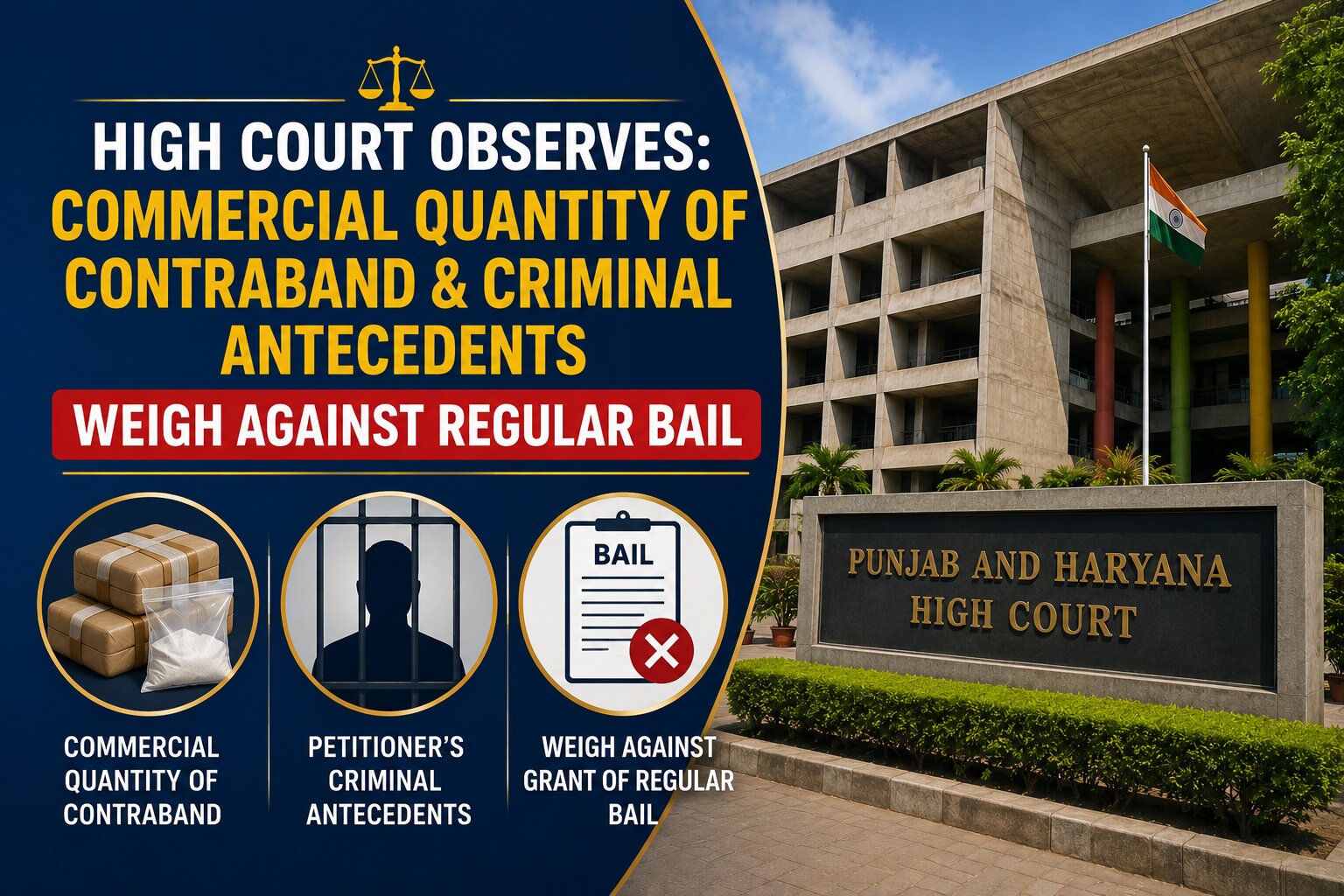
The Punjab and Haryana High Court observed that, ordinarily, recovery of a commercial quantity of contraband coupled with the petitioner's criminal antecedents would weigh against grant of regular bail.
-
The Court clarified that the petitioner's marriage with the victim in the earlier POCSO case had no bearing on the merits of the pending NDPS prosecution.
-
Nevertheless, the Court observed that the verified fact of the marriage and the existence of a child indicated that the petitioner had an opportunity to lead a settled family life and rehabilitate himself in society.
-
The Court considered the personal statement made by the woman before the Court confirming that she had married the petitioner after conclusion of the POCSO proceedings and that they were living happily together.
-
The Court further took note of the fact that the petitioner had already undergone more than one year and four months of incarceration.
-
The Court also observed that despite the lapse of considerable time, none of the 21 prosecution witnesses cited by the prosecution had been examined.
-
Considering the delay in trial, the prolonged custody, and the possibility of rehabilitation, the Court held that continued incarceration would serve no useful purpose.
-
Accordingly, the Court granted the petitioner regular bail, while making it clear that its observations regarding the petitioner's marriage were confined to the question of bail and did not affect the merits of the NDPS prosecution.
Held
- However, such a circumstance may be considered for the limited purpose of assessing the petitioner's prospects of rehabilitation while deciding bail.
-
Prolonged custody exceeding one year and four months, coupled with the failure to examine any prosecution witness, justified grant of regular bail.
-
The petitioner was granted regular bail subject to applicable conditions.
Analysis
-
The judgment illustrates that while considering regular bail, courts may evaluate factors extending beyond the gravity of the accusation, including the accused's prospects of social rehabilitation.
-
The Court carefully distinguished between considerations relevant to bail and issues bearing upon guilt, emphasizing that the petitioner's subsequent marriage had no evidentiary relevance to the NDPS prosecution itself.
-
By expressly clarifying that the marriage was considered only as an indicator of rehabilitation, the Court avoided conflating unrelated criminal proceedings.
-
The decision also reiterates that prolonged pre-trial detention and delay in examination of prosecution witnesses remain significant constitutional considerations even in prosecutions under the stringent provisions of the NDPS Act.
-
Although offences involving commercial quantity ordinarily attract stricter scrutiny, the Court balanced the seriousness of the allegations with the accused's right to a speedy trial and the practical realities of delayed proceedings.
-
The judgment reflects the principle that bail decisions require a holistic assessment of all relevant circumstances, including custody period, progress of trial, possibility of rehabilitation, and the likelihood that continued detention would serve any legitimate purpose.
-
Overall, the ruling demonstrates that while statutory rigour under the NDPS Act remains important, constitutional concerns relating to personal liberty and undue delay continue to inform the exercise of judicial discretion in bail matters.