
Purshotam Ranchhodbhai Pankhania & Ors. v. Harihar Ambalal Patel & Ors., 2026
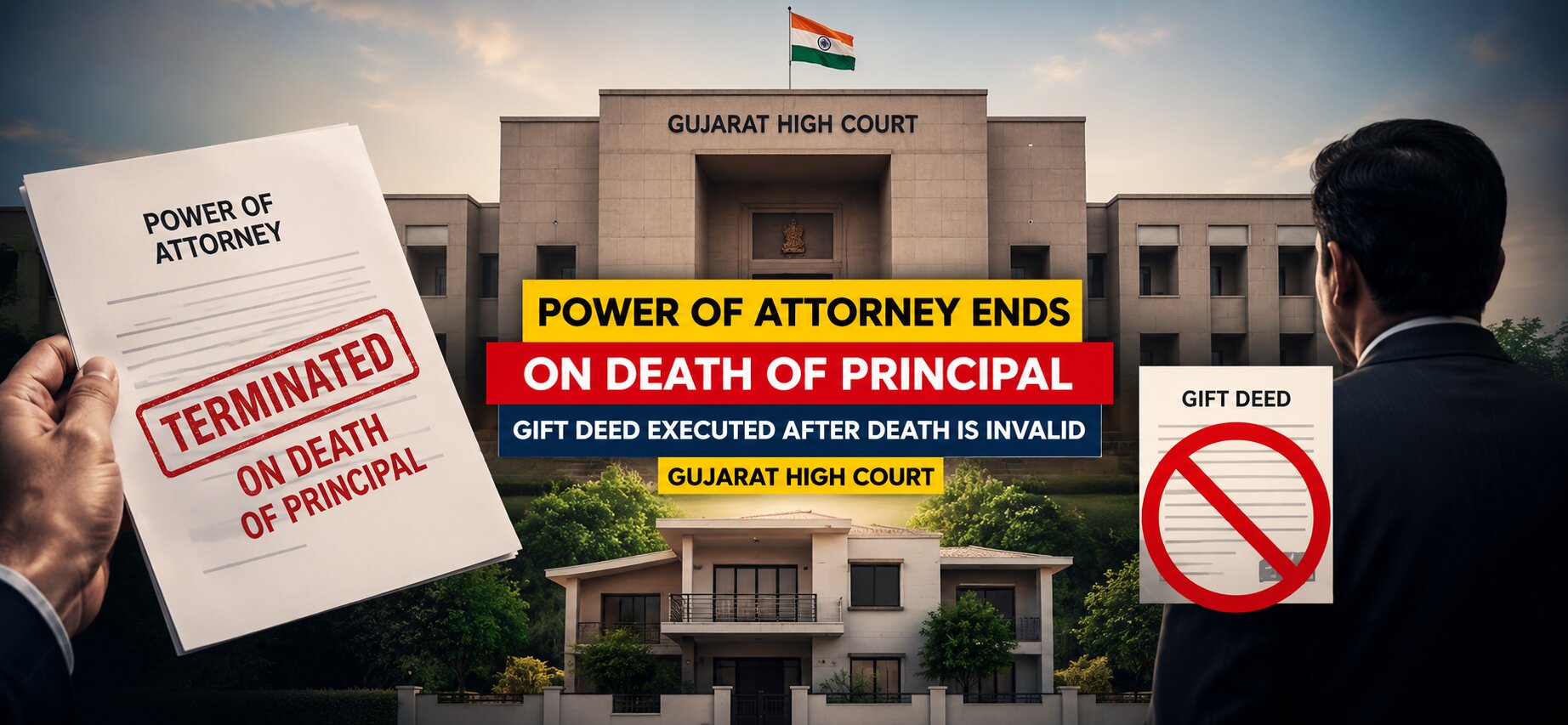
The authority of a Power of Attorney holder automatically ceases upon the death of the principal.
Judgement Details
Court
Gujarat High Court
Date of Decision
20 July 2026
Judges
Justice Ilesh J. Vora & Justice R.T. Vachhani
Citation
Acts / Provisions
Facts of the Case
-
The plaintiff and his wife, both NRIs, purchased the suit property through a registered sale deed dated 16 September 1999 from Smt. Maniben Chimanbhai Desai.
-
The entire consideration was paid through cheque, and thereafter the plaintiffs remained in possession and occupation of the property.
-
The plaintiffs executed a General Power of Attorney (GPA) in favour of Defendant No. 1 for conducting partnership business and managing certain affairs.
-
The plaintiff's wife (Plaintiff No. 2) died in London on 21 July 2010.
-
Owing to the emotional distress caused by his wife's death, the plaintiff did not immediately recover or cancel the Power of Attorney, which remained with Defendant No. 1.
-
The plaintiff asserted that upon the death of his wife, the authority granted by her under the Power of Attorney automatically came to an end.
-
Despite this, Defendant No. 1 executed a Gift Deed dated 5 January 2011 in favour of Defendant Nos. 2 and 3 (his son and daughter-in-law) by relying upon the existing Power of Attorney.
-
The plaintiff alleged that Defendant No. 1 acted fraudulently and in collusion with the other defendants to transfer the property without lawful authority.
-
The defendants contended that Plaintiff No. 1 had borrowed £78,000 from Defendant No. 2 for business purposes and failed to repay the amount.
-
According to the defendants, the plaintiff had agreed that the suit property would be transferred in lieu of repayment of the loan.
-
They argued that Defendant No. 1 merely executed the Gift Deed pursuant to the plaintiff's instructions and that no illegality had occurred.
-
The Trial Court dismissed the plaintiff's suit.
-
Aggrieved by the dismissal, the plaintiffs filed a First Appeal before the Gujarat High Court.
Issues
-
Whether the authority of a Power of Attorney holder automatically terminates upon the death of the principal?
-
Whether Section 208 of the Indian Contract Act protects an agent who acts without knowledge of the principal's death?
-
Whether a Power of Attorney holder can validly execute a Gift Deed after the death of the principal?
-
Whether the General Power of Attorney in the present case conferred authority upon the attorney holder to execute a Gift Deed of the suit property?
-
Whether the Trial Court erred in dismissing the plaintiff's suit by relying upon alleged financial transactions instead of examining the legality of the Gift Deed?
Judgement
-
The Gujarat High Court allowed the First Appeal and set aside the judgment of the Trial Court.
-
The Court held that the authority of an agent under a Power of Attorney automatically terminates immediately upon the death of the principal.
-
It ruled that such termination takes place by operation of law, irrespective of whether the attorney holder had knowledge of the principal's death.
-
The Court rejected the defendants' reliance on Section 208 of the Indian Contract Act, holding that the provision cannot revive an agency that has already ceased because of the principal's death.
-
It observed that the attorney holder had no legal authority to execute any transaction on behalf of the deceased principal after her death.
-
The Court found that the General Power of Attorney contained no specific clause authorizing execution of a Gift Deed.
-
Consequently, the Gift Deed executed after the death of Plaintiff No. 2 was held to be without authority and legally unsustainable.
-
The Court further held that the Trial Court had improperly focused on alleged financial dealings between the parties rather than deciding the core legal issue regarding the validity of the Gift Deed.
-
The High Court concluded that the Trial Court's findings were based upon assumptions and presumptions instead of settled legal principles governing agency and powers of attorney.
Held
-
Section 208 of the Indian Contract Act does not protect acts performed after the principal's death merely because the agent was unaware of the death.
-
A Gift Deed executed by a Power of Attorney holder after the principal's death is invalid unless saved by a legally recognized exception (such as an agency coupled with interest, where applicable).
-
A General Power of Attorney cannot be interpreted as conferring authority to execute a Gift Deed unless such power is expressly granted.
-
The Trial Court's judgment was set aside, and the appeal was allowed.
Analysis
-
The judgment reaffirms the settled principle under the law of agency that the relationship of principal and agent ordinarily comes to an end upon the death of either party.
-
The Court emphasized that the termination of agency by death is automatic and occurs by operation of law, leaving no scope for the agent to continue acting on behalf of the deceased principal.
-
By rejecting the applicability of Section 208 in such circumstances, the Court clarified that the provision cannot be invoked to validate transactions performed after the legal extinction of the agency.
-
The decision reinforces the principle that a Power of Attorney must be construed strictly, and powers not expressly granted cannot be implied, especially in relation to transfers of immovable property by way of gift.
-
The Court correctly distinguished between disputes concerning financial liabilities and disputes concerning legal authority under a Power of Attorney, preventing contractual disputes from expanding the scope of an agent's powers.
-
The judgment strengthens safeguards against fraudulent or unauthorized transfers of property after the death of a principal.
-
It serves as an important precedent reminding attorneys, purchasers, and registrars to verify whether the principal is alive before acting upon a Power of Attorney.
-
The ruling also highlights the limited scope of Section 208, ensuring that it is not interpreted in a manner inconsistent with the fundamental principles governing termination of agency under the Indian Contract Act.
-
The decision promotes certainty in property transactions by affirming that rights over immovable property cannot be altered through an extinguished authority.