
Punjab National Bank v. M/s. Shree Jyoti Education and Management Trust World & Others, 2026
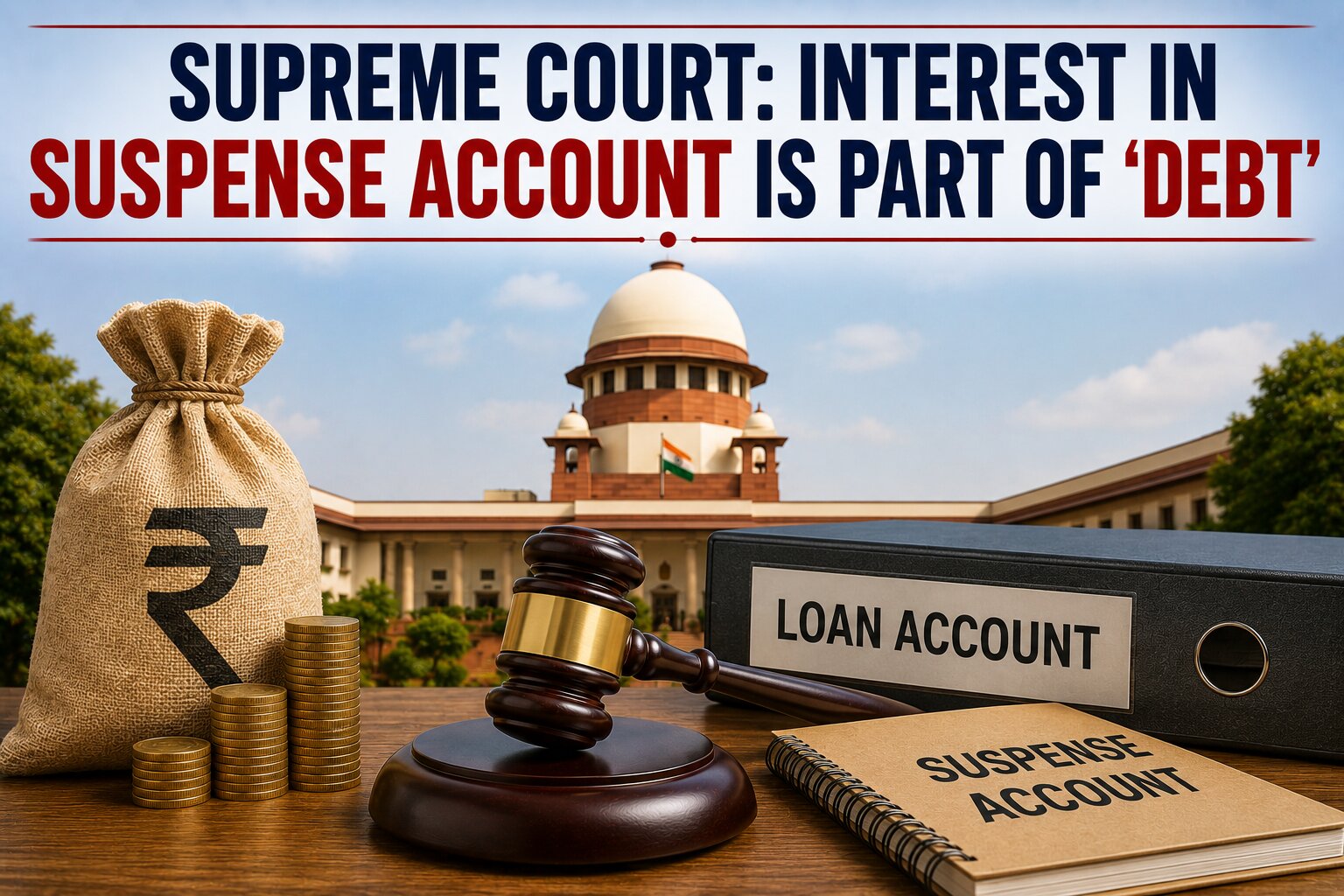
Interest maintained in a suspense account remains part of the debt due to the bank, provided it is otherwise legally chargeable.
Judgement Details
Court
Supreme Court of India
Date of Decision
12 August 2026
Judges
Justice Sanjay Kumar and Justice Sanjeev Sachdeva
Citation
Acts / Provisions
Facts of the Case
-
The dispute concerned a loan transaction between a banking institution and an educational trust.
-
In 2011, United Bank of India, which subsequently merged with Punjab National Bank (PNB), sanctioned a loan of approximately ₹5 crore to the respondent.
-
The loan was sanctioned for the purpose of constructing a college building.
-
The respondent failed to maintain regular repayment obligations under the loan arrangement.
-
The loan account was subsequently classified as a Non-Performing Asset (NPA).
-
Following the NPA classification, the bank initiated recovery proceedings before the Debts Recovery Tribunal (DRT).
-
The DRT substantially reduced the amount claimed by the bank.
-
The matter thereafter reached the Debts Recovery Appellate Tribunal (DRAT).
-
The DRAT recalculated the amount recoverable by the bank at approximately ₹54.90 lakh, together with interest that had been maintained in the bank's suspense account.
-
The bank maintained the accrued interest separately after the loan account became an NPA in accordance with its accounting practice.
-
The respondent subsequently relied upon a certificate issued by PNB in December 2020, which reflected an outstanding amount of approximately ₹31.99 lakh.
-
The Orissa High Court relied upon that certificate while determining the amount payable.
-
The High Court directed the bank to accept approximately ₹29.55 lakh as full settlement after taking into account a payment of approximately ₹2.43 lakh made by the respondent.
-
The High Court's calculation effectively excluded the interest maintained in the suspense account.
-
PNB challenged the High Court's decision before the Supreme Court.
-
The principal controversy before the Supreme Court was whether interest transferred to a separate suspense account after an account becomes an NPA continues to constitute part of the debt due to the bank.
-
The Supreme Court examined the statutory definition of "debt" under Section 2(g) of the RDB Act.
-
The Court concluded that the definition expressly includes interest and that the accounting treatment of such interest in a suspense account does not extinguish the borrower's liability.
-
The Supreme Court therefore restored the tribunal's determination of the amount payable by the respondent.
Issues
-
Whether interest accrued on a loan account after its classification as a Non-Performing Asset and maintained by the bank in a separate suspense account continues to form part of the debt due from the borrower?
-
Whether the mere transfer of accrued interest to a suspense account causes such interest to cease to be legally recoverable by the bank?
-
Whether interest legally chargeable under the loan agreement and applicable banking regulations can be excluded from the outstanding debt merely because it does not appear in the regular loan account statement?
-
Whether Section 2(g) of the Recovery of Debts and Bankruptcy Act, 1993 expressly includes the interest component maintained in a suspense account within the statutory definition of "debt"?
-
Whether the Orissa High Court was justified in relying upon the PNB certificate dated 24 December 2020 while disregarding the interest component maintained separately in the suspense account?
-
Whether the High Court was justified in directing PNB to accept approximately ₹29.55 lakh as full settlement after excluding the interest maintained in the suspense account?
-
Whether the tribunal's determination of the outstanding dues, including the interest component maintained in the suspense account, was required to be restored?
Judgement
-
The Supreme Court allowed the appeal filed by Punjab National Bank.
-
The Court set aside the judgment of the Orissa High Court.
-
The Supreme Court held that interest maintained by the bank in a separate suspense account continues to form part of the debt due from the borrower.
-
The Court emphasised that the accounting treatment adopted after classification of an account as an NPA does not extinguish or waive the borrower's legal liability to pay interest.
-
The Court relied upon Section 2(g) of the Recovery of Debts and Bankruptcy Act, 1993, which defines "debt" to include liability inclusive of interest claimed as due by a bank or financial institution.
-
The Supreme Court therefore held that the interest component could not be ignored merely because it had been transferred to a separate suspense account.
-
The Court found that the High Court had oversimplified the calculation of the outstanding amount.
-
The High Court had relied principally upon the figure reflected in the PNB certificate dated 24 December 2020 and failed to account for the interest component separately maintained by the bank.
-
The Supreme Court held that the respondent could not selectively rely upon different figures from the bank's accounting records to reduce its liability.
-
The Court restored the tribunal's determination of the amount payable, including the relevant interest component.
-
The Court held that the fact that the interest was no longer reflected in the ordinary loan account statement did not mean that it was no longer payable.
-
The appeal was consequently allowed.
Held
-
Classification of a loan account as an NPA does not extinguish the underlying liability to pay legally chargeable interest.
-
Transfer of interest to a separate accounting head is an accounting treatment and does not, by itself, amount to waiver or abandonment of the bank's claim.
-
The definition of "debt" under Section 2(g) of the RDB Act expressly includes interest.
-
Interest cannot be excluded merely because it does not appear in the regular loan account statement.
-
The borrower's liability must be determined by considering the complete outstanding debt, including legally recoverable interest.
-
The High Court erred by relying solely upon the amount reflected in the PNB certificate while ignoring the suspense-account interest.
-
The tribunal's calculation, which included the interest maintained in the suspense account, was legally sustainable.
-
A borrower cannot adopt different calculations at different stages to obtain an advantage from the bank's accounting presentation.
-
The Supreme Court therefore restored the tribunal's decision and allowed PNB's appeal.
Analysis
-
Central reasoning: The Supreme Court distinguished between the accounting treatment of interest and the legal existence of the borrower's liability. Merely recording interest in a suspense account does not transform legally recoverable interest into a non-existent liability.
-
Meaning of "debt": Section 2(g) of the RDB Act is central to the judgment. The provision defines debt broadly enough to include liabilities inclusive of interest claimed as due from a borrower by a bank or financial institution.
-
Effect of NPA classification: Classification of an account as an NPA affects the manner in which a bank recognises and accounts for income. It does not, by itself, cancel the contractual obligation of the borrower to pay interest that has legally accrued.
-
Suspense account is an accounting mechanism: The Court's reasoning makes clear that a suspense account should not be confused with a waiver or relinquishment of the bank's claim. The interest remains identifiable and recoverable where the underlying contractual and statutory requirements are satisfied.
-
Accounting records versus legal liability: The High Court placed excessive emphasis on the amount shown in one certificate. The Supreme Court held that a particular accounting statement cannot be treated as conclusively determining the complete legal liability where other relevant components of the debt have been separately maintained.
-
Importance of Section 2(g): The statutory definition provides the legal foundation for treating the interest component as part of the debt. Consequently, the bank's claim is not limited to the principal amount merely because accrued interest has been transferred to another accounting head.
-
NPA does not mean interest disappears: The judgment is important because it prevents an erroneous assumption that once an account becomes an NPA, interest maintained separately by the bank automatically loses its legal character as part of the debt.
-
Protection of banking claims: The decision protects banks against a borrower arguing that accounting treatment has reduced or extinguished an otherwise valid contractual liability.
-
Borrower's inconsistent calculations: The Supreme Court criticised the respondent's attempt to rely upon different calculations at different stages to suit its position. The Court emphasised that the accounting system adopted by banks cannot be selectively ignored when determining actual outstanding liability.
-
Tribunal versus High Court: The DRT and DRAT had considered the relevant components of the outstanding debt, including the interest maintained separately. The Supreme Court found that the High Court's simplified calculation failed to properly account for this component.
-
Commercial significance: The decision is particularly relevant to banking and financial-recovery disputes involving NPAs. It clarifies that the determination of debt must take account of legally recoverable interest even where the bank's accounting system records that interest separately.
-
Recovery proceedings: The ruling strengthens the position of banks in proceedings before debt-recovery tribunals by confirming that the statutory concept of debt is not restricted to the principal loan amount.
-
Distinction between accounting and waiver: An important practical principle is that separate accounting does not equal waiver. A bank's decision to maintain interest in a suspense account should not automatically be treated as abandonment of its right to recover that interest.
-
Role of banking regulations: The Court's reasoning also depends upon the interest being otherwise legally chargeable under the loan agreement and applicable banking framework. The judgment therefore does not create an unrestricted right to claim any amount merely by recording it in a suspense account.
-
Impact on borrowers: Borrowers cannot rely solely upon the figure appearing in a regular loan statement or certificate if other legally recoverable interest has been separately maintained and forms part of the outstanding debt.
-
Impact on financial litigation: The decision provides greater clarity in disputes where parties rely upon different accounting statements to establish the amount outstanding. Courts and tribunals must examine the underlying components of the debt rather than mechanically relying upon one isolated figure.
-
Overall legal significance: The judgment reinforces a substantive approach to determining bank dues. The legal liability of the borrower must be distinguished from the bank's internal accounting presentation.