
Puneet Batra v. Union of India & Ors., 2026
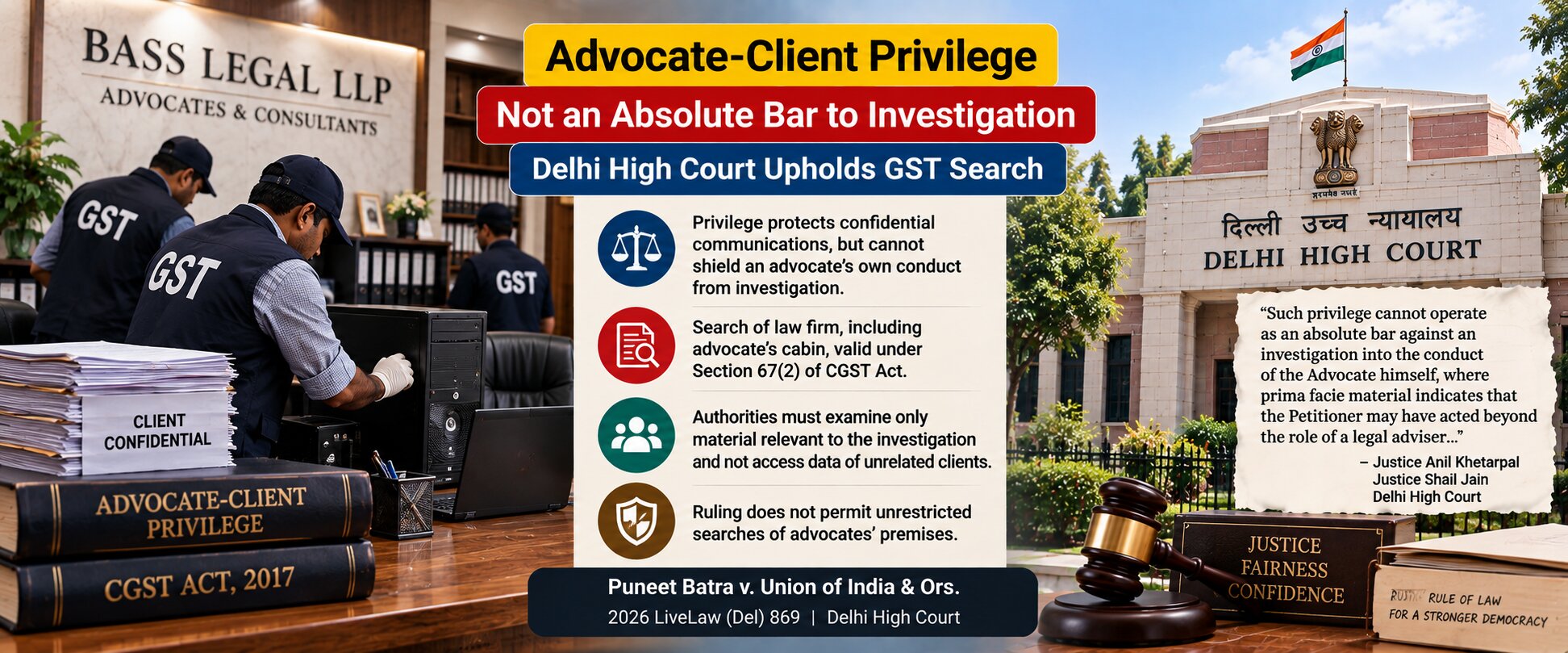
Advocate-client privilege is an important legal protection but is not an absolute bar against investigation into the advocate's own conduct.
Judgement Details
Court
Delhi High Court
Date of Decision
18 September 2026
Judges
Justice Anil Khetarpal and Justice Shail Jain
Citation
Acts / Provisions
Facts of the Case
-
The petitioner, Puneet Batra, was an advocate associated with Bass Legal LLP.
-
The GST Department was conducting an investigation concerning the affairs of Martkarma Technology Pvt. Ltd. (MTPL), a gaming company.
-
Batra had provided professional and legal services to MTPL.
-
The GST authorities conducted a search at the premises of Bass Legal LLP, including Batra's cabin.
-
During the search, the authorities seized his CPU and documents.
-
Batra challenged the search and seizure before the Delhi High Court.
-
He contended that the seized computer could contain privileged and confidential advocate-client communications, including communications relating to MTPL and potentially other clients.
-
His principal concern was that access to such information could violate the protection afforded to advocate-client confidentiality and legal professional privilege.
-
The GST Department disputed the contention that Batra's role was confined to that of a legal adviser.
-
The Department relied upon statements recorded during the investigation and other material which, according to it, indicated that Batra may have been actively involved in the affairs of MTPL.
-
The Department therefore contended that Batra's own conduct and role could form part of the subject matter of the investigation.
-
The High Court considered whether advocate-client privilege could completely prevent investigation into an advocate where there was prima facie material suggesting that the advocate may have acted beyond the role of a legal adviser.
-
The Court also examined whether the search conducted under Section 67(2) of the CGST Act was legally authorised.
-
The Court considered how the GST authorities should deal with data containing information belonging to other clients unrelated to the MTPL investigation.
Issues
-
Whether advocate-client privilege operates as an absolute bar against investigation into the conduct of an advocate where prima facie material indicates that the advocate may have acted beyond the role of a legal adviser?
-
Whether the search of an advocate's office and cabin under Section 67(2) of the CGST Act can be held unauthorised merely because the premises contain privileged and confidential advocate-client communications?
-
Whether the GST authorities were entitled to examine data seized during the search where the material before them indicated that the advocate's own role and conduct formed part of the subject matter of investigation?
-
Whether the protection afforded to advocate-client privilege requires the investigating authorities to exclude unrelated confidential information belonging to other clients from examination?
-
Whether the search and seizure conducted at Bass Legal LLP, including the petitioner's cabin, was valid in the circumstances of the case?
Judgement
-
The Delhi High Court dismissed the petition filed by Puneet Batra.
-
The Court declined to interfere with the search and seizure conducted by the GST authorities.
-
It held that the search of Bass Legal LLP, including Batra's cabin, was carried out pursuant to a valid authorisation under Section 67(2) of the CGST Act.
-
The Court held that the mere fact that the person whose premises were searched was an advocate did not, by itself, render the search unauthorised.
-
The Court recognised that advocate-client privilege and confidentiality are important legal protections.
-
However, it held that such privilege cannot operate as an absolute prohibition against investigating the advocate's own conduct.
-
The Court took note of the prima facie material relied upon by the GST authorities indicating that Batra may have acted beyond the role of a legal adviser and may have been involved in MTPL's affairs.
-
The Court clarified that it was considering this material only to determine whether there was a basis for continuing the investigation, and not to determine Batra's guilt or liability.
-
The Court directed the GST authorities to use the cloned copy of the data prepared pursuant to earlier orders of the Court for further investigation.
-
The authorities were directed to restrict their examination to material relevant to the MTPL investigation.
-
They were specifically directed not to open, access or examine data belonging to Batra's other clients where such data was unrelated to MTPL.
-
The authorities were directed to ensure that the confidentiality of information relating to unrelated clients was not compromised.
-
The Court clarified that if specific material relating to another client subsequently became relevant, the authorities could seek appropriate orders from the High Court in accordance with law.
-
The Court expressly stated that the judgment should not be understood as permitting unrestricted searches of advocates' premises or as diluting the protection available to genuinely privileged communications.
-
The decision was expressly confined to the peculiar facts and circumstances of the case.
Held
-
Where there is prima facie material indicating that an advocate may have acted beyond the role of a legal adviser and may have participated in the affairs under investigation, the advocate's own conduct may be investigated.
-
A search of an advocate's premises is not automatically unlawful merely because the premises contain privileged or confidential client material.
-
The search in the present case was supported by a valid authorisation under Section 67(2) of the CGST Act.
-
The protection of privilege continues to apply to genuinely privileged communications and confidential client material.
-
Investigating authorities must restrict their examination of seized data to material relevant to the investigation.
-
Confidential information relating to unrelated clients must not be accessed or examined merely because it happens to be stored on the seized device.
-
The authorities may approach the Court for appropriate directions if specific information concerning another client subsequently becomes relevant.
-
The judgment does not authorise unrestricted searches of advocates' offices.
-
The petition challenging the search and seizure was therefore dismissed.
Analysis
-
Privilege versus investigation: The central issue is the balance between two competing legal interests: protection of confidential lawyer-client communications and the State's authority to investigate suspected wrongdoing. The Court did not treat either interest as absolute.
-
Advocate's own conduct: The crucial distinction drawn by the Court is between investigating a lawyer merely because the lawyer represents a person under investigation and investigating the lawyer because there is prima facie material suggesting that the lawyer's own conduct may form part of the alleged wrongdoing.
-
No blanket immunity: The judgment makes clear that professional status as an advocate does not create blanket immunity from lawful investigation. The existence of an advocate-client relationship cannot, by itself, prevent authorities from examining conduct that falls outside legitimate legal representation.
-
Privilege remains protected: At the same time, the Court expressly preserved the protection available to genuinely privileged communications. The ruling therefore should not be read as permitting investigators to freely inspect all information stored in a lawyer's office or computer.
-
Relevance-based examination: The direction to use the cloned data only for material relevant to MTPL establishes an important safeguard. Investigators must distinguish between relevant investigative material and confidential information belonging to unrelated clients.
-
Search under Section 67(2): The Court found that the search was supported by a valid statutory authorisation. The fact that the location was a law firm's premises did not, standing alone, invalidate the exercise of statutory search powers.
-
Prima facie material versus proof of guilt: The Court carefully distinguished the threshold for continuing an investigation from the standard required to establish guilt. The material relied upon by the GST Department was considered only to determine whether there was a legitimate basis for investigation.
-
Protection of third-party clients: The directions concerning unrelated clients are significant. A lawyer may store sensitive information concerning numerous clients on the same devices. The Court therefore required the authorities to prevent unrelated confidential information from being unnecessarily accessed.
-
Limited nature of the ruling: The Court specifically confined its conclusion to the facts and circumstances before it. It expressly rejected any interpretation that the judgment permits unrestricted searches of advocates' premises.
-
Practical significance: The decision establishes a fact-sensitive approach: an advocate cannot invoke privilege as an absolute shield where the advocate's own conduct is legitimately under investigation, but investigators must still respect the confidentiality and privilege attaching to unrelated client material.