
Prosecutrix X v. State of Madhya Pradesh, 2026
Judgement Details
Court
Madhya Pradesh High Court
Date of Decision
14 August 2026
Judges
Justice Vishal Mishra
Citation
Acts / Provisions
Facts of the Case
-
The matter concerned a 17-year-old rape survivor who became pregnant as a result of the alleged sexual assault.
-
A medical board examined her and submitted its report on 4 July 2026.
-
The girl was approximately 10 weeks pregnant.
-
Her mother, being her guardian, gave consent for termination of the pregnancy.
-
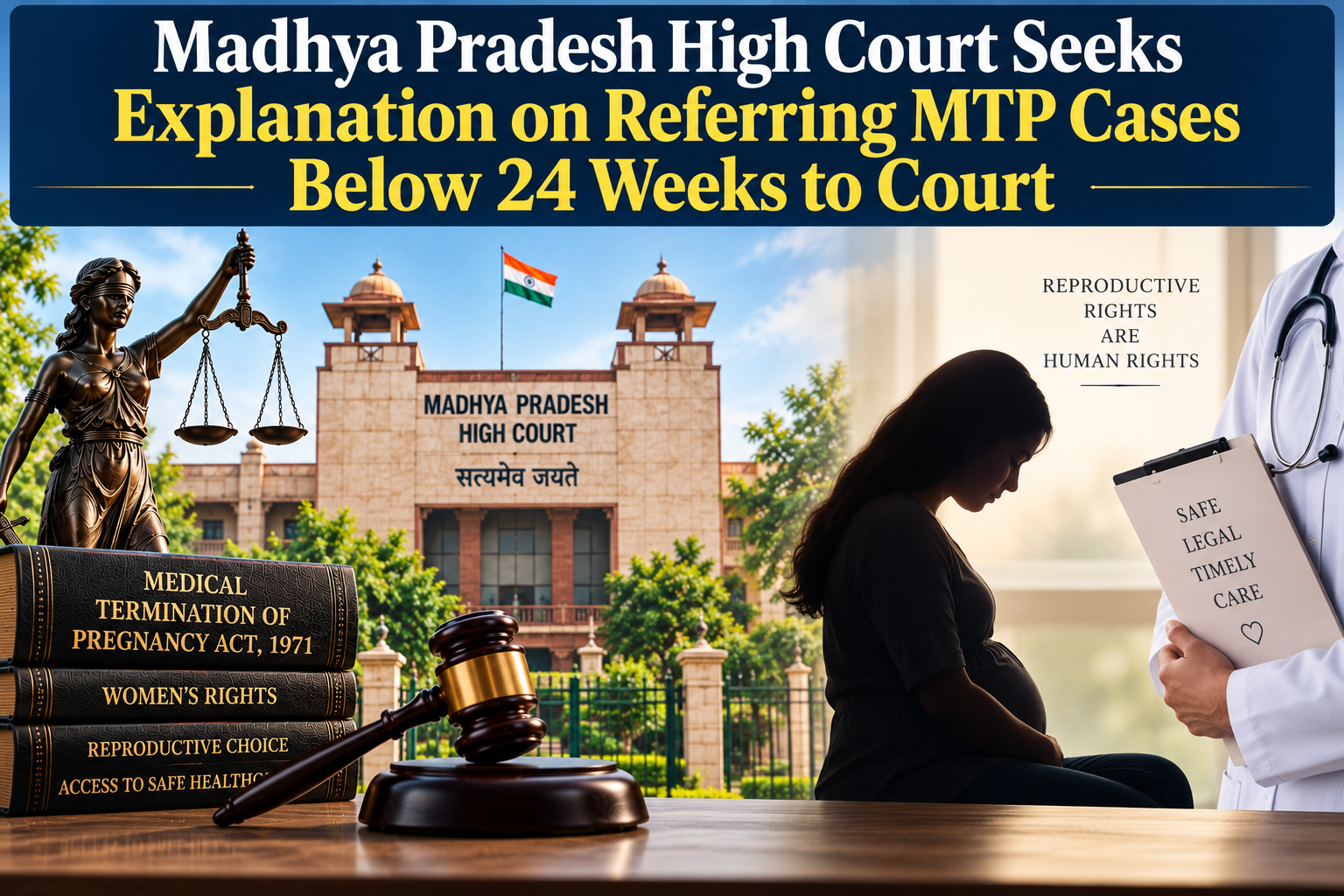
Despite the pregnancy being well below the statutory 24-week limit, the matter was brought before the Court seeking permission for termination.
-
The High Court noted that authorities had been repeatedly approaching courts in MTP cases even where the statutory requirements could be fulfilled by medical practitioners themselves.
-
The Court questioned why such cases were being referred to courts instead of being dealt with promptly by the competent medical authorities.
Issues
-
Whether court permission is required for termination of pregnancy below 24 weeks when the requirements under the MTP Act are otherwise satisfied?
-
Whether medical authorities can refer eligible MTP cases to courts merely to obtain permission instead of exercising their statutory powers?
-
Whether unnecessary judicial intervention in urgent pregnancy termination cases causes avoidable delay and prejudice to the victim?
Judgement
-
The High Court observed that where the pregnancy does not exceed 24 weeks, the requirements prescribed under Section 3 of the MTP Act must be followed by the competent medical practitioners.
-
The Court held that there is no automatic requirement to obtain permission from the High Court merely because the pregnant woman is a minor or because the pregnancy resulted from rape.
-
In the present case, since the girl was 10 weeks pregnant and her mother had consented to the termination, the Court granted permission for the procedure.
-
At the same time, the Court sought an explanation from the Civil Surgeon and Assistant Chief Superintendent of the concerned hospital as to why such matters were being brought before courts.
-
The Court directed the State's Principal Secretary and Director of Health Services to issue appropriate directions so that courts are not unnecessarily burdened with such cases.
-
The petition was disposed of.
Held
-
The MTP Act provides a statutory framework for termination of pregnancy within the prescribed period.
-
Where a pregnancy is below 24 weeks, court permission is not ordinarily required merely for authorising termination if the statutory conditions are satisfied.
-
Medical authorities competent under the Act should take an independent and timely decision in accordance with the statutory requirements.
-
Authorities should not unnecessarily shift responsibility to courts in urgent medical matters.
-
Termination of pregnancy is a matter requiring prompt medical attention, and avoidable litigation can result in loss of valuable time.
-
The High Court directed the State Health Department to ensure that appropriate administrative guidelines are issued to prevent unnecessary court proceedings.
Analysis
-
The judgment addresses an important issue concerning the implementation of the MTP Act and the tendency of medical authorities to seek judicial orders even where the statute itself provides a mechanism for termination.
-
The Court emphasised that judicial intervention should not become a routine substitute for the statutory decision-making process entrusted to registered medical practitioners.
-
The concern is particularly significant in cases involving minors and rape survivors, where delay can increase physical, psychological and medical risks.
-
The Court's direction seeks to establish greater clarity between the respective roles of medical authorities and courts.
-
The judgment also reinforces the principle that statutory powers must be exercised by the authorities to whom Parliament has entrusted them rather than being unnecessarily transferred to the judiciary.
-
The Court's criticism of authorities "shifting their burden" highlights the importance of institutional accountability in sensitive medical cases.
-
At the same time, the Court's approach does not eliminate judicial oversight where judicial intervention is genuinely required because of disputed facts, medical complications, statutory limitations or other exceptional circumstances.
-
The broader significance of the ruling lies in ensuring that eligible MTP cases are handled quickly, lawfully and medically, rather than being delayed by unnecessary court proceedings.
-
The direction to the Health Department may help create a more uniform approach across hospitals and reduce the number of cases reaching courts merely for routine permission.