
Prem Singh v. State of Haryana, 2026
Repeated failure of official witnesses, particularly police personnel, to appear before Trial Courts despite warrants can seriously prejudice the accused's Article 21 right to a speedy trial.
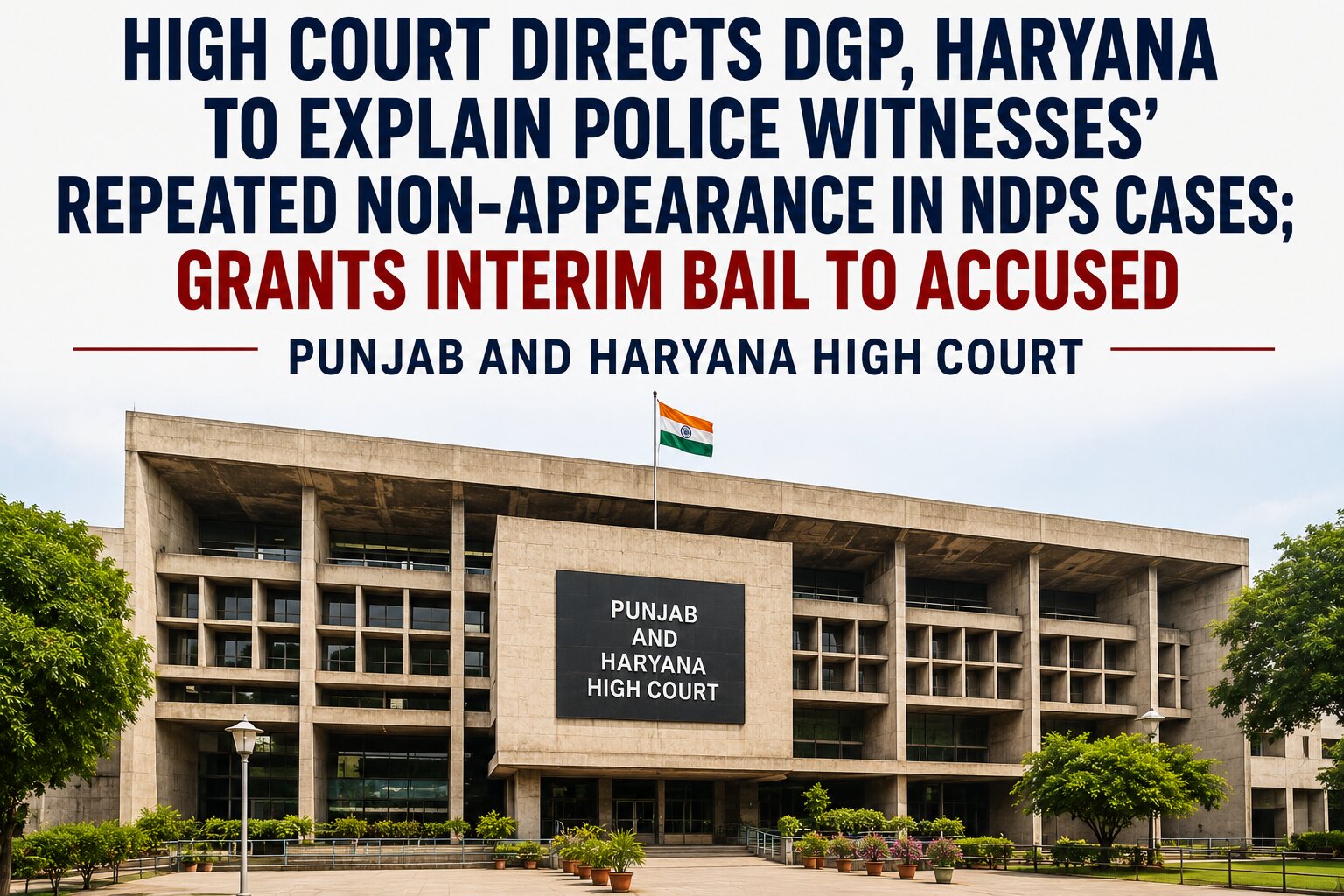
Judgement Details
Court
Punjab and Haryana High Court
Date of Decision
20 August 2026
Judges
Justice Sumeet Goel
Citation
Acts / Provisions
Facts of the Case
-
The petitioner, Prem Singh, was facing prosecution in an FIR registered at GRP Ambala Cantt.
-
The FIR was initially registered under Section 21-C of the NDPS Act.
-
Section 29 of the NDPS Act was subsequently added to the case.
-
The prosecution had cited 19 witnesses.
-
A significant number of the prosecution witnesses were official witnesses, particularly police personnel.
-
Despite repeated directions from the Trial Court, the prosecution witnesses failed to appear for recording their evidence.
-
The Trial Court issued bailable warrants against the police witnesses.
-
In some instances, even non-bailable warrants had reportedly been issued, yet the witnesses continued to remain unavailable.
-
The High Court noted that none of the 19 prosecution witnesses had been examined by the time it considered the petitioner's bail application.
-
The petitioner had been in custody since 24 January 2025.
-
The petitioner sought bail, contending that the trial was being substantially delayed for reasons that were not attributable to him.
-
The State's failure to secure the presence of its own official witnesses became a central concern before the High Court.
-
The Court examined the effect of this delay on the petitioner's Article 21 right to a speedy trial.
-
The Court also considered the stringent bail restrictions contained in Section 37 of the NDPS Act.
-
The High Court expressed serious concern over the repeated failure of police officials to appear before Trial Courts despite warrants.
-
The Court directed the Director General of Police, Haryana to remain personally present and explain the systemic failure concerning the appearance of official witnesses in NDPS cases.
-
The Court ultimately ordered the petitioner's release on interim regular bail until the next date of hearing, subject to conditions.
Issues
-
Whether repeated failure of police officials cited as prosecution witnesses to appear before the Trial Court despite warrants violates the accused's constitutional right to a speedy trial under Article 21?
-
Whether prolonged non-examination of prosecution witnesses for reasons attributable to the prosecution can justify release on bail despite the stringent conditions under Section 37 of the NDPS Act?
-
Whether indefinite incarceration of an accused can be justified solely by the stringent statutory restrictions applicable to bail in commercial-quantity NDPS cases when the trial is substantially delayed for reasons not attributable to the accused?
-
Whether senior police authorities have a duty to ensure the appearance of serving police officials who are required to testify as prosecution witnesses before Trial Courts?
-
Whether repeated non-appearance of official witnesses despite bailable and non-bailable warrants constitutes a systemic failure affecting the administration of criminal justice?
-
Whether the Director General of Police, Haryana should be directed to personally appear before the High Court and explain the failure to secure the attendance of police witnesses in NDPS trials?
-
Whether the petitioner was entitled to interim regular bail in view of his prolonged custody and the absence of meaningful progress in the trial?
Judgement
-
The Punjab and Haryana High Court expressed serious concern over the repeated failure of police officials to appear as prosecution witnesses in NDPS cases.
-
The Court observed that official witnesses were frequently failing to attend Trial Courts despite issuance of bailable warrants and, in several cases, non-bailable warrants.
-
The Court found that such conduct was resulting in routine adjournments and indefinite delays in NDPS trials.
-
The Court held that the situation represented a serious and systemic lapse in the prosecutorial mechanism.
-
The Court emphasized that such delays directly affect the accused's right to a speedy trial under Article 21.
-
The Court observed that the failure of State officials to perform their duties undermines public confidence in the criminal justice system.
-
The Court noted that the delay also undermines the objectives of the NDPS Act by allowing prosecutions to remain pending for prolonged periods.
-
The Court held that senior police officials, particularly the concerned SSP/SP, have a duty to monitor the conduct of police personnel and ensure their appearance before Trial Courts.
-
The Court expressed its inability to ignore what it described as the apparent abdication of responsibility by senior police authorities.
-
The Court specifically directed the Director General of Police, Haryana to remain personally present before the Court and explain the reasons for the repeated failure of police witnesses to appear.
-
The Court noted that the petitioner had remained in custody since 24 January 2025.
-
Despite 19 prosecution witnesses being cited, none had been examined by the time of the High Court's consideration.
-
The Court held that the stringent conditions under Section 37 NDPS Act cannot be used to justify indefinite incarceration where the delay in trial is attributable to the prosecution or State machinery.
-
The Court therefore ordered the petitioner's release on interim regular bail until the next date of hearing, subject to appropriate conditions.
Held
-
The State has a duty to ensure that its police officials appear before courts when cited as prosecution witnesses.
-
Senior police authorities have a corresponding responsibility to monitor and secure the attendance of such witnesses.
-
Prolonged trial delay caused by the prosecution cannot be ignored merely because the case concerns a commercial quantity of narcotics and is subject to Section 37 NDPS Act.
-
Section 37's stringent bail conditions do not justify indefinite incarceration where the accused is not responsible for the delay in trial.
-
Systemic failure to produce prosecution witnesses undermines the administration of criminal justice and public confidence in the rule of law.
-
The High Court was justified in requiring the DGP, Haryana to personally explain the failure of police witnesses to appear.
-
Considering the prolonged custody and absence of examination of any of the 19 prosecution witnesses, the petitioner was granted interim regular bail.
Analysis
-
Speedy trial under Article 21: The judgment reinforces that the right to a speedy trial applies even in serious offences under the NDPS Act. The seriousness of the allegations does not permit the State to indefinitely postpone the trial.
-
Section 37 NDPS Act: Section 37 creates a stringent framework for bail, particularly in cases involving commercial quantities. However, the Court emphasized that this statutory restriction cannot be interpreted as permitting incarceration for an unlimited period when the prosecution itself is responsible for substantial trial delays.
-
Failure of official witnesses: The Court's strongest criticism was directed towards police officials who failed to appear despite repeated warrants. Because these witnesses are employees of the State, their absence reflects not merely individual default but potentially a systemic administrative failure.
-
Responsibility of senior officers: The Court placed responsibility on senior police officials to monitor the attendance of police witnesses. The duty does not end with filing the charge sheet; the State must also ensure that its witnesses are available to complete the trial.
-
Effect on criminal justice: When prosecution witnesses repeatedly fail to appear, the accused remains in custody while the trial remains stagnant. This can convert the process itself into a form of punishment before guilt has been established.
-
NDPS Act objectives: The Court recognized the importance of combating narcotics offences but noted that enforcement objectives cannot be achieved by compromising fundamental procedural guarantees. A strong prosecution must also be an efficient prosecution.
-
Public confidence: Repeated failure of State officials to comply with court processes weakens confidence in the justice system. The Court viewed such conduct as an affront to the rule of law because court-issued warrants were themselves not being effectively executed.
-
Interim bail: The grant of interim regular bail was linked to the particular circumstances, especially the petitioner's prolonged custody and complete absence of examination of the prosecution witnesses. It should not be understood as an automatic relaxation of Section 37 in every NDPS case.
-
Systemic significance: The direction requiring the DGP to personally appear elevates the matter beyond the individual bail application. The Court treated witness non-appearance as an institutional problem requiring accountability at the highest level of the police hierarchy.
-
Balancing competing interests: The judgment balances two important concerns: effective prosecution of narcotics offences and protection of the accused's constitutional liberty. The Court's approach is that both objectives must operate within the framework of a functioning and timely criminal trial.
-
Impact on NDPS trials: The ruling sends a strong message that prosecution agencies cannot rely on the severity of NDPS offences to excuse repeated procedural failures. The State must actively facilitate the progress of the trial.
-
Broader legal significance: The decision underscores a fundamental principle of criminal justice: stringent bail provisions do not give the prosecution a licence to delay trial indefinitely.