
Praveen Kumar Yadav v. Smt. Priyanka Yadav, 2026
Section 9 requires more than proof of separate residence; the withdrawing spouse's lack of reasonable excuse must also be established.
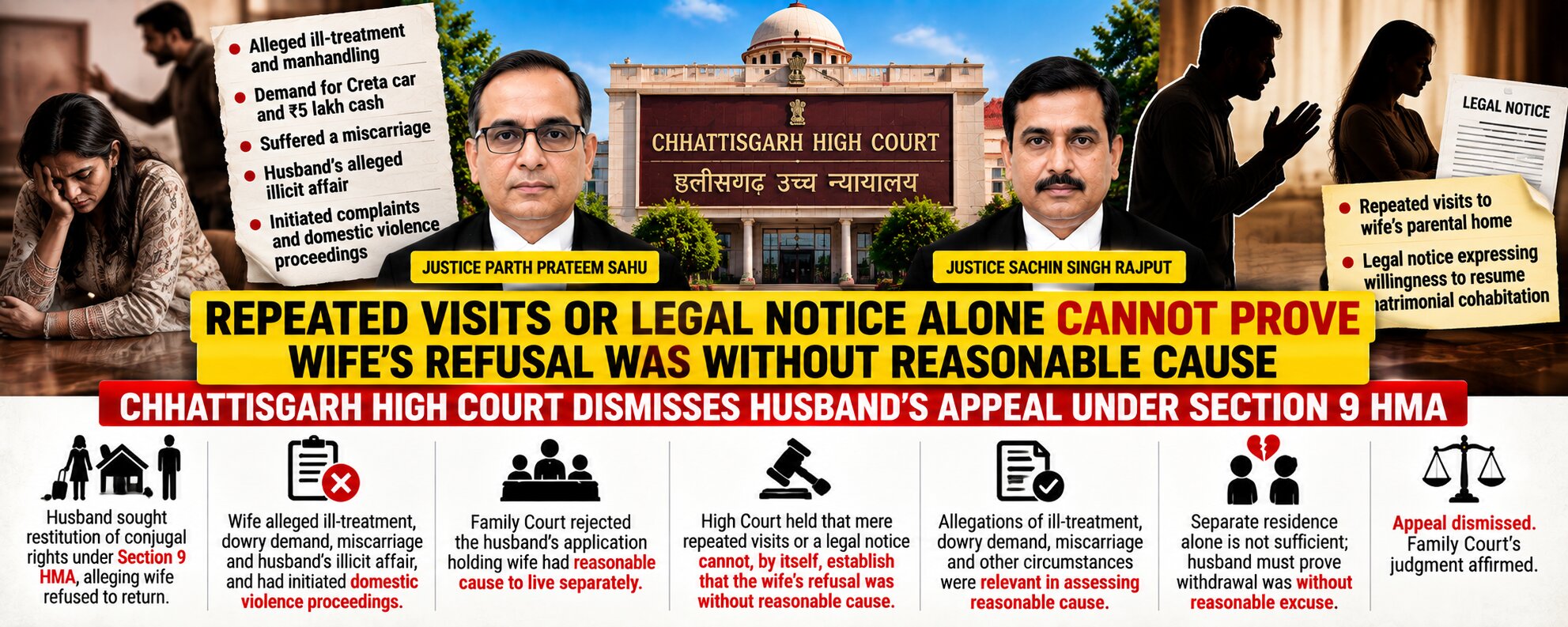
Judgement Details
Court
Chhattisgarh High Court
Date of Decision
28 September 2026
Judges
Justice Parth Prateem Sahu and Justice Sachin Singh Rajput
Citation
Acts / Provisions
Facts of the Case
-
The appellant-husband filed an application under Section 9 of the Hindu Marriage Act, 1955, seeking restitution of conjugal rights.
-
According to the husband, he had taken his wife to her parental home after receiving information about her mother's illness.
-
He alleged that thereafter the wife refused to return to the matrimonial home despite his repeated requests.
-
The husband claimed that he subsequently made repeated visits to the wife's parental home and expressed his willingness to resume matrimonial cohabitation.
-
He also issued a legal notice expressing his willingness to resume matrimonial life with the wife.
-
The wife opposed the husband's claim and alleged that she had been subjected to ill-treatment and manhandling by the husband and his family members.
-
She further alleged that the husband and his family had demanded a Creta car and ₹5 lakh in cash.
-
The wife stated that she had suffered a miscarriage and attributed circumstances surrounding it to the matrimonial difficulties.
-
She also alleged that the husband was maintaining an illicit relationship with another woman.
-
The wife had initiated complaints and domestic violence proceedings, which formed part of the circumstances considered by the Court.
-
The wife was admittedly living separately from the husband.
-
The Family Court rejected the husband's application for restitution of conjugal rights.
-
Aggrieved by the Family Court's decision, the husband approached the Chhattisgarh High Court by way of appeal.
Issues
-
Whether the wife's withdrawal from the society of the husband was without reasonable excuse within the meaning of Section 9 of the Hindu Marriage Act, 1955?
-
Whether the husband's repeated visits to the wife's parental home and his legal notice expressing willingness to resume matrimonial cohabitation were sufficient, by themselves, to establish that the wife's refusal to return was without reasonable cause?
-
Whether the allegations of ill-treatment, manhandling, dowry demands, miscarriage and other matrimonial circumstances provided a reasonable justification for the wife's separate residence?
-
Whether the Family Court's refusal to grant restitution of conjugal rights suffered from any perversity, illegality or material infirmity warranting interference by the High Court?
Judgement
-
The Chhattisgarh High Court dismissed the husband's appeal and affirmed the judgment and decree of the Family Court.
-
The Court held that the mere fact that the wife was residing separately from her husband was not sufficient to grant relief under Section 9 of the Hindu Marriage Act.
-
The husband was required to establish not merely that the wife had withdrawn from his society, but also that such withdrawal was without reasonable excuse.
-
The Court found that the husband had failed to discharge this burden.
-
The wife's allegations of ill-treatment, manhandling and demands for a Creta car and ₹5 lakh in cash were considered relevant to determining whether she had reasonable justification for living separately.
-
The circumstances surrounding the wife's miscarriage were also considered relevant in assessing the overall matrimonial circumstances.
-
The Court also took into account the complaints and domestic violence proceedings initiated by the wife.
-
These circumstances, when considered cumulatively, could not be dismissed as irrelevant to the question of whether the wife had a reasonable cause to remain separately.
-
The Court also considered it significant that the husband had retained the wife's educational and other public documents in his custody.
-
The Court held that the wife had furnished a reasonable and plausible explanation for remaining apart from the husband.
-
The husband's subsequent conduct of visiting the wife's parental home repeatedly and issuing a legal notice expressing willingness to resume matrimonial cohabitation did not, by itself, establish that the wife's refusal to return was without reasonable cause.
-
The Court emphasised that such subsequent expressions of willingness must be assessed in the context of the circumstances prevailing between the parties and the evidence already on record.
-
Finding no perversity, illegality or material infirmity in the Family Court's decision, the High Court declined to interfere.
-
The appeal was accordingly dismissed, and the Family Court's judgment and decree were affirmed.
Held
-
The fact that a wife is living separately does not automatically entitle the husband to a decree for restitution of conjugal rights.
-
The husband must establish that the wife's withdrawal from his society was without reasonable cause.
-
Repeated visits to the wife's parental home cannot, by themselves, establish absence of reasonable cause.
-
A legal notice expressing willingness to resume matrimonial cohabitation cannot, standing alone, prove that the wife's refusal to return was unjustified.
-
Subsequent expressions of willingness to resume cohabitation must be examined in the context of the entire matrimonial relationship and evidence on record.
-
Allegations of ill-treatment, manhandling and dowry demands may be relevant while determining whether the wife had reasonable justification for living separately.
-
The circumstances relating to the wife's miscarriage were also relevant when considered along with the other evidence.
-
Complaints and domestic violence proceedings initiated by the wife could not be treated as wholly irrelevant to the question of reasonable excuse.
-
The husband's retention of the wife's educational and other public documents was also considered a material circumstance.
-
The wife had provided a reasonable and plausible explanation for her decision to live separately.
-
The Family Court's decision did not suffer from any perversity, illegality or material infirmity warranting appellate interference.
Analysis
-
The central issue in the case was the interpretation of the expression “reasonable excuse” under Section 9 of the Hindu Marriage Act.
-
Section 9 does not merely require proof that one spouse has withdrawn from the society of the other. The court must also determine whether that withdrawal was without reasonable cause.
-
Therefore, separate residence alone cannot automatically result in a decree for restitution of conjugal rights.
-
The judgment adopts a contextual approach to Section 9 by requiring the court to examine the circumstances that led to the spouses living separately.
-
The Court did not treat the husband's repeated attempts to bring the wife back as conclusive proof that the wife's refusal lacked justification.
-
A spouse's subsequent willingness to resume cohabitation must be evaluated alongside the earlier conduct, matrimonial circumstances and evidence already placed before the court.
-
The Court considered the allegations of ill-treatment, physical manhandling and dowry demands relevant to the wife's explanation for living separately.
-
The complaints and domestic violence proceedings initiated by the wife provided additional circumstances that could not simply be ignored while determining whether her separate residence was justified.
-
The Court's approach demonstrates that the determination of reasonable excuse is fact-specific and must be made after considering the cumulative circumstances of the matrimonial relationship.
-
The allegation concerning the husband's retention of the wife's educational and public documents was another circumstance supporting the wife's explanation for remaining separately.
-
Importantly, the Court did not hold that every allegation made by a spouse automatically constitutes a reasonable excuse. Rather, such allegations must be assessed along with the evidence and surrounding circumstances.
-
The judgment therefore reinforces that Section 9 proceedings cannot be decided merely by examining the later willingness of one spouse to resume cohabitation.
-
The relevant inquiry is whether, considering the circumstances as a whole, the spouse living separately had a reasonable justification for doing so.
-
The decision also reflects the limited scope of appellate interference where the Family Court has considered the relevant evidence and its conclusion does not suffer from perversity or legal infirmity.
-
The judgment thus strengthens the principle that restitution of conjugal rights is not automatic merely because one spouse expresses willingness to resume matrimonial life.