
Pramod Kumar Singh Alias Guddu Singh v. State of U.P. through Secretary, Department of Home, Lucknow, 2026
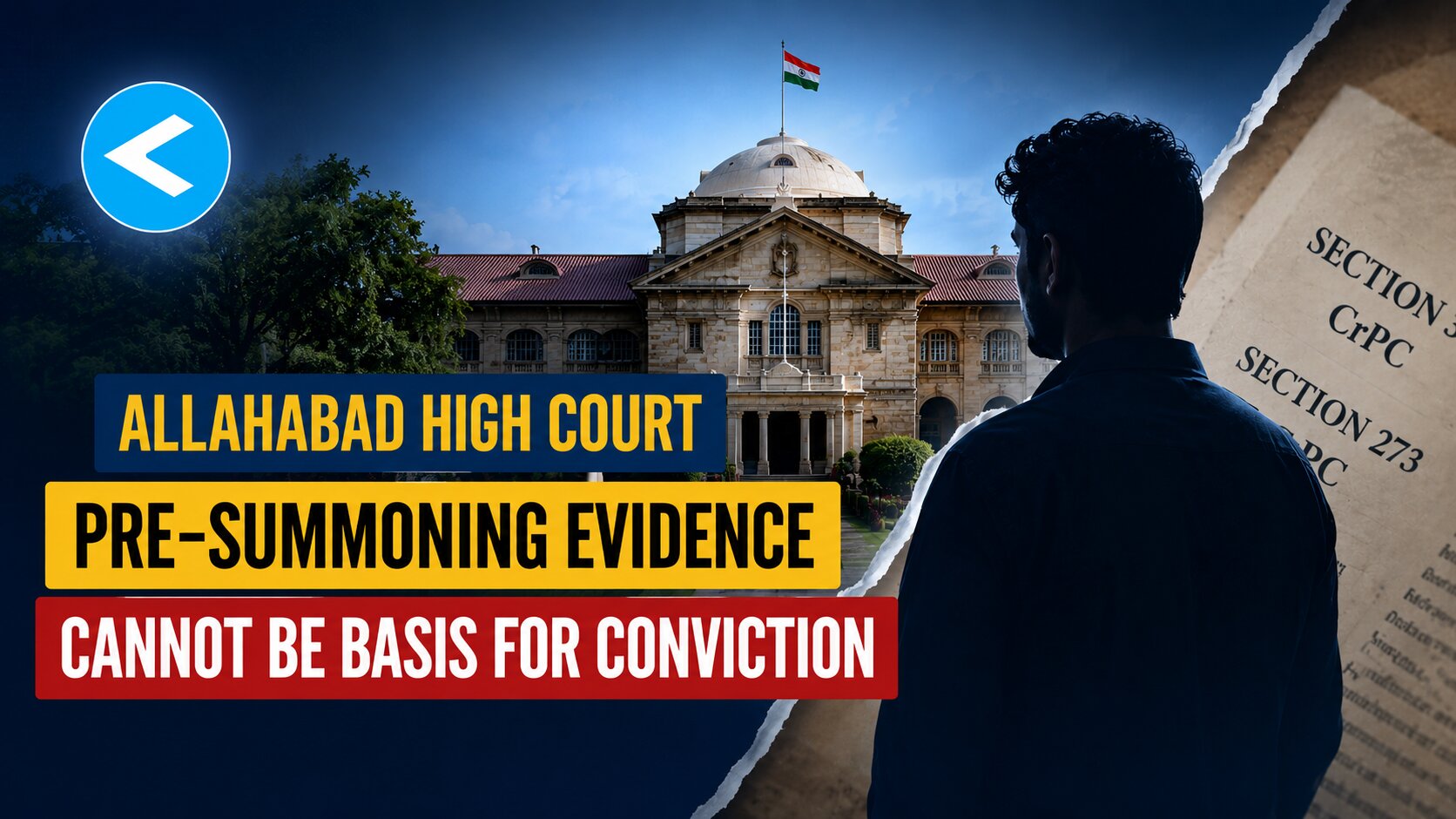
Evidence Recorded Before Summoning an Accused Under Section 319 CrPC Cannot Be Used as Basis for Conviction.
Judgement Details
Court
Allahabad High Court
Date of Decision
1 June 2026
Judges
Justice Rajesh Singh Chauhan & Justice Subhash Vidyarthi
Citation
Acts / Provisions
Facts of the Case
-
Vijay Kumar Singh sustained gunshot injuries allegedly caused by four accused persons and subsequently died.
-
During investigation, the police could not establish the involvement of Pramod Kumar Singh alias Guddu Singh.
-
Consequently, the appellant was not charge-sheeted.
-
During the trial of the charge-sheeted accused, certain prosecution witnesses implicated the appellant.
-
Based on those statements, an application under Section 319 CrPC was filed seeking his summoning as an additional accused.
-
The trial court allowed the application in June 2012 and summoned the appellant to face trial.
-
The application was based mainly on the testimonies of:
-
PW-1 Pintu Singh (injured complainant),
-
Indrapal Singh (uncle of the deceased),
-
Ajay Kumar Singh (independent witness).
-
-
After the appellant was summoned, PW-1 and Indrapal Singh were re-examined in 2013.
-
Both witnesses resiled from their earlier statements and denied the appellant's involvement.
-
PW-1 specifically stated that he had falsely implicated the appellant due to pressure.
-
Ajay Kumar Singh never appeared again after the appellant was summoned.
-
Despite these developments, the trial court convicted the appellant by relying upon the pre-summoning testimonies.
Issues
-
Whether statements of witnesses recorded before the appellant was summoned under Section 319 CrPC can be relied upon for recording his conviction?
-
Whether evidence recorded in the absence of an accused person violates the mandate of Section 273 CrPC when used against him?
-
Whether the trial court was justified in ignoring the subsequent testimonies of witnesses who denied the appellant's involvement after he was summoned to face trial?
-
Whether statements relied upon for summoning an accused under Section 319 CrPC can automatically constitute substantive evidence for convicting him?
-
Whether the prosecution succeeded in proving the guilt of the appellant beyond reasonable doubt?
Judgement
-
The Allahabad High Court allowed the appeal.
-
The Court held that evidence recorded before the appellant was summoned could not be used as the basis for his conviction.
-
The Court emphasized that Section 273 CrPC requires evidence to be recorded in the presence of the accused.
-
The Bench found that the trial court wrongly relied upon the earlier testimony of Indrapal Singh while ignoring his later statement exonerating the appellant.
-
The Court noted that both PW-1 and Indrapal Singh had denied the appellant's involvement after he was summoned.
-
The independent witness Ajay Kumar Singh did not appear for examination after the appellant entered the trial.
-
The Bench relied upon Hardeep Singh v. State of Punjab (2014) and reiterated that proceedings under Section 319 CrPC are only for deciding whether a person should be tried and not whether he is guilty.
-
The Court held that the trial court committed a serious error by treating the pre-summoning statements as substantive evidence of guilt.
-
Since no legally admissible evidence remained against the appellant, the conviction could not be sustained.
Held
-
The prosecution failed to prove guilt beyond reasonable doubt.
-
Pre-summoning evidence could not be relied upon to convict the appellant.
-
Reliance on such evidence violated Section 273 CrPC.
-
The conviction and sentence imposed by the trial court were set aside.
-
The appellant was acquitted of all charges.
Analysis
-
The judgment reinforces the principle of a fair trial by ensuring that an accused gets an opportunity to challenge evidence used against him.
-
The Court correctly distinguished between the standard required for summoning an accused under Section 319 CrPC and the higher standard required for conviction.
-
The decision clarifies that evidence sufficient for summoning is not automatically sufficient for convicting an accused.
-
By emphasizing Section 273 CrPC, the Court protected the valuable right of cross-examination.
-
The judgment prevents the misuse of Section 319 CrPC by ensuring that subsequently added accused persons are not convicted solely on statements recorded before they became parties to the trial.
-
The reliance on Hardeep Singh v. State of Punjab strengthens the principle that proceedings under Section 319 CrPC are procedural in nature and do not determine guilt.
-
The ruling serves as an important safeguard against convictions based on evidence that an accused never had the opportunity to challenge.
-
The judgment contributes significantly to the jurisprudence relating to admissibility of evidence, natural justice, and criminal procedure.