
Pramod Kumar Shukla v. State of Uttar Pradesh & Others, 2026
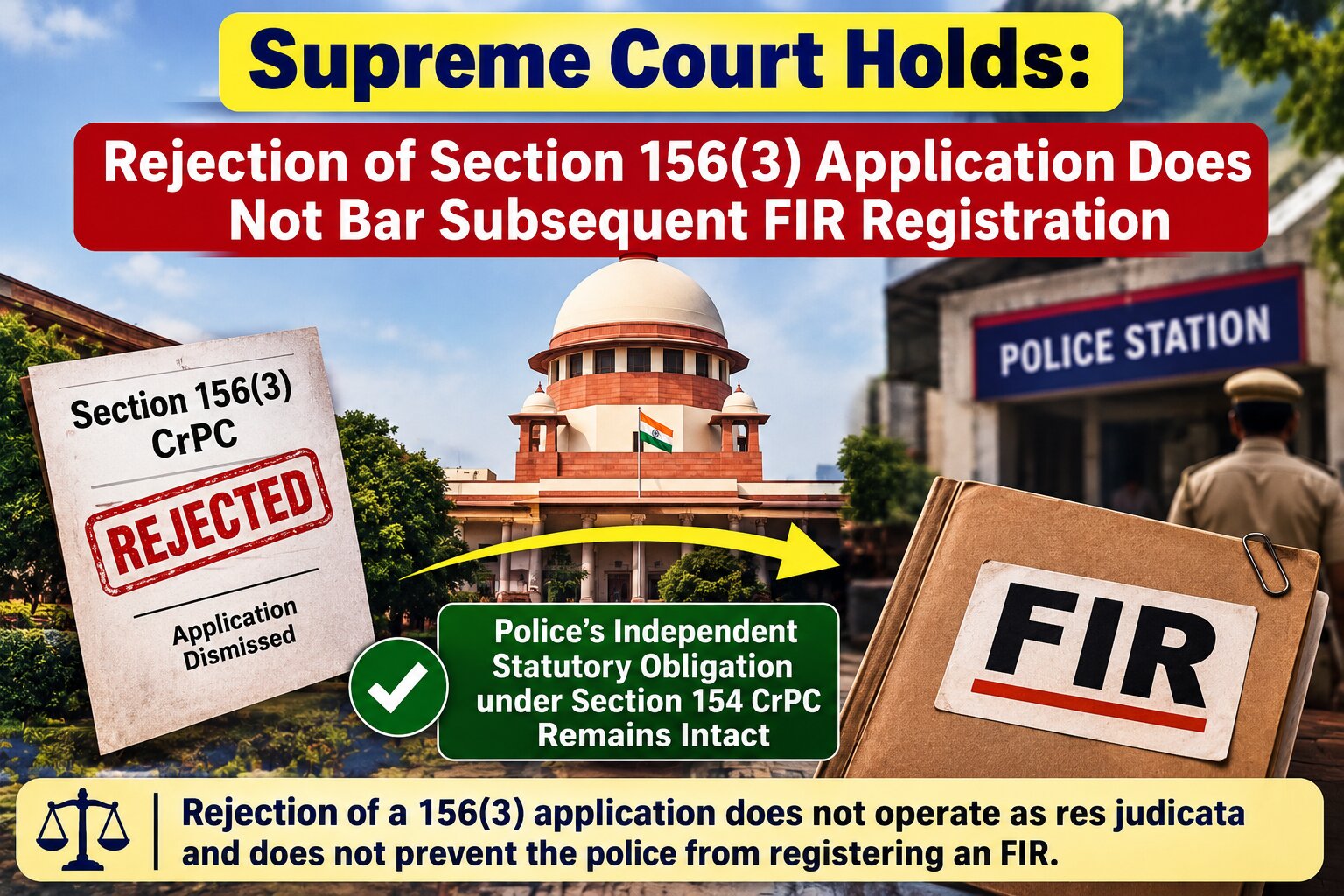
Rejection of a Section 156(3) application does not bar subsequent FIR registration.
Judgement Details
Court
Supreme Court of India
Date of Decision
21 August 2026
Judges
Justice Prashant Kumar Mishra and Justice N.V. Anjaria
Citation
Acts / Provisions
Facts of the Case
- The complainant alleged that the appellant had taken money by promising to secure government employment.
-
It was alleged that forged examination documents were also supplied in connection with the alleged transaction.
-
The complainant initially approached the Magistrate under Section 156(3) CrPC seeking registration of an FIR.
-
The Magistrate obtained a police report and rejected the application.
-
The complainant subsequently approached the police.
-
The police registered an FIR concerning the allegations.
-
The appellant challenged the FIR before the Allahabad High Court.
-
He argued that the earlier rejection of the Section 156(3) application prevented subsequent registration of an FIR.
-
The High Court declined to quash the FIR.
-
The appellant therefore approached the Supreme Court.
Issues
-
Whether rejection of an application under Section 156(3) CrPC bars subsequent registration of an FIR on the same or substantially similar allegations?
-
Whether rejection of a Section 156(3) application amounts to a final adjudication on the merits attracting the doctrine of res judicata?
-
Whether the police retain an independent statutory obligation under Section 154 CrPC to register an FIR when information discloses a cognizable offence?
-
Whether the subsequent FIR could be quashed merely because the complainant's earlier Section 156(3) application had been rejected?
-
Whether the High Court was justified in refusing to exercise its inherent jurisdiction to quash the FIR?
Judgement
-
The Supreme Court dismissed the appeal.
-
It upheld the Allahabad High Court's decision refusing to quash the FIR.
-
The Court held that rejection of an application under Section 156(3) CrPC does not prevent the police from subsequently registering an FIR.
-
An order under Section 156(3) concerns whether the Magistrate should direct investigation.
-
Such an order does not ordinarily decide the truth or falsity of the allegations.
-
Therefore, rejection of the application does not operate as res judicata.
-
The police's statutory obligation under Section 154 CrPC exists independently.
-
Where information discloses a cognizable offence, the police are required to act in accordance with the statutory mandate.
-
The Court found that the allegations in the FIR prima facie disclosed cognizable offences.
-
Questions concerning the credibility and evidentiary value of the allegations were matters for investigation and trial.
-
The Court therefore declined to interfere with the criminal proceedings.
Held
-
A Section 156(3) order does not ordinarily constitute a final adjudication on the merits.
-
The doctrine of res judicata therefore does not apply merely because such an application was rejected.
-
The police's duty under Section 154 CrPC is independent of Section 156(3) proceedings.
-
If information discloses a cognizable offence, the police can register an FIR notwithstanding the earlier rejection.
-
The truthfulness and evidentiary value of the allegations are matters for investigation and trial.
-
The appeal was dismissed.
Analysis
-
Independent police duty: The judgment makes clear that the police's obligation under Section 154 is not dependent upon a Magistrate first directing investigation under Section 156(3).
-
No final adjudication: Rejection of a Section 156(3) application does not determine whether the accused committed an offence. It is therefore not equivalent to a judgment on merits.
-
Res judicata inapplicable: Since there is no final adjudication of rights or liabilities at this stage, the earlier rejection cannot ordinarily prevent a subsequent FIR.
-
FIR stage has limited scrutiny: Courts generally do not conduct a detailed examination of evidence while deciding whether an FIR should continue.
-
Cognizable offence: Once the information prima facie discloses a cognizable offence, the statutory mechanism for registration and investigation can operate independently.
-
Civil nature argument: The mere assertion that a dispute has a civil or monetary dimension does not automatically justify quashing criminal proceedings where the allegations disclose criminal offences.
-
Protection against procedural misuse: The judgment prevents the rejection of a Section 156(3) application from becoming an automatic mechanism for preventing investigation of subsequently disclosed cognizable offences.