
Poosa Sri Krishna & Ors. v. Gattu Kishan Rao & Anr., 2026
The doctrine of in pari delicto prevents a party who participated in an illegal transaction from obtaining judicial relief arising from that transaction.
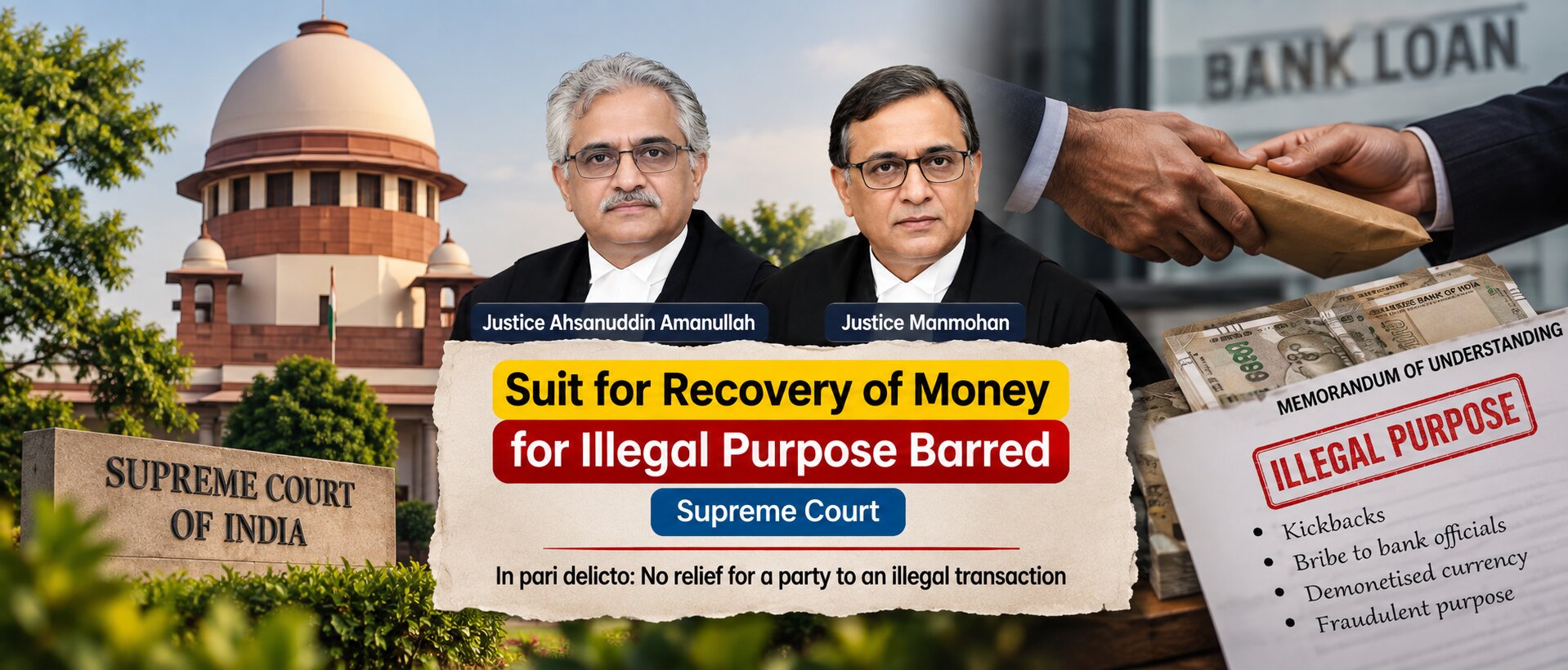
Judgement Details
Court
Supreme Court of India
Date of Decision
11 September 2026
Judges
Justice Ahsanuddin Amanullah and Justice Manmohan
Citation
Acts / Provisions
Facts of the Case
-
The dispute arose from a money-recovery suit filed by the original plaintiff against the appellants.
-
The plaintiff claimed recovery of money allegedly paid to the appellants in connection with arrangements for procuring loans from various banks.
-
According to the plaint, the amounts were described in connection with certain overhead expenses and payments associated with obtaining bank loans.
-
The appellants contended that the plaint itself disclosed that the money was intended to be used for an illegal and fraudulent purpose, including satisfying demands of bank officials in their personal capacity.
-
It was further alleged in the plaint that demonetised currency notes had been procured and handed over to the appellants for exchange for consideration.
-
The appellants therefore argued that the underlying agreement had an unlawful object and consideration and was void under Section 23 of the Indian Contract Act, 1872.
-
On this basis, the appellants filed an application seeking rejection of the plaint under Order VII Rule 11(d) CPC.
-
The trial court rejected the application for rejection of the plaint.
-
The respondents thereafter succeeded before the Telangana High Court, which upheld the trial court's decision.
-
Aggrieved by the High Court's decision, the appellants approached the Supreme Court of India.
-
Before the Supreme Court, the appellants argued that the plaintiff could not seek recovery from a transaction whose own pleadings disclosed an illegal and fraudulent purpose.
-
The respondents argued that the payments were intended for legitimate loan-processing activities and that the appellants had themselves fraudulently induced the plaintiff to part with money by promising substantial returns.
-
The respondents relied upon Sita Ram v. Radha Bai & Ors., arguing that where an illegal transaction has not been completed, recovery of money paid under it may, in appropriate circumstances, remain permissible.
Issues
-
Whether a plaint disclosing that the money claimed for recovery was paid for an illegal and fraudulent purpose is liable to be rejected under Order VII Rule 11(d) of the CPC?
-
Whether the underlying agreement having an unlawful consideration or object is void under Section 23 of the Indian Contract Act, 1872?
-
Whether the doctrine of in pari delicto bars a plaintiff who participated in an illegal transaction from recovering money paid pursuant to that transaction?
-
Whether the exception recognised in Sita Ram v. Radha Bai, permitting recovery in certain cases where an illegal transaction has not been completed, was applicable to the facts of the present case?
-
Whether the plaint disclosed that the illegal purpose had been substantially carried into effect so as to prevent the plaintiff from seeking recovery of the money through a civil suit?
Judgement
-
The Supreme Court allowed the appeal filed by the appellants.
-
The Court held that the statements contained in the plaint itself disclosed that the money had been paid for an illegal and fraudulent purpose.
-
The Court identified two significant aspects of illegality disclosed by the plaint: the alleged payment of money to bank officials in their personal capacity for facilitating loans and the alleged procurement and exchange of demonetised currency notes for consideration.
-
The Court held that the consideration and object of the underlying Memorandum of Understanding were forbidden by law, opposed to public policy and fraudulent, thereby attracting Section 23 of the Indian Contract Act, 1872.
-
The Court applied the doctrine of in pari delicto, under which a person who has participated in an illegal transaction cannot ordinarily ask the court to provide relief arising from that illegality.
-
The Court explained that the doctrine is founded on the principle that courts should not assist parties in resolving disputes arising from their own wrongdoing and that denial of judicial relief can deter participation in unlawful conduct.
-
The Court relied upon its earlier decision in G. Pankajakshi Amma v. Mathai Mathew (Dead) Through LRs, reiterating that courts should not assist a party in enforcing or recovering money arising from an illegal and unaccounted transaction.
-
The Court also considered Vinod Popli v. Ragini Popli & Ors., in which the principle against granting judicial assistance in relation to illegal transactions was applied.
-
The Court distinguished the decision in Sita Ram v. Radha Bai, holding that the exception permitting recovery where an illegal transaction had not been carried into effect did not apply in the present circumstances.
-
The Court observed that, according to the plaintiff's own pleadings, the plaintiff had already parted with the money and the illegal purpose had been substantially carried into effect.
-
The alleged transaction involving demonetised currency further demonstrated that the illegality was not merely a contemplated future act.
-
Consequently, the plaintiff could not rely upon the argument that the illegal transaction had remained wholly unexecuted.
-
The Supreme Court therefore held that the suit was barred by the legal principles applicable to illegal transactions and that the plaint was liable to be rejected under Order VII Rule 11(d) CPC.
-
The Court allowed the application under Order VII Rule 11 and rejected O.S. No. 18 of 2018, pending before the Additional District Judge at Godavarikhani, Peddapalli District, Telangana.
Held
-
The Supreme Court held that a plaintiff cannot seek recovery of money when the plaint itself reveals that the money was paid for an illegal and fraudulent purpose.
-
An agreement whose consideration or object is unlawful, opposed to public policy or intended to defeat the provisions of law is void under Section 23 of the Indian Contract Act, 1872.
-
Where the plaint itself discloses the illegality, the court can reject the plaint under Order VII Rule 11(d) CPC without allowing the plaintiff to proceed with a suit based upon the illegal transaction.
-
The Sita Ram v. Radha Bai exception was not applicable because the illegal purpose in the present case had been substantially carried into effect.
-
The suit for recovery was therefore rejected at the threshold.
Analysis
-
The judgment reinforces the principle that courts will not assist a party in enforcing rights arising directly from an illegal transaction.
-
The Supreme Court focused on the averments contained in the plaint itself. For an application under Order VII Rule 11(d), the court primarily examines the statements made in the plaint to determine whether the suit is barred by law.
-
The decision demonstrates the interaction between procedural law and substantive contract law. Order VII Rule 11(d) provides the procedural mechanism for rejecting a barred suit, while Section 23 of the Contract Act supplies the substantive basis for treating the underlying agreement as void.
-
The doctrine of in pari delicto operates on the principle that a participant in an illegal transaction should not ordinarily be permitted to use the judicial process to recover benefits arising from that illegality.
-
The Court's reasoning also reflects the public-policy objective of discouraging unlawful transactions. Granting recovery could effectively allow courts to facilitate the consequences of an illegal arrangement.
-
The judgment is particularly significant because the alleged illegality was not merely inferred from external evidence; it was disclosed in the plaintiff's own pleadings.
-
The Court distinguished between an illegal purpose that has not been carried into effect and one that has been substantially implemented. This distinction was important in determining whether the exception recognised in Sita Ram could assist the plaintiff.
-
The decision also illustrates that the in pari delicto doctrine is not merely a technical defence but is rooted in broader considerations of judicial policy, deterrence and the integrity of the legal system.
-
The judgment does not mean that every claim involving an unlawful transaction will automatically fail. The applicability of the doctrine depends on the nature of the illegality, the parties' participation, the relief sought and whether any recognised exception applies.
-
The case strengthens the principle that a plaintiff cannot circumvent the consequences of an illegal transaction simply by presenting the proceeding as an ordinary money-recovery suit.
-
Overall, the judgment provides an important illustration of how Order VII Rule 11(d), Section 23 of the Contract Act and the doctrine of in pari delicto can operate together to prevent the judicial enforcement of an illegal transaction.