
Pawan Kumar v. State of Uttar Pradesh, 2026
The judgment reiterates that a conviction can safely rest on circumstantial evidence if every circumstance is fully established and forms a complete chain.
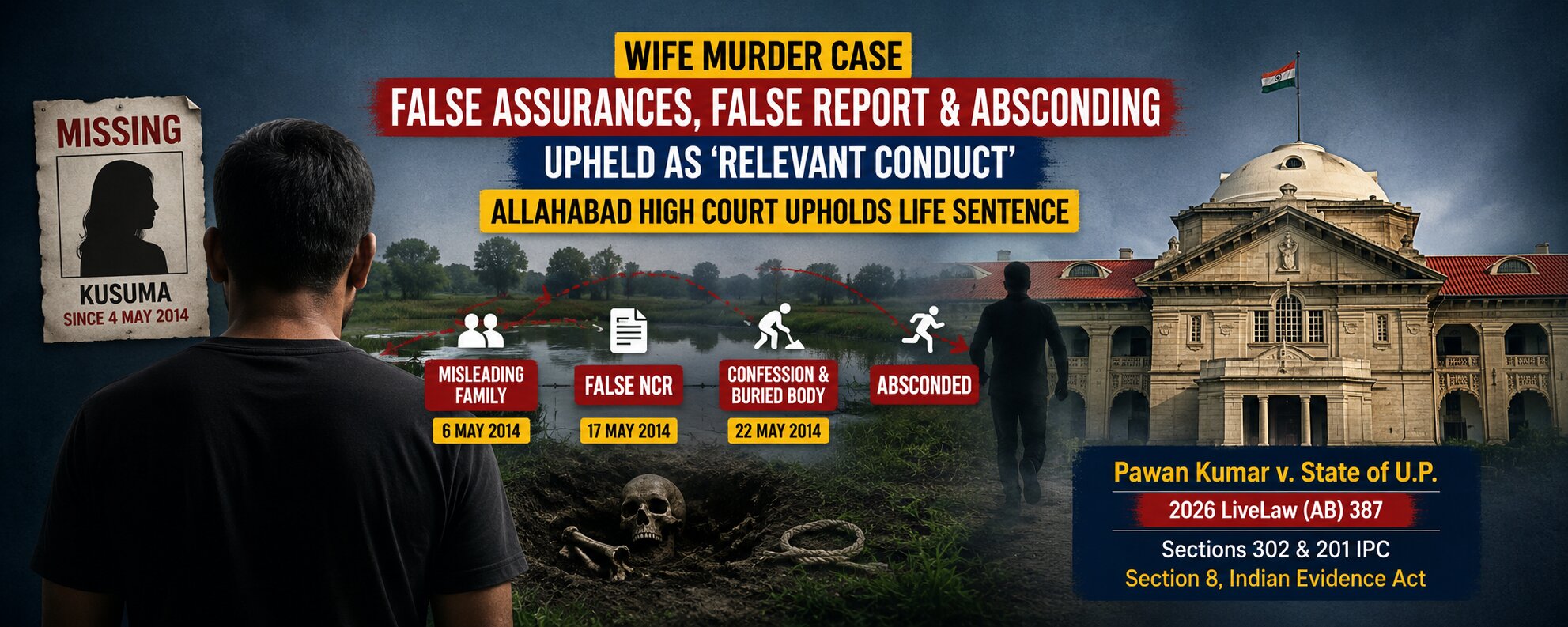
Judgement Details
Court
Allahabad High Court
Date of Decision
13 July 2026
Judges
Justice Rajnish Kumar and Justice Babita Rani
Citation
Acts / Provisions
Facts of the Case
- The accused, Pawan Kumar, was married to the deceased, Kusuma.
-
He frequently quarreled with his wife because he suspected her of having an illicit relationship with another villager.
-
Due to continuous harassment, the deceased went to live with her father.
-
The accused persuaded her to return home by assuring her that he would not harm her.
-
On 6 May 2014, the accused informed his father-in-law that his wife had gone missing two days earlier.
-
He falsely claimed that she had eloped with another villager in order to mislead her family and the police.
-
On 17 May 2014, he lodged a Non-Cognizable Report (NCR) alleging that the villager had abducted his wife.
-
On 22 May 2014, the complainant received information that the accused had murdered his wife and buried her body near a pond.
-
When confronted, the accused confessed before his father-in-law, pointed out the place where he had buried the body, and immediately absconded.
-
The police recovered a decomposed skeletonized body and a plastic rope with a knot from the place indicated by the accused.
-
After his arrest, the accused led the police to his house, where a spade allegedly used to dig the grave was recovered.
-
The Sessions Court convicted him under Sections 302 and 201 IPC and sentenced him to life imprisonment.
-
The accused challenged the conviction before the Allahabad High Court.
Issues
-
Whether the previous and subsequent conduct of the accused was admissible under Section 8 of the Indian Evidence Act?
-
Whether the accused's false assurances, misleading statements, false NCR, confession before the complainant, and subsequent absconding constituted relevant conduct pointing towards guilt?
-
Whether the recovery of the dead body and the spade at the instance of the accused strengthened the prosecution's case?
-
Whether the skeletonized condition of the recovered body created a reasonable doubt regarding the identity of the deceased and the prosecution's version?
-
Whether the conviction and life sentence awarded by the Trial Court required interference?
Judgement
-
The Allahabad High Court dismissed the criminal appeal.
-
The Court upheld the conviction and life sentence imposed upon the accused.
-
The Court held that the entire chain of circumstantial evidence was complete and pointed only towards the guilt of the accused.
-
It observed that the accused's conduct before, during, and after the offence was highly relevant under Section 8 of the Indian Evidence Act.
-
The Court held that giving false assurances to the deceased, misleading the family, lodging a false NCR, confessing before the complainant, pointing out the burial site, recovering the spade, and absconding collectively established his guilty conduct.
-
The Court relied upon the Panchsheel principles laid down in Sharad Birdhichand Sarda to conclude that every circumstance was fully proved and formed a complete chain.
-
It relied upon State (NCT of Delhi) v. Navjot Sandhu to hold that the conduct of an accused may itself become an important incriminating circumstance.
-
The Court rejected the defence argument regarding decomposition of the body and held that medical opinion regarding decomposition is not conclusive.
-
Referring to Uttarakhand v. Darshan Singh (2019) and Modi's Medical Jurisprudence, the Court observed that climatic conditions vary considerably in India and decomposition cannot be determined with mathematical precision.
-
Consequently, the Court affirmed the judgment of the Sessions Court.
Held
-
The prosecution successfully established the guilt of the accused beyond reasonable doubt through circumstantial evidence.
-
The accused's previous and subsequent conduct constituted relevant conduct under Section 8 of the Indian Evidence Act.
-
The chain of circumstances was complete and excluded every hypothesis except the guilt of the accused.
-
The conviction under Sections 302 and 201 IPC and the sentence of life imprisonment were upheld.
-
The criminal appeal was dismissed.
Analysis
- It gives significant importance to Section 8 of the Indian Evidence Act, emphasizing that an accused's conduct before and after the offence may become an important incriminating circumstance.
-
The Court correctly distinguished between admissible conduct and mere suspicion by requiring a close nexus between the conduct and the fact in issue.
-
The decision strengthens the evidentiary value of acts such as absconding, giving false explanations, misleading investigators, and recovery of incriminating articles.
-
The Court reaffirmed the principles laid down in Sharad Birdhichand Sarda, thereby reinforcing settled law relating to circumstantial evidence.
-
By relying on Navjot Sandhu, the judgment clarifies that conduct itself may reveal motive, preparation, or consciousness of guilt.
-
The Court appropriately rejected speculative medical arguments regarding decomposition and reaffirmed that expert opinion must be assessed along with all surrounding circumstances.
-
The judgment is significant because it demonstrates how a chain of conduct, though individually insufficient, may collectively establish guilt beyond reasonable doubt.