
Parwinder Singh @ Pindu v. U.T. Chandigarh, 2026
Bail and Criminal Proceedings
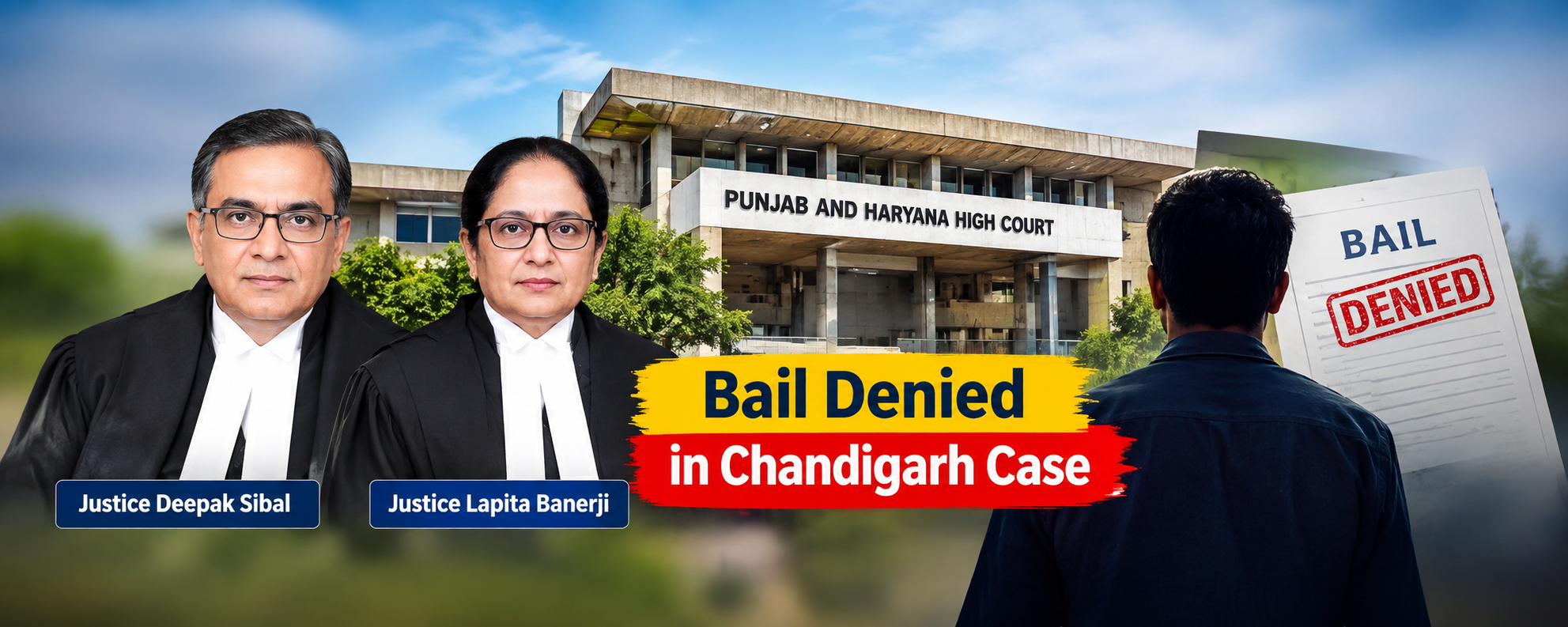
Judgement Details
Court
Punjab and Haryana High Court
Date of Decision
28 September 2026
Judges
Justice Deepak Sibal and Justice Lapita Banerji
Citation
Acts / Provisions
Facts of the Case
-
The case originated from FIR No. 29 dated 26 February 2024, registered at Police Station Sector-36, Chandigarh.
-
According to the prosecution, on the night of 25 February 2024, Sunny @ Sachin @ Maddy Manchanda and Umang were apprehended near the Sector-43 Bus Stand, Chandigarh. A pistol and live cartridges were recovered from them, resulting initially in registration of the FIR under the Arms Act.
-
Their disclosures allegedly led investigators to Parwinder Singh @ Pindu and other accused persons. Parwinder was arrested on 28 February 2024 at TDI City, Sector-111, SAS Nagar, Mohali. A Verna car and two mobile phones were recovered from him.
-
The prosecution alleged that Parwinder had links with persons associated with Goldy Brar, who was described in the case as a designated terrorist. It alleged that Parwinder: brought Sunny and Umang from Chandigarh Railway Station to his flat; subsequently shifted them to another flat; received money allegedly sent by Goldy Brar and Vicky Chauhan; handed money to Sunny and Umang; communicated with persons allegedly associated with the terrorist network; and assisted the alleged conspiracy to kill gangster Bhupinder @ Bhuppi Rana during a court appearance.
-
The prosecution also relied on bank transactions, mobile-phone evidence and CFSL analysis. The Court noted allegations of three withdrawals of ₹15,000 each and deposits of ₹49,900 and ₹16,000 connected with Parwinder's account.
-
The alleged plan involved reconnaissance of court premises at Mohali, Chandigarh and Panchkula, with the prosecution alleging that the proposed target was to be killed when he appeared for a court hearing.
-
Parwinder challenged the 16 July 2024 order of the Special Judge, NIA Court, Chandigarh, which had rejected his bail application.
Issues
-
Whether Parwinder Singh @ Pindu was entitled to regular bail despite the stringent bail restrictions applicable under the UAPA.
-
Whether the material collected by the prosecution prima facie connected the appellant with designated terrorists and the alleged conspiracy.
-
Whether the alleged conspiracy to murder a person inside court premises could prima facie fall within the concept of a “terrorist act” under Section 15 UAPA.
-
Whether prolonged incarceration and the Article 21 right to a speedy trial justified release on bail, notwithstanding Section 43-D(5) UAPA.
-
Whether the prosecution material was sufficient at the bail stage to satisfy the statutory threshold under Section 43-D(5) UAPA.
Judgement
-
The High Court dismissed the appeal and declined to grant regular bail to Parwinder Singh @ Pindu.
-
The Court considered the material placed by the prosecution, including alleged financial transactions, mobile-phone material, CFSL analysis and the alleged links between Parwinder, the co-accused and Goldy Brar.
-
The Court noted that Section 43-D(5) UAPA imposes a stringent restriction on bail where, after examining the case diary or the report under Section 173 CrPC, there are reasonable grounds for believing that the accusation is prima facie true.
-
The Court further considered Section 15 UAPA and the prosecution's allegation that the proposed murder was to be carried out within court premises. It held, at the prima-facie stage, that such a conspiracy involving a designated terrorist could be intended to create terror among people.
-
The Court therefore concluded that it could not say that there was no material connecting the appellant with an intention to strike terror.
-
Regular bail was refused and the appeal was dismissed.
Held
The High Court held, for the limited purpose of deciding the bail appeal, that:
-
There was prima facie material connecting Parwinder Singh with the alleged conspiracy and with persons described as designated terrorists, and the alleged plan to commit a murder within court premises could prima facie indicate an intention to strike terror.
-
Consequently, the Court was not inclined to grant regular bail under the circumstances of the case.
-
Importantly, the Court expressly clarified that its observations were limited to the bail proceedings and were not an expression of opinion on the merits of the criminal trial.
Analysis
-
The central legal feature of the judgment is Section 43-D(5) UAPA. Unlike ordinary bail proceedings, the Court must consider whether there are reasonable grounds for believing that the accusation is prima facie true.
-
The Court therefore did not conduct a full trial of the evidence. Instead, it examined whether the prosecution material was sufficient to cross the statutory prima-facie threshold.
-
The Court considered this material sufficient, at the bail stage, to conclude that there was prima-facie material connecting the appellant to the alleged network.
-
The Court examined Section 15 UAPA, which covers acts intended or likely to strike terror in people, among other circumstances.
-
A significant part of the reasoning was the alleged choice of court premises as the location for the proposed murder. The Court reasoned that if a person were targeted inside a court, the location itself could have a wider psychological impact because courts are places where members of the public expect security.
-
Thus, at the prima-facie stage, the Court considered the alleged choice of location relevant to determining the alleged intention to strike terror.
-
The appellant argued that he had been in custody for a substantial period and relied on Article 21 and Supreme Court decisions concerning prolonged incarceration in UAPA cases. The High Court acknowledged that personal liberty and speedy trial are constitutionally protected.
-
However, the Court found that this was not a situation where the State had failed to attribute any specific prima-facie role to the appellant. It therefore did not consider prolonged custody, by itself, sufficient to overcome the circumstances and the UAPA bail restrictions in this case.
-
The judgment is important to read as a bail-stage determination, rather than a final finding of guilt.
-
The Court expressly stated that its observations were made only for deciding the regular-bail appeal and should not be treated as an opinion on the merits of the case.
-
Therefore, the judgment's immediate legal effect is primarily on bail under the UAPA, rather than a final adjudication of whether the accused committed the alleged offences.