
Parsharvanath Weld Wires Pvt. Ltd. & Anr. v. State of Chhattisgarh & Anr., 2026
Decision promotes commercial certainty by encouraging parties to resolve financial disputes amicably.
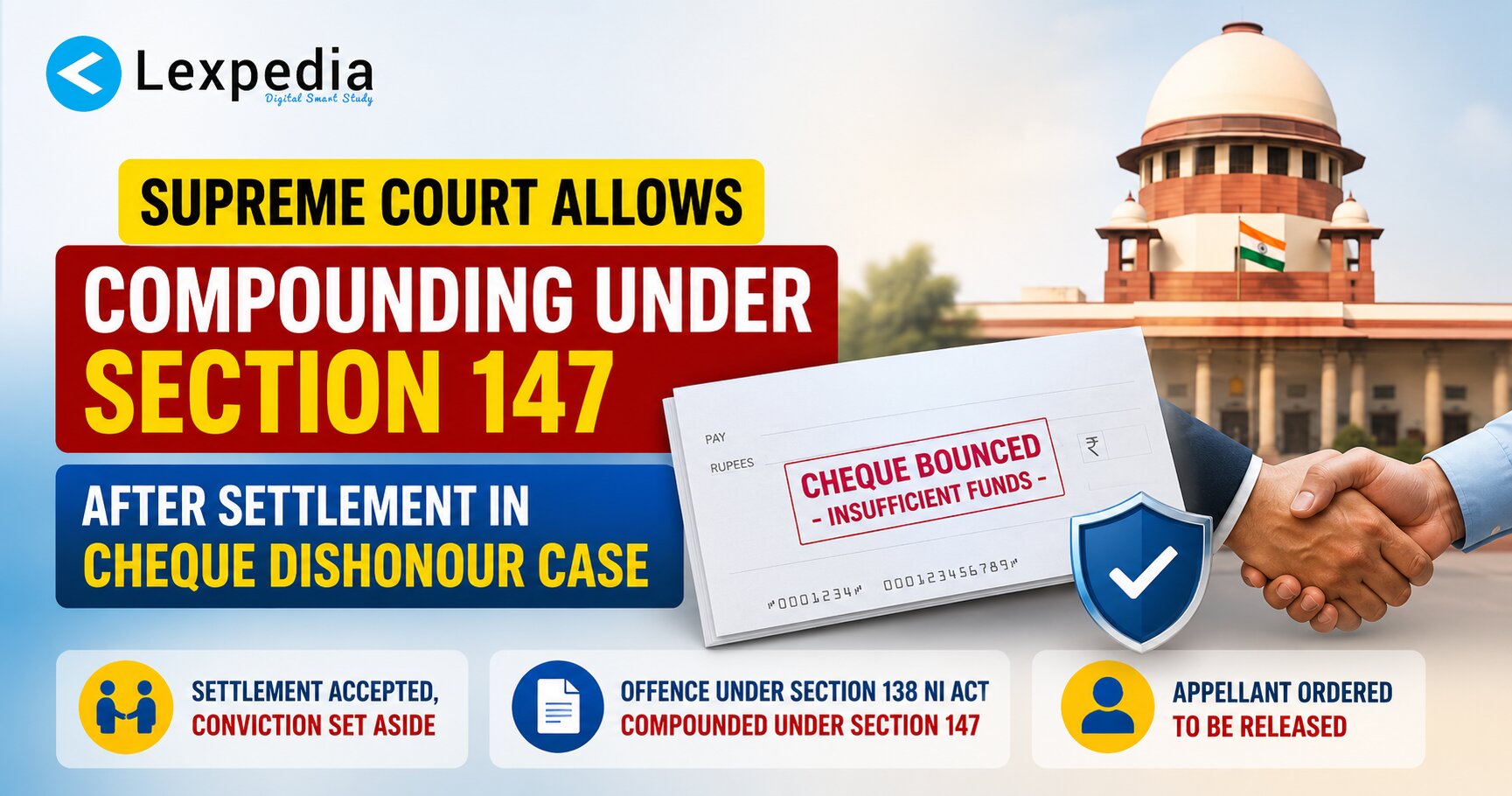
Judgement Details
Court
Supreme Court of India
Date of Decision
2 June 2026
Citation
Acts / Provisions
Facts of the Case
-
The appellant was a Director of a company against whom proceedings were initiated under Section 138 of the Negotiable Instruments Act due to dishonour of a cheque on account of insufficiency of funds.
-
In 2014, the trial court convicted the appellant and sentenced him to one year of simple imprisonment.
-
The appellant was also directed to pay compensation of Rs. 28,00,000 under Section 357(3) of the Code of Criminal Procedure.
-
The conviction and sentence were subsequently affirmed by the Sessions Court.
-
Thereafter, the High Court of Chhattisgarh also upheld the conviction and sentence.
-
Following the dismissal of challenges before the lower courts, the appellant was taken into custody to undergo the sentence imposed.
-
Within two days of being taken into custody, the parties entered into a settlement.
-
Pursuant to the settlement, the appellant paid Rs. 30,00,000 to the complainant.
-
An application seeking compounding of the offence under Section 147 of the Negotiable Instruments Act was filed before the Judicial Magistrate First Class.
-
The Judicial Magistrate rejected the application on the ground that the judgment could not be reviewed after conviction.
-
The High Court affirmed the Magistrate's decision.
-
Aggrieved by these orders, the appellant approached the Supreme Court.
Issues
-
Whether an offence under Section 138 of the Negotiable Instruments Act can be compounded under Section 147 of the Act after conviction and sentencing when the parties have subsequently entered into a settlement?
-
Whether the conviction and sentence imposed under Section 138 of the Negotiable Instruments Act can be sustained after the complainant and the accused have amicably settled the dispute?
-
Whether the courts below were justified in refusing to compound the offence on the ground that the judgment had already attained finality and could not be reviewed?
-
Whether the principles laid down by the Supreme Court in Gian Chand Garg v. Harpal Singh were applicable to the facts of the present case?
Judgement
-
The Supreme Court accepted the compromise entered into between the parties.
-
The Court held that the settlement reached between the complainant and the accused warranted compounding of the offence under Section 147 of the Negotiable Instruments Act.
-
The Court relied upon its earlier decision in Gian Chand Garg v. Harpal Singh (2025 SCC OnLine SC 2317).
-
It reiterated that once a valid settlement has been entered into between the complainant and the accused, continuation of the conviction under Section 138 of the Negotiable Instruments Act would not be justified.
-
The Court found no reason to refuse compounding merely because the conviction had already been affirmed by appellate courts.
-
The orders of the Judicial Magistrate and the High Court refusing compounding were set aside.
-
The conviction and sentence imposed upon the appellant were quashed.
-
The Court directed the Jail Superintendent, Central Jail, Raipur, to immediately release the appellant.
-
The Jail Superintendent was further directed to communicate compliance to the Registry of the Supreme Court.
Held
-
The offence under Section 138 of the Negotiable Instruments Act was compounded under Section 147 of the Act.
-
The conviction and sentence imposed upon the appellant were set aside.
-
The settlement between the parties was accepted by the Supreme Court.
-
The appellant was ordered to be released from custody forthwith.
Analysis
-
The judgment reinforces the legislative intent behind Section 147 of the Negotiable Instruments Act, which promotes settlement and compounding of cheque dishonour disputes.
-
The Court emphasized the restorative and compensatory nature of proceedings under Section 138 rather than a purely punitive approach.
-
By relying on Gian Chand Garg v. Harpal Singh, the Court strengthened the principle that genuine settlements should ordinarily bring criminal proceedings under Section 138 to an end.
-
The decision promotes commercial certainty by encouraging parties to resolve financial disputes amicably.
-
The judgment recognizes that once the complainant has received the agreed amount and no grievance survives, continuation of criminal punishment may serve little practical purpose.
-
It clarifies that compounding can be permitted even after conviction and commencement of sentence where justice so requires.
-
The ruling advances the objective of reducing unnecessary criminal litigation and judicial burden arising from cheque dishonour cases.
-
The judgment is likely to encourage settlement-oriented resolution in commercial disputes involving negotiable instruments.
-
It underscores the Supreme Court's preference for substantive justice over technical procedural objections when parties have voluntarily resolved their dispute.